

In the face of these shocks and the uncertainties of the coming years, the concept of resilience has gradually gained prominence in economic analysis to describe a system’s ability to cope with past, present, or future shocks. It is measured in terms of cycles to account for fluctuations in employment or income, as well as the duration of periods of decline, rebound, or recovery.
When analyzed through the lens of these cycles, the study of the long-term resilience of French intermunicipal communities—the subject of our recent research article published in the *Revue d’économie régionale & urbaine*—reveals three major findings. First, for nearly thirty years, certain areas have experienced each crisis more acutely than others. Second, in terms of resilience, metropolitan areas are not necessarily more effective than other regions. Finally, the 2020 crisis highlights the fragility of sectoral specialization dynamics.
An analysis of changes in employment observed since the early 1990s allows us to measure the long-term impact of crises. Five distinct trends can be identified at the level of public intermunicipal cooperation entities (EPCI):
EPCIs experienced continuous growth from 1993 to 2020;
countercyclical EPCIs, that is, those that are in decline except during times of crisis;
EPCIs that are vulnerable to crises but manage to bounce back;
crisis-prone EPCIs that have not seen a recovery;
and the EPCIs showed a steady decline from 1993 to 2020.
15% of French intermunicipal communities experienced continuous employment growth for nearly 30 years (from 1993 to 2019). When the 2020 crisis is factored in, only 6% of EPCIs remain unaffected by crises of any kind.
Generally located in the southern regions of the country, these areas benefit from public redistribution policies, combined with factorsthat make them attractive to residents and tourists. For now, these areas benefit from their low exposure to external shocks and receive transfer payments as part of national solidarity efforts.
While not entirely unscathed, 44% of intermunicipal associations appear to be fairly resilient to crises. They are located primarily in the western and southern parts of the country.
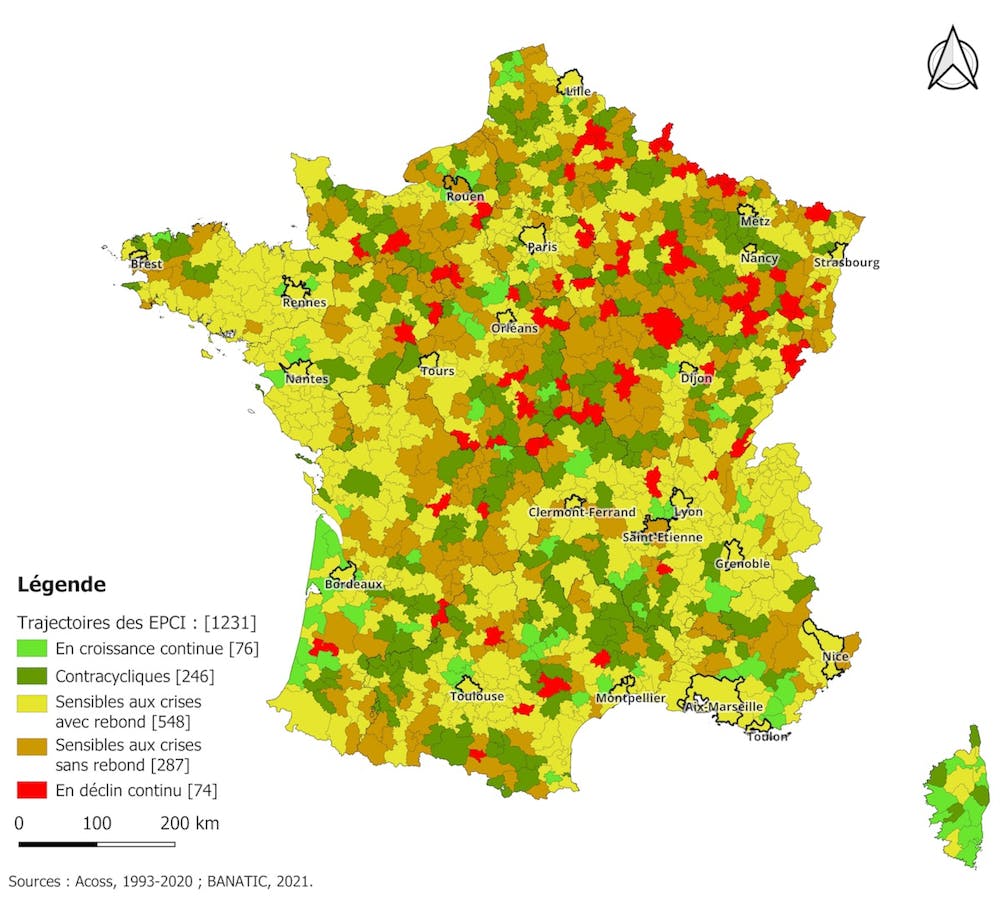
Alongside this part of France, which has been largely spared by past crises, lies a vast area of intermunicipal communities that are far more vulnerable. For example, 41% of EPCIs had still not recovered from the 2008 crisis when the pandemic struck in early 2020. Taken together over the entire period, 30%—or nearly one in three intermunicipal communities (home to 20% of the French population)—have seen their private-sector salaried jobs decline for nearly thirty years!
These areas, which have been made vulnerable by the globalization of trade and processes of metropolization, are primarily located in the northern regions of the country, in areas with a tradition of industry, as well as in what geographers call the “diagonal of emptiness”—a band stretching from the northeast to the southwest that refers to areas of low population density.
Are large cities more resilient than their suburbs? Some major cities proved extremely resilient to the 2008 crisis—such as Toulouse, Montpellier, Aix-Marseille, and Toulon—or, on a different scale, Lyon and Paris, which were able to bounce back quickly. Grenoble, Saint-Étienne, and Strasbourg, on the other hand, had much more difficulty recovering from the crisis. The Grenoble metropolitan area, for example, lost many jobs and took nearly 10 years to return to its pre-crisis level of salaried employment. Finally, Rouen has, as of yet, still not recovered from these major past shocks.
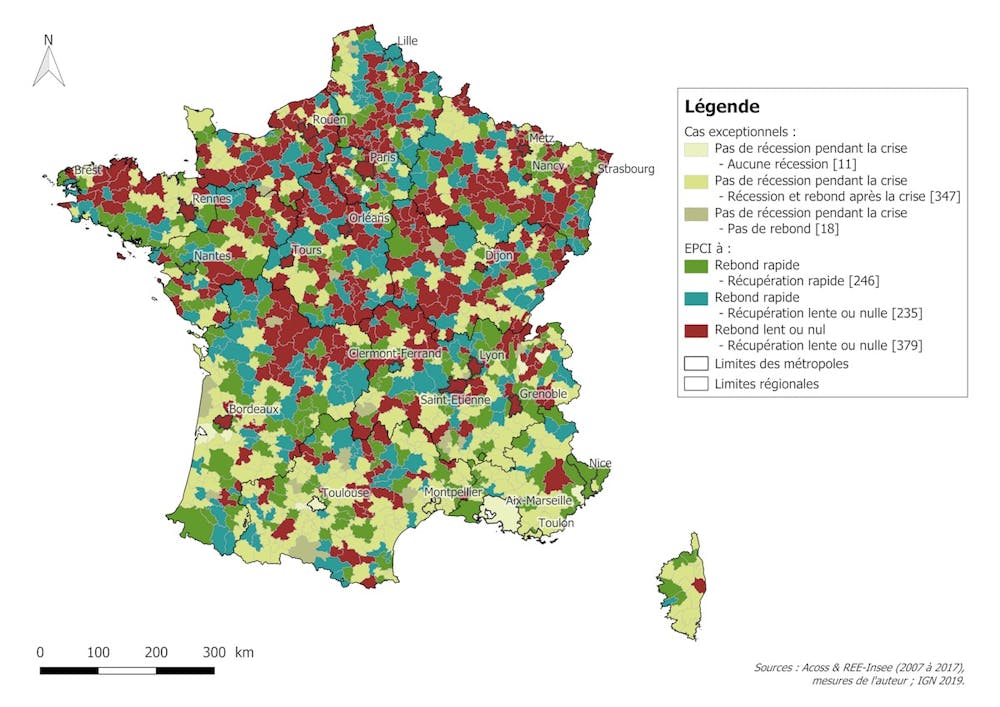
In our recent work, we highlight the importance of regional contexts, rather than a divide between major cities and the rest of the country. Thus, disparities in resilience are more pronounced between France’s major regions than between large metropolitan areas and their outskirts.
However, in the regions hardest hit by the crisis, the “metropolis-hinterland” gap exists and is widening over the long term. This situation is particularly evident in the north-northeastern quarter of France, especially in areas that have been chronically affected by crises, as we saw in the previous paragraph.
The socioeconomic crisis linked to COVID-19 is obviously very different from that of 2008, which was itself very different from that of 1993. The first available national and subnational figures show that the sectors most affected are those linked to the decline in household demand: retail and market-based services, tourism, recreation, and passenger transportation. Since these sectors are present in most French regions, the regional impact of the crisis is much more widespread than what was observed in 2008. It should be noted, however, that certain manufacturing sectors have also suffered, such asthe aerospace industry.
What this crisis teaches us is that regions that had previously specialized in dynamic industries—and had consistently been spared by previous crises—found themselves hit hard by the upheaval in our lifestyles and the sharp slowdown in global trade. Small towns specializing in a particular industry, such as aerospace or tourism, were spared in 2008 but paid a heavy price in 2020.
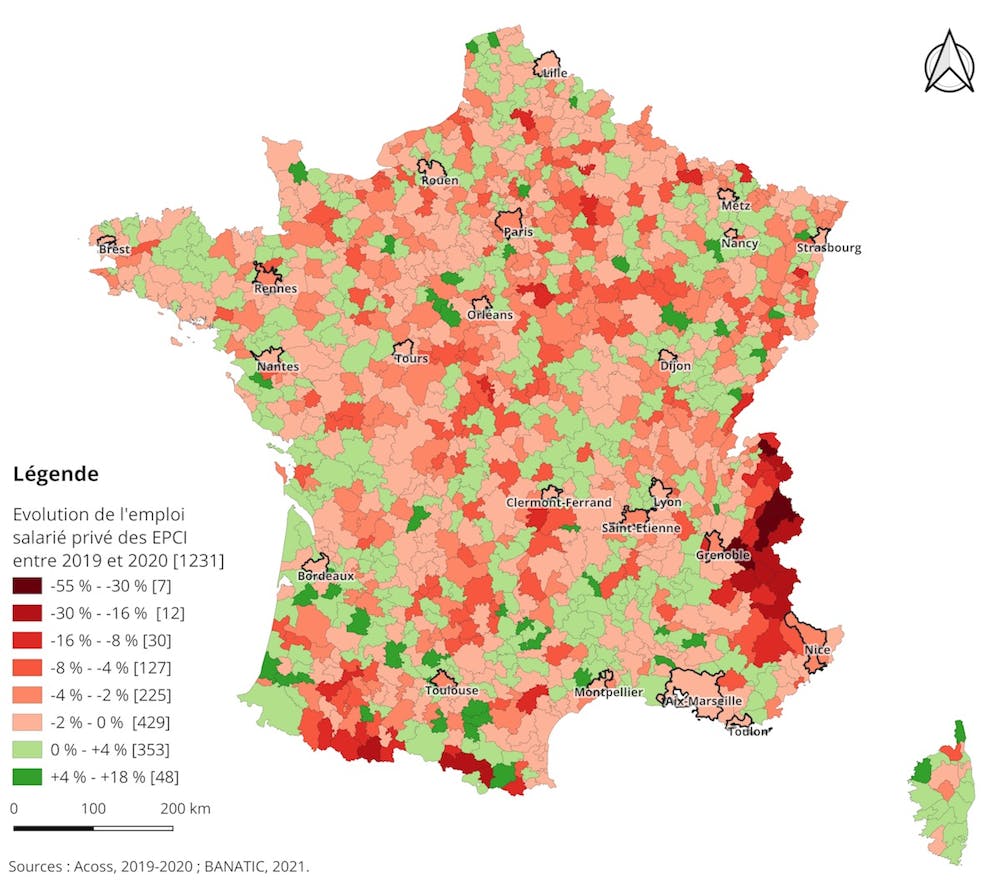
Thus, sectors that today may seem immune to any economic shock (electronics, for example) could very well be affected tomorrow by a war, major natural disasters, the scarcity of a resource such as water, and so on. In the uncertain world we live in, the strategies of hyper-specialization that prevailed in the past seem risky, to say the least—if not completely outdated.
Resilience is a long-term challenge, and periods of recovery and subsequent revitalization are just as crucial as the responses implemented at the time of the shock. The geoeconomic analyses developed in our research help shed light on regions that have been adversely affected by past decades. In these areas, the government must step up and adapt national economic recovery policies – particularly industrial development – in line with the needs of the population, regional characteristics, and the environmental challenges that lie ahead.