

Our calculations based on Eurostat data show that France currently ranks near the bottom of the European Union in terms ofindustry. It ranks22nd (out of 27) in terms of the share of industrial employment in total employment and24th in terms of the share of industrial value added in total value added (GDP). This places France just ahead of countries such as Luxembourg, the Netherlands, Greece, Cyprus, and even Malta, which have never truly been industrialized. Furthermore, during the period of industrial recovery between 2016 and 2019, France ranked only21st in terms of industrial employment growth (2%).
Furthermore, this rebound results in a spatial shift, as illustrated by Maps 1 and 2 below.
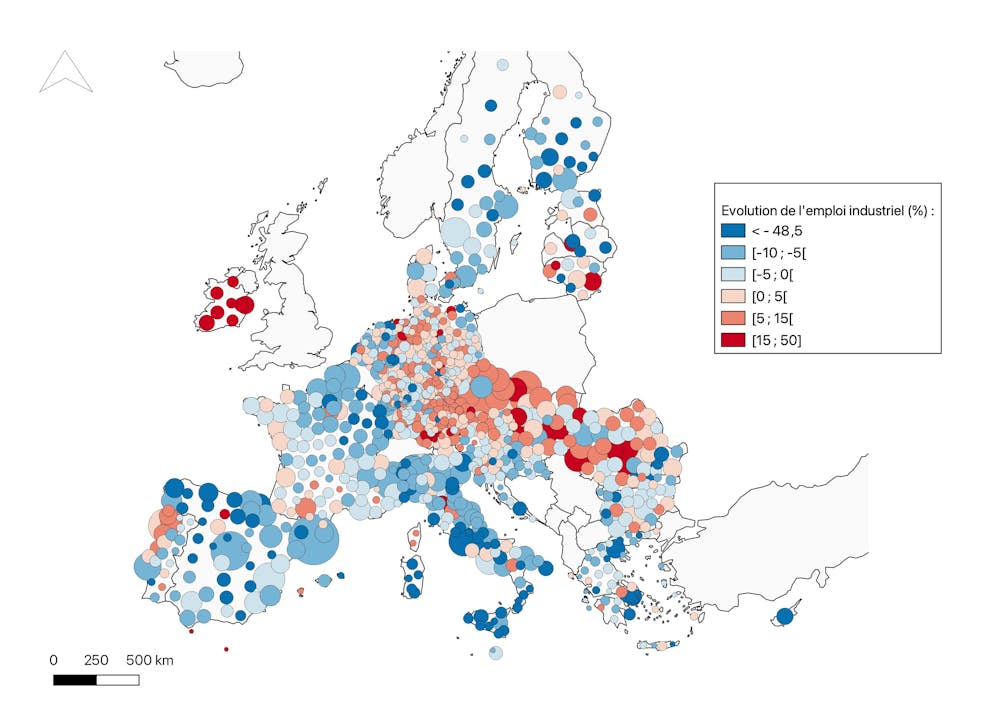
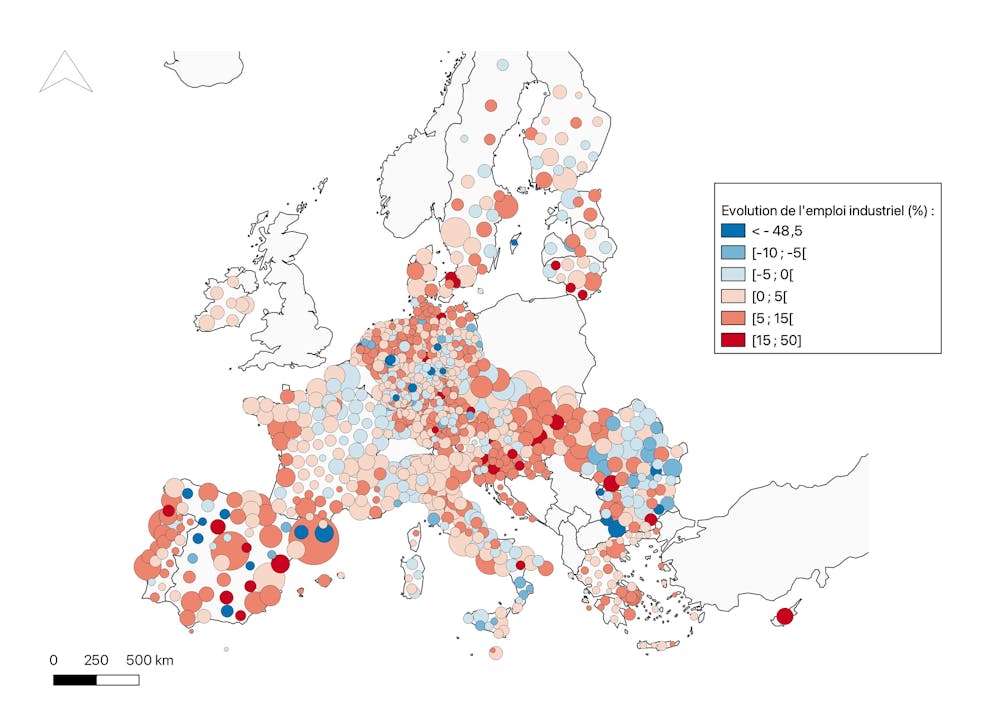
Between 2011 and 2016, the decline revealed significant differences in industrial dynamism among countries. Germany, Ireland, the Czech Republic, Hungary, and Romania stood out positively. Since 2016, the recovery has become more widespread, but with more pronounced regional disparities within countries, as seen in France, where reindustrialization is occurring almost exclusively south of the Le Havre–Geneva diagonal.
Let's take a closer look at the regions of France (Map 3).
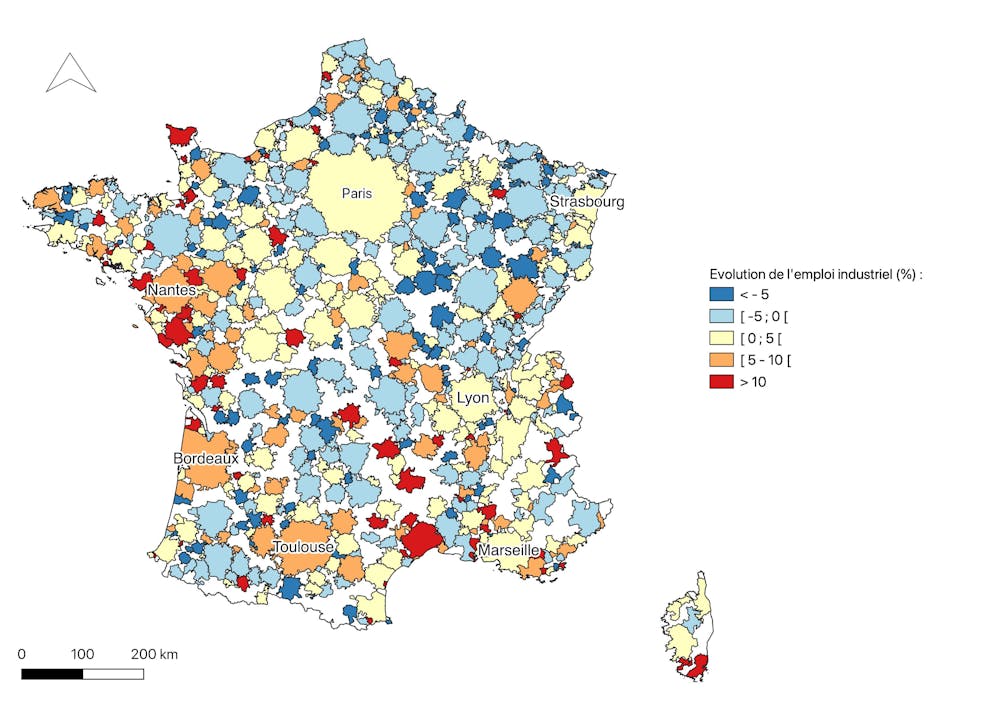
The results of our analysis of Acoss employment data lead us to identify three types of spaces that are likely to play a pivotal role in the coming years.
For obvious reasons, industry is not automatically associated with the economic fabric of major cities (land use, pollution, noise pollution, traffic, etc.). However, 60% of the industrial jobs created between 2016 and 2019 were in metropolitan areas and their surrounding regions (or catchment areas with more than 700,000 residents), even though these areas account for only 35% of France’s industrial jobs but more than 50% of total employment.
This can be explained in part by specialization in dynamic industrial sectors characterized by high levels of skill and value added (the information and communications industry; the manufacture of computer, electronic, and optical products; and the manufacture of transportation equipment other than automobiles). These sectors alone account for the bulk of the positive changes in industrial employment in metropolitan areas.
[More than 80,000 readers rely on The Conversation's newsletter to better understand the world's major issues. Subscribe today]
These new dynamics raise numerous challenges—in areas already under significant pressure from land use and population growth—as seen in cities such as Montpellier, Toulouse, Nantes, and Bordeaux, especially since no metropolitan area is included in the French government’s “industrial territories” policy. However, other regions are also emerging as strategic.
In 2019, medium-sized French cities (or catchment areas with populations between 50,000 and 200,000), which are more traditionally associated with industrial growth, accounted for 16% of total employment but 21% of industrial employment.
Over the 2016–2019 period, they accounted for 21 percent of France’s industrial recovery. Their dynamism is all the more remarkable given that their sectoral specialization tends to put them at a disadvantage. For example, there has been a decline in the automotive industry and in the manufacture of rubber and plastic products—sectors in which they are very often specialized.
Many of these medium-sized cities continue to be severely affected by deindustrialization, but those that manage to bounce back are experiencing rapid growth in industrial employment. More specifically, nearly 60% of areas of this size are undergoing reindustrialization. The sectors driving this trend include the food industry, the manufacture of transportation equipment and machinery, and the pharmaceutical industry.
Finally, one of the defining characteristics of French industry is its continued presence in rural areas. Twenty-seven percent of jobs in rural areas are still in manufacturing, compared to an average of 16.5 percent nationwide. This continued presence can be explained by several factors, including the availability of land, a skilled workforce, an industrial structure centered on a dense network of small and medium-sized enterprises (SMEs), and the effects of sectoral and geographic proximity that favor the presence of, for example, the agri-food industry. The increase in industrial jobs remains moderate, however, and accounts for 5% of the positive changes observed since 2016.
Although these findings highlight the dominant role of cities in these industrial revitalization trends, we know that scale effects do not explain everything. The European and French maps highlight regional effects, in addition to sectoral effects.
The former are influenced in particular by demographic trends, which benefit regions in the west and south. The latter can be explained by national and local history, as well as by the distinct strengths of each region (tangible and intangible resources, specific expertise, infrastructure, etc.).
All of these factors demonstrate not only the diversity of regional assets but also, and above all, the high degree of complementarity among the different types of areas. It therefore appears necessary to coordinate, at the national and regional levels, the alignment of action scales in order to successfully implement the industrial revitalization policy. Indeed, all regions have a role to play—from the largest cities to low-density areas—based on a framework of complementarity, equitable reciprocity, and sustainable resource management.