

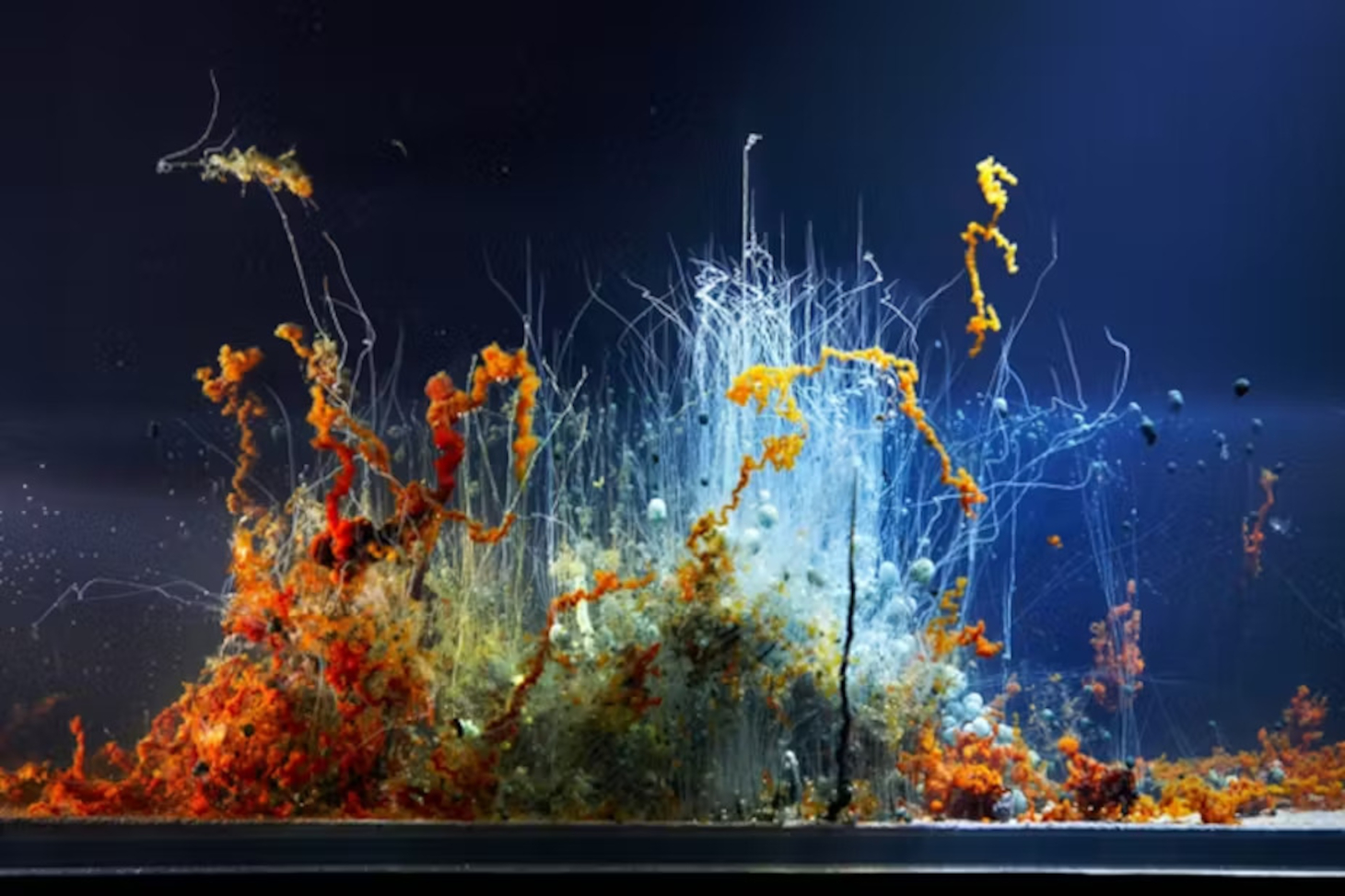
Hicham Berrada is currently presenting his work “Présage” (2018) at the Bourse du Commerce (Pinault Collection) in Paris, as part of the exhibition “Avant l’orage.” On a giant curved screen, in a room plunged into darkness, viewers are immersed in landscapes composed of minerals suspended in an aqueous solution: fluid movements, strange, growing forms, and colors that unfold. These ever-surprising and varied transformations are observed through a beaker or an aquarium.
At first, I just wanted to let myself be carried away and daydream as I wandered past these fluid movements, these growths, these bubbles, and this profusion of ever-changing shapes. But of course, I eventually found myself trying to understand, through my scientific lens, how the artist had conceived this work.
Yet this work is “merely” the result of a chemical process that one might be tempted to describe as mundane. The beaker—an indispensable item in a chemistry lab, a simple glass container—holds the filmed scene as it unfolds. The choice of substances submerged in the water determines the chemical reactions, the colors produced, and the types of shapes that will appear. The characteristics of the reactions—temperature, pressure, and concentrations—determine the reaction rates. This is referred to as “reaction kinetics.”
Hicham Berrada knows all this well—probably better than I do, a physicist whose knowledge of chemistry is quite rusty. He plays with these ideas, and we can try to discern with him—beyond even the application of chemistry—the invisible yet very real questions at play here, which, in my view, are key elements of this work of art. These are also fundamental scientific questions.
The first of these fundamental elements is color. A profusion of colors is a constant in Berrada’s work: the artist controls an entire palette starting from the initial reagents. In this, he draws on a long history of pigments in painting and the techniques that allow them to be used. Certain painters are referred to as great colorists—Matisse comes to mind, as do many others. Among chemists, the analysis of colors has been and remains of paramount importance. Today, with the various spectroscopic techniques available, it is a daily practice.
The second aspect is based on chemistry itself—the science of transformations that are visible to us but actually occur at the atomic or molecular level. A basic chemical reaction is described by a chemical equation, which does not contain an equals sign—and for good reason. The combustion of methane in air, for example, is a chemical reaction. It starts with methane and oxygen. The end products are carbon dioxide and water. Armed with our knowledge of atoms, molecules, and chemical bonds, this reaction doesn’t seem all that mysterious.
[Nearly 80,000 readers rely on The Conversation’s newsletter to better understand the world’s major issues. Subscribe today]
But more prosaically, we must remember that when methane burns, it turns into water. And it’s still just as mind-boggling: at first glance, the properties of methane and water have nothing in common. It was, of course, Lavoisier who articulated this truth inthe 18th century: “Nothing is lost, nothing is created, everything is transformed”!
We can even understand the alchemists. Imagine: you know nothing about atoms, molecules, or the concept of energy. Yet you still have empirical experience with heat, weight, and the liquid, solid, or vapor states, and you see that everything around you is transforming—that some substances disappear only for others to appear. It’s even the way the world works—the very foundation of cooking!
So… why not turn lead into gold? The20th century provided the answer: yes, it’s possible! But since lead and gold are elements on the periodic table, this transformation does not involve altering the electron clouds around atomic nuclei or exchanging electrons between atoms—which is at the heart of chemistry—but rather involves altering the atomic nuclei themselves. This, then, is nuclear chemistry. To develop it, the work of Henri Becquerel, Marie and Pierre Curie, Ernest Rutherford, and many others was required. Particle accelerators have added the heaviest unstable elements ever observed. This impossible alchemist’s dream has been realized by chemistry and physics!
Hicham Berrada thus works at the heart of chemistry—on the emergence of a new solid, liquid, or gaseous substance that appears in audiovisual representations, with an appearance and properties that are very difficult to predict based solely on those of the reactants. This emergence of a new substance—which draws on the substances introduced in the reactants—lies at the heart of all biological activity on planet Earth, of all its diversity, and of all its new developments.
The third element is time. We’re talking about chemical kinetics—that is, the time these transformations take. This time can vary greatly. Fireworks share with Hicham Berrada’s work the elements of chemical reactions and the sudden appearance of colors. But the pyrotechnician plays with fire and produces an explosion in an extremely short period of time. Chemical reactions—and transformations of matter in general—can occur over very short periods of time, such as explosions, or over infinitely long periods. The erosion of rocks by a river involves so-called mechanochemical effects, which continuously erode over immense periods of time and shape landscapes, their colors, and their forms.
The landscapes of our lives evolve over time scales that range from weeks to months, seasons, or years. Hicham Berrada sets up his chemical reactions so that something visible happens during the duration of the exhibition—or during the time we spend contemplating his work, which lasts, on average, a few minutes. This is the time of our daily lives, during which a multitude of chemical reactions take place in our bodies, which are in a state of constant transformation.
The final element is chance. It’s certainly at least as important here as the emergence of transformed matter. Do we ever finish high school without the saying “You can’t step into the same river twice” forever etched in our minds? In physics or chemistry, we would speak of random effects or noise. Hicham Berrada precisely controls what happens in the beaker—but only up to a certain point. He sets up a scene and chooses the colors, quantities, durations, and characteristic forms that will appear—balls, threads, concretions—but not the details of these permanent and predictable elements. And I am convinced that he would not wish to extend his control to that level of detail even if he could. In practice, the question does not arise: it is impossible. His work titled “Les augures mathématiques,” produced usingdigital morphogenesis algorithms, shows me that he is well aware of this.
I loved working in a CNRS crystal growth laboratory in Marseille inthe 20th century, exploring kinetic roughness. It was much later that I discovered Marcel Duchamp and Man Ray’s “Dust Farm.” Dust falls randomly onto a surface, and the dust particles cling to one another to form airy structures with randomly arranged patterns.
As part of this work, we used computer simulations to model crystal growth by adding virtual atoms—at high or low temperatures, in small or large quantities, with strong or weak chemical bonds, and so on.
This made it possible to explore—by incorporating chance—the forms of growth and the immense variety of shapes produced. One thinks of snowflakes, of course, and of the shapes that appear in Hicham Berrada’s works. But it remains experimentally impossible to control the aggregation of atoms and molecules at this level of detail and simultaneously on a macroscopic scale, even though progress in this area has been remarkable. Using the same reagents under the same conditions, Hicham Berrada will indeed obtain the same colors and the same generic shapes—strands or clusters, for example—but the exact length of the strands, the precise shape of the clusters, and even the number of strands or clusters are left to chance. Empty everything out, clean it up, start over—and a whole new landscape emerges. It bears a strong resemblance to the previous one, of course, but in detail it is always new and unpredictable.
Hicham Berrada is thus also a patient observer of his own works; like us, he discovers how chance collaborates with him in real time. In an attempt to analytically study the landscapes generated “in real life” by crystal growth or in numerical simulations, the equations incorporate a small “h(x,t),” known as “white noise.” It is the manifestation of chance in the equation that describes growth atom by atom.
This small white noise “h(x,t)” reveals the presence of chance in an equation that simultaneously attempts to incorporate the emergence of changing and unique forms as well as their permanent properties. Hicham Berrada selects the permanent properties—the colors, the generic forms, the durations—and thus creates a small world through chemistry. Then he starts the video recording, stirs the mixture from time to time, adds more if necessary, but above all, he waits to see the work come into being in its singularity—a work born of chance as well.
Of course, this work only makes sense on a screen—once the beaker is forgotten—and with a carefully chosen scale. By showing the reactions on a very large screen, the artist immerses us in his little world.