

Darkness, light, and infinity are perennial questions for scientists. If, aboard the International Space Station, Thomas Pesquet turns his head away from Earth, all that remains is space—infinite, dark, and filled with light, including the fossil radiation originating directly from the Big Bang, which is imperceptible to his eyes.
As we saw earlier, American astronaut Story Musgrave turned his attention to this aspect and shared his experience of space, darkness, those lights, and infinity. He beautifully described how his distorted perception was transformed during those unique moments.
The #Crew4 astronauts arrived at the space station at 7:37 p.m. ET. The @SpaceX Dragon Freedom docked with the orbiting complex while the spacecraft were flying about 261 miles above the Pacific Ocean.https://t.co/emyi08nJ0V
— International Space Station (@Space_Station) April 27, 2022
In physics, the interaction between light and matter is at the heart of much fundamental research. Two French Nobel laureates, Serge Haroche and Claude Cohen-Tannoudji, have devoted their scientific careers to studying this question. It lies at the heart of quantum information, from which we anticipate astonishing new applications. Max Planck’s “quantum theory of the black body” revolutionized our understanding of the interaction between light and matter in the early20th century. In physics, a black body refers to an ideal object that perfectly absorbs all the light it receives. The absorption of this electromagnetic energy causes it to heat up and re-emit light whose wavelengths are determined solely by the temperature of the black body.
On Earth, the light we receive is primarily visible light. The light re-emitted at room temperature is infrared light, which is invisible to the human eye. According to this definition, a black body emits nothing that is visible to the human eye. If the object’s surroundings, which reflect light, are visible, only the contrast allows us to locate the black body in space. It is a flaw, a sort of black hole in our reality. After all, our eyes are detectors with limited capabilities, and even an object that is not strictly a black body can appear to us as such a black hole. Anish Kapoor has been playing with this limitation of our perception for years, and more recently by using Vantablack.
Projects such as the development of Vantablack have very clear motivations in the space, scientific, and military fields. Creating screens to absorb stray light is one such motivation.
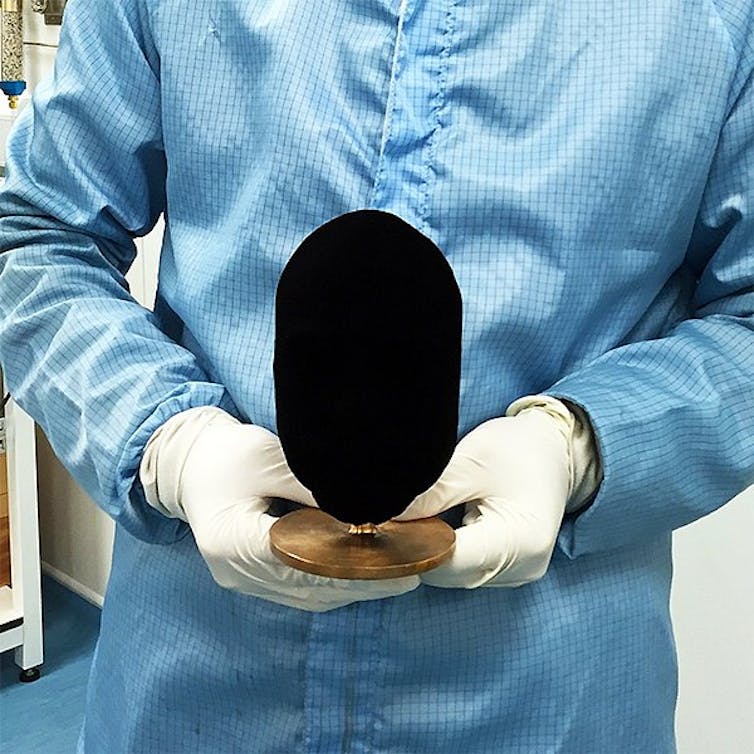
Vantablack consists of forests of carbon nanotubes that trap light and utilize all absorption mechanisms simultaneously. As a result, 99.965% of incident light is absorbed. That’s extraordinary, but even a simple little red laser pointer emits an enormous number of photons per second. Vantablack still reflects a significant amount. 99.965% isn’t 100%. And that difference is no small matter for certain applications! MIT announced 99.995% in 2019. The race continues.
The painter who, in his work, has perhaps explored light in space the most is Pierre Soulages. His fascination with black is well known and central to his work, but it has nothing to do with the ideal black body.
On the contrary, he is interested in very real black surfaces that interact with light in highly sophisticated ways. You only need to look around to see what he means: most black surfaces reflect grazing light. Some, in fact, reflect a great deal of light under these conditions.
5:35 p.m. on Arte this Sunday, October 22, to discover just how expressive monochrome can be....#painting #soulages pic.twitter.com/pKqWgAhViO
— Marino (@FAIMDELOUVE) October 22, 2017
Pierre Soulages plays with light against black in all these variations. I have spent many hours at all times of the day and throughout the seasons standing before the large *Outrenoir* at the Musée de Grenoble, which was exceptionally well-lit. Pierre Soulages painted his first *Outrenoir* in 1969. To our delight, he continues on this path to this day.
But this is not an exploration of the effects of absolute black in painting. I believe there is no connection between Anish Kapoor’s artistic approach and that of Pierre Soulages. In this regard, Anish Kapoor is much closer to the astronaut Story Musgrave than to Pierre Soulages. Story Musgrave emphasizes the experience of that absolute black that he “saw” in space through the space shuttle’s porthole: infinite, black areas of space, right in front of him, reflect no light back to him. As a scientist, he knows they are empty. But his perception does not…
The media buzz surrounding Vantablack thus highlights a fascinating case. The impression takes hold that a scientific and technological breakthrough has radically opened up new possibilities for artistic creation. Perhaps it took this combination of art and science to view these “blacks” in this way?
Yet Anish Kapoor didn’t wait for Vantablack to create and exhibit fascinating works of art that explore these questions—and that work. What do we see when, as far as our perception is concerned, there is no light? What exists before us in that case?
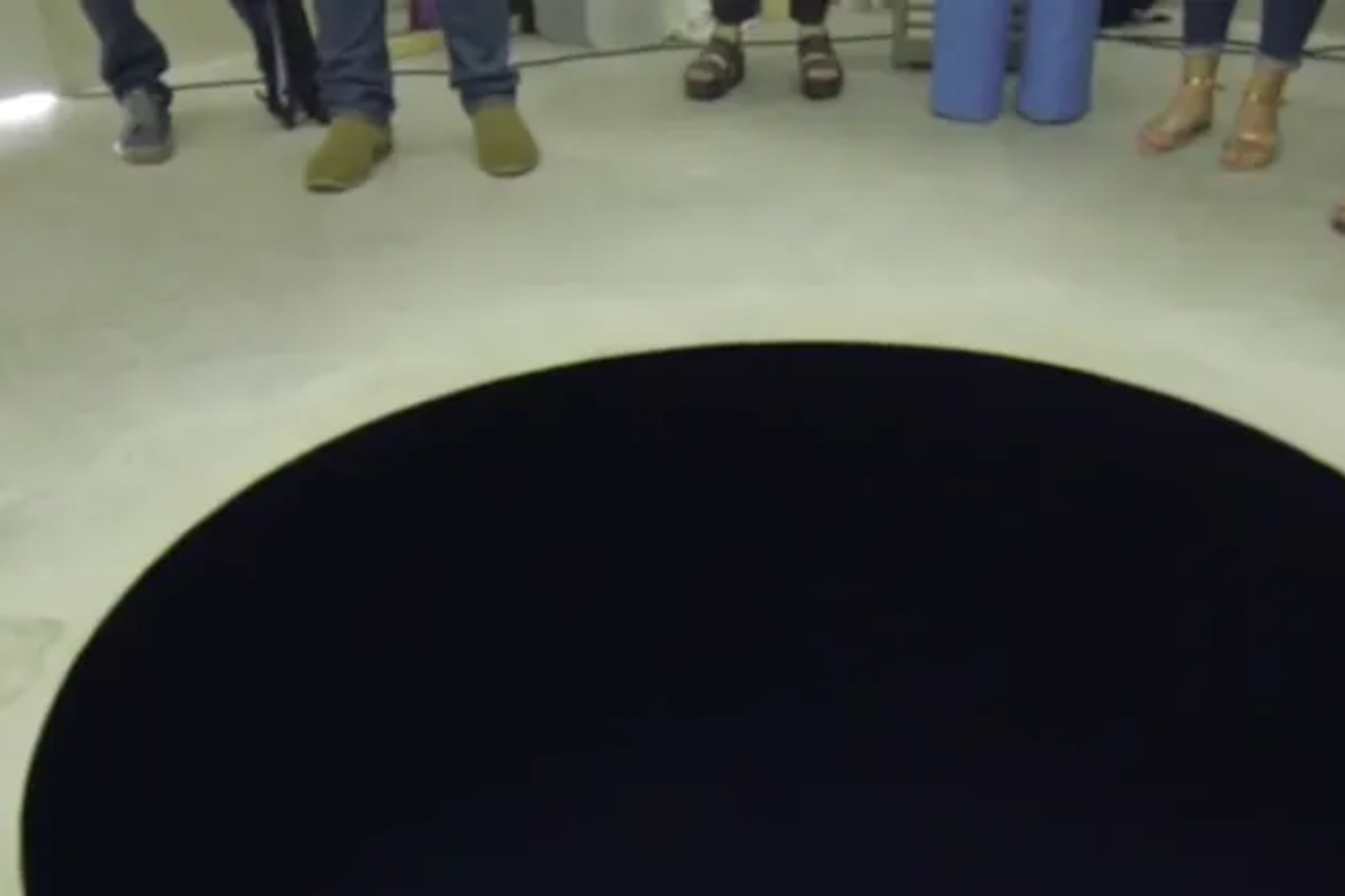
This work by Anish Kapoor depicts a black hole so black that you can't tell it's a hole... more than two meters deep. A man fell into it while visiting the Museum of Contemporary Art in Porto, where "Descent into Limbo" is on display. pic.twitter.com/ufLdvlX0Th
— Loopsider (@Loopsidernews) August 24, 2018
Anish Kapoor created the installation *Descent into Limbo* (perhaps a reference to Mantegna’s painting) in 1992, long before the development of Vantablack, a concept he would later revisit in numerous works. The setup of this work is very simple: a hole 2.5 meters deep with a diameter of about 1.5 meters. Its coating reflects very little visible light, making the hole seem unreal by distorting perception.
In the collection of interviews with the ironic title *I Have Nothing to Say*, published in 2011—again, before the invention of Vantablack—Anish Kapoor also speaks of a very dark blue paint and adds: “It just so happens that blue produces a much denser darkness than black because we do not perceive color entirely with our eyes. The eyes are instruments of the intellect, so much so that we even perceive colors with our minds.”
He said he was pleased by the anger of a visitor who, instead of a hole that turned out to be very dark blue, had seen nothing but a black carpet… and had fallen into it.
Finally, the intersection of the arts and sciences is remarkable here. The ideal black body in physics is perfect: all incident light is absorbed by the material. This ideal black body described by physicists does not exist.
To our eyes, yes. Anish Kapoor creates situations in which, to the eye, everything is absorbed and nothing appears to be emitted. It is an ideal situation from the perspective of our perception, but obviously not from the perspective of physics. Anish Kapoor thus explores its possibilities for us. In the same collection, he states: “It is a vision of darkness. Fear is a darkness in which the eye loses itself, toward which the hand reaches out in hope of contact, and from which only the imagination can escape.” And Story Musgrave adds in Dana Rana’s film, gazing at the blackness of space: “It would be something with the hands, you know, something you can feel with your hands. Something you can feel flowing through you, something that might be a little spongy.” Both tell us that absolute “black” is a shock. Alien to us, it disorients us to the point of losing ourselves.