

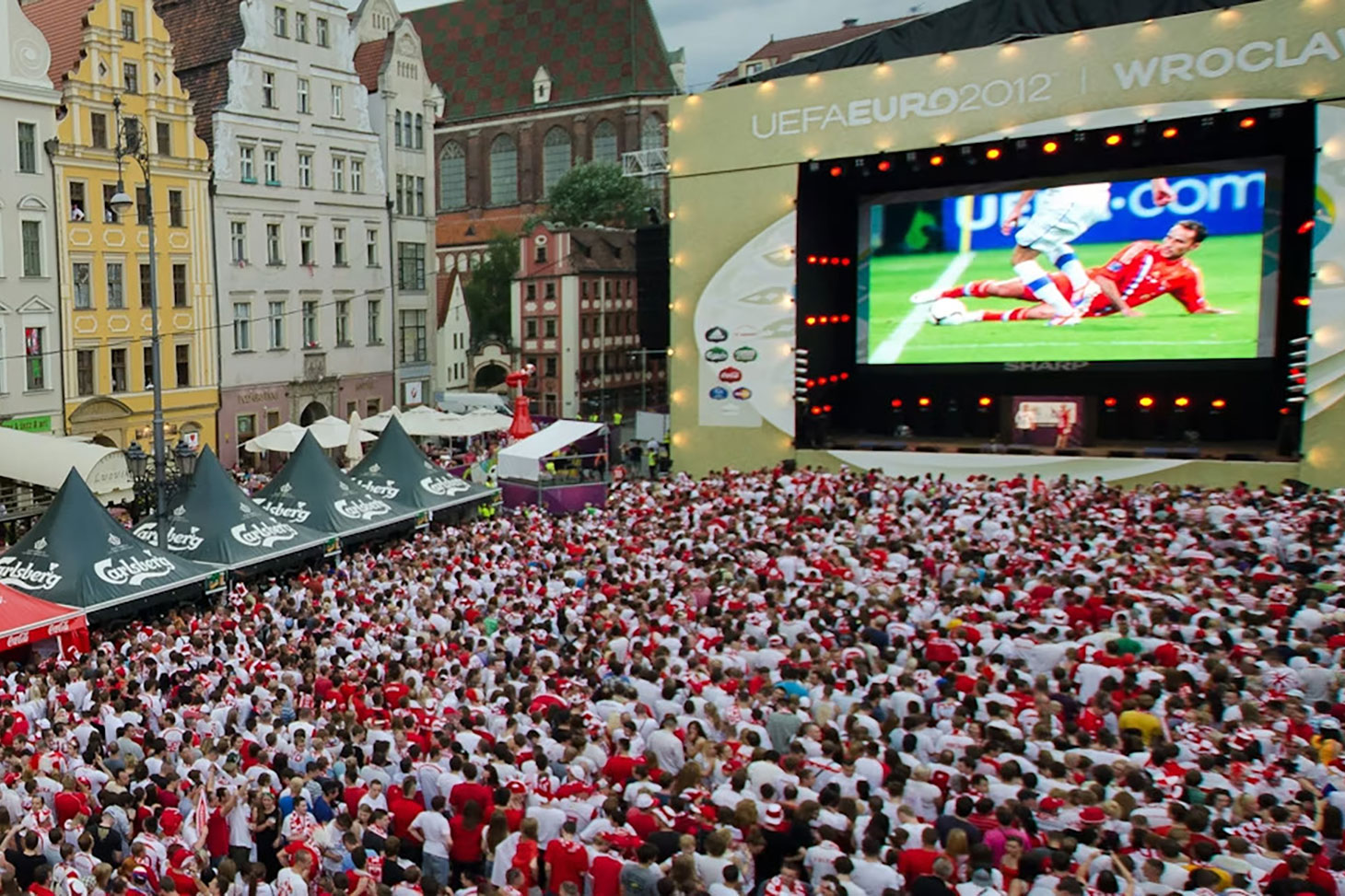
Attending a sporting event among a large crowd allows us to experience what Durkheim called “collective effervescence,” which results from the sacralization of the sense of collective belonging. This is the need to come together in person, to be together, and to share emotions in our increasingly digital society.
In this context, sporting and musical events (concerts, festivals, free parties) are increasingly replacing large gatherings—particularly religious or political ones—that once served as prime venues for collective emotional connection.
My previous studies have shown that the social and emotional dimensions of the experience play a central role for spectators and festivalgoers, confirming—in the events sector—the findings of P. Rimé’s social psychology studies: individuals seek to experience an emotion more to share it than to feel it themselves. This phenomenon largely explains the success of fan zones, regardless of their form
The fan zone: above all, a space for emotional connection
Our study highlights the fact that the fan zone is perceived as a space for social connection and shared experiences, both before going there and after the experience. Some people go there to “get into the spirit together,” especially when they can’t get into the stadium: “You go to the fan zone because you don’t want to watch the game alone or with just one other person at home. It’s bigger than a bar, which is nice, because you don’t necessarily have the means [to go to the event itself]; it’s a great alternative. You get out of the house and hang out with other fans.” (Vincent)
It fosters a sense of emotional connection and of sharing a memorable moment together: “We could feel everyone’s good spirits; it was nice to see the crowd rallying behind the French teams.” (Emmanuelle, 2024 Olympic Games, Club France in Nantes.)
The spread of emotions through the phenomenon of emotional contagion—which causes us to be swept up in and moved by the emotions expressed by others, which we then share in turn—is amplified by the spatial layout of fan zones, which brings spectators into close proximity with one another. This high social density, however, is not consistently found at sporting events where public areas are less concentrated (such as spectators lining the route of the Tour de France or a biathlon course) or where the stadium is sparsely populated.
In the fan zones, this shared sense of excitement—which sports fans seek out—is everywhere: “The appeal of the fan zone is sharing the moment, sharing that excitement with others from a distance—that’s the power of watching sports together; the emotion is amplified tenfold.” (Marie)
The social values associated with the experience of sporting events (social interactions, a sense of community, patriotism) are important and are consistently present in these spaces.
Thus, the fan zone meets spectators’ social and emotional expectations; that is its strength. Nevertheless, when it comes to other aspects of the experience, perceptions remain largely negative.
A fun place, despite its bad reputation
The general perception of fan zones is rather negative, as the experience doesn’t necessarily seem enjoyable at first glance (in terms of comfort, view quality, and the ability to choose one’s seat or standing position, for example). They are often seen as very basic spaces: “An open-air square packed with people.” (Karine)
However, in some fan zones—for example, those for the 2024 Olympic Games in Paris and in other major cities—a wide range of activities were organized. The experience wasn’t limited to showing sporting events on a giant screen but included a wide range of services for visitors (food and drink, games, shows, presentations, DJs, or concerts…). In this context, the experience can be very fun and interactive—which won’t be the case in a fan zone organized by a bar.
Moreover, official fan zones (managed by event organizers) are open well before and after the sporting event, as is the case with the fan zone set up by PSG at the Parc des Princes for the 2025 and 2026 Champions League finals, which will not be held in Paris. Furthermore, some spectators at sporting events view these types of fan zones as “a tourist trap or a money-making scheme” (Pierre).
The New Jersey fan zone for the 2026 World Cup is, in fact, the first fan zone that charges an admission fee. This commercial image tends to obscure, in popular depictions, the fun aspect that a fan zone can offer.
A substitute for the television experience or the stadium experience?
At first glance, the fan zone is primarily seen as a substitute for the TV viewing experience: “It doesn’t replace the stadium—it’s a substitute. The fan zone is more of a replacement for watching the game at home; it’s the middle ground. You go to the fan zone because you don’t want to watch the game alone at home.” (Vincent)
Respondents often associate the fan zone experience with the TV experience at home, comparing (or contrasting) the on-site experience with the “screen” experience: “What you experience there, you can’t compare to what you watch on TV.” (Clément)
However, it’s worth noting that the in-person spectator experience can sometimes resemble the fan zone experience, depending on the sport. This is particularly true for outdoor sports: “When you go to watch an alpine skiing race, it’s kind of like a fan zone—you watch the skier on the screen, and then you see the skier cross the finish line for two seconds. ” (Thierry)
Or, as Karine put it: “In biathlon, we’re right on the edge of the track, so we try to have a screen in front of us.” (Karine)
Once you’ve experienced the fan zone, it can feel like a substitute for the stadium experience, especially on an emotional level: “To go to the fan zone, you have to be hooked, high on thrills—during the Olympics, I’d go to the fan zone if I didn’t have a ticket.” (Patricia)
Furthermore, the fan zone experience—even from a distance—provides a sense of belonging to the event, the feeling of being able to take part in the festivities: “Being there without actually being there” (Valérie, 2024 Olympic Games fan zone, in Angers). This also fosters a sense of inclusion for those who were unable to buy tickets:“Here, it feels like we’re watching the competitions as if we were in the stands.” (Jérémy, 2024 Youth Olympic Games, Club France Paris.)
Or: “We experienced the Olympic spirit; I tell myself that I, too, went to the Games, even though I didn’t go to see an event live.” (Marie, JOP 2024, Club France Paris.)
Thus, from an emotional value perspective, experiencing the sporting event in a local or remote fan zone can serve as an alternative to the on-site experience for some spectators.
And finally, it may also be neither of the above for people who didn’t watch the game on TV—let alone buy tickets to the stadium—but who will still go to a fan zone. Because, as we’ve seen, people don’t go to a fan zone just to cheer on their team or watch the sporting event, but to share the experience. Our observations show that this is particularly true in casual fan zones (such as bars) or intimate ones (organized in a private setting), although this type of profile is also found in institutional fan zones.
Fan zone or “fun zone”?
People come here to have fun—whether that means doing the wave, singing along, enjoying themselves, and interacting with others—all while watching the screen with varying degrees of intensity depending on the viewer’s preferences. In this sense, the fan zone is also a recreational space that isn’t exclusively popular among fans, defined as “enthusiastic admirers who are passionate about someone or something.” People come here to have fun (in the sense of enjoyment and amusement).
The fan zone is therefore more than just a “space reserved for fans” (according to the Académie Française’s translation of “fan zone”). We might also ask ourselves: What are we fans of? For some, it’s the team playing; for others, it’s the event itself; or, quite simply, it’s the collective celebrations for “party enthusiasts”—and in that case, the fan zone becomes a fun zone.