

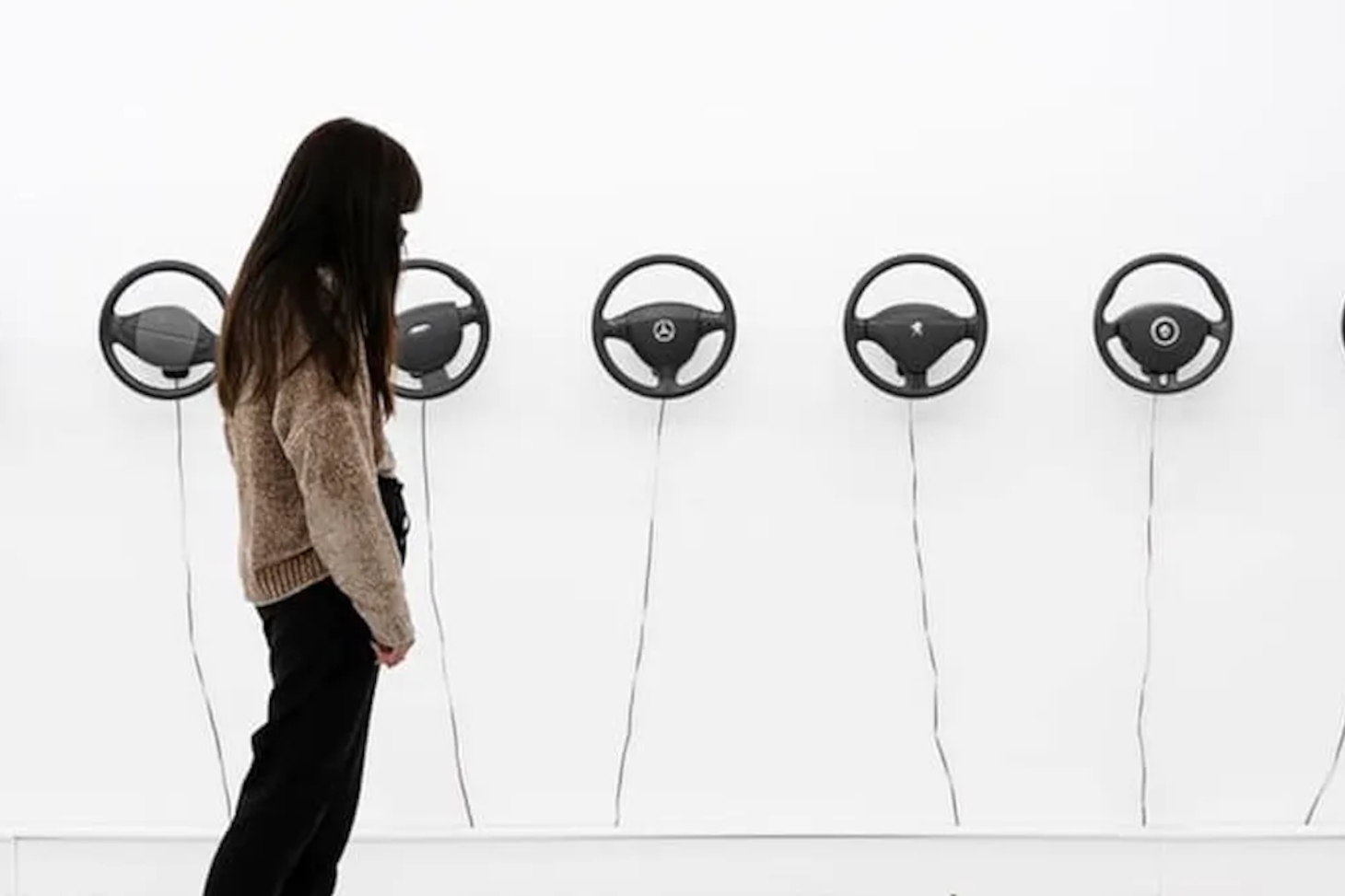
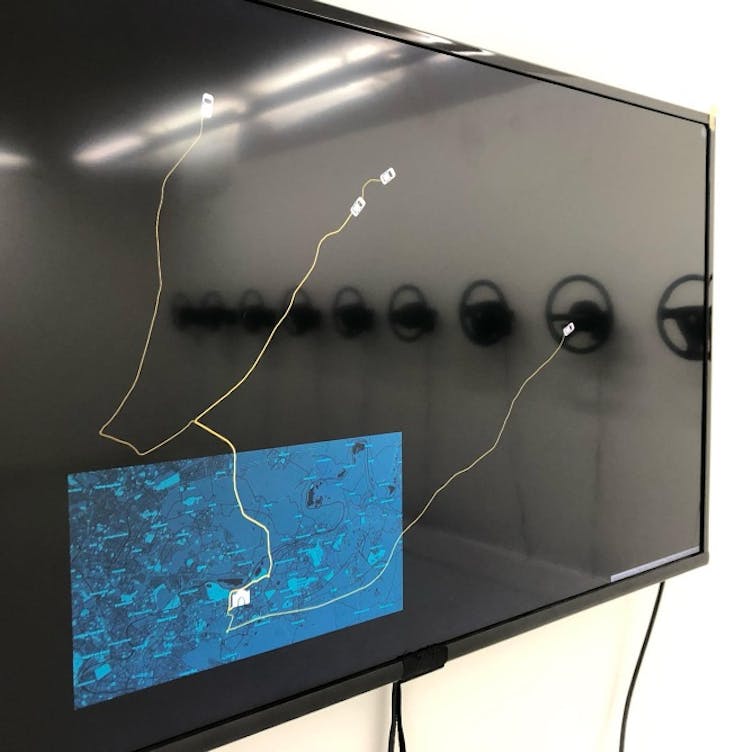
They turn right, then left, then return to their “go straight” position, only to turn right or left again. Apparently, they spend their time “driving” their own virtual cars in a sort of Google Maps. The screen on the side wall shows the nine little cars in motion, each heading toward its destination, as chosen by a visitor.
The text in the program accompanying the work states:
“Much like autonomous driving systems, Filipe Vilas-Boas’s work *Data Driven: Hands-Free* invites us to passively watch the steering wheels navigate the routes we ask them to take. At the dawn of an era in which excessive energy consumption may lead us to travel less, the work invites us to imagine an infinite number of destinations. Somewhere between daydreaming and laziness, the artist explores the relationship between humans and machine automation.”
I had the chance to meet Filipe Vilas-Boas. He had described his work with car steering wheels to me without telling me the title or his intention—without “spoil[ing]” anything—and then I found myself standing in front of his artwork at La Ferme du Buisson.
As soon as I walked into the room, I saw nine steering wheels continuing their lives as steering wheels—like “in a video game for car steering wheels”—devoid of drivers and cars. Drive a little longer. Take one more lap. With the energy of desperation. Even if it’s just a lap as a car avatar in a virtual space. And even if, in the absence of a driver, to take that lap, one must become the useless and almost ridiculous plaything of “data.” Sensors and software become the real drivers—whether in this artwork or in real life. There are no hands. The software, fed by streams of “data,” doesn’t need an interface like a steering wheel to take control of a vehicle—whether virtual or real, for that matter.
The actual vehicle is on its way to becoming autonomous. Eventually, there won’t be a steering wheel anymore. It’s said that Elon Musk changed the automotive paradigm by putting software at the center. An autonomous car in kit form consists roughly of: sensors scattered throughout the car’s structure, a connected computer with internal software that’s updated remotely, an engine, brakes, and steering. And a passenger compartment, perhaps. Of course, you’ll also need a battery to power the whole system.
The sensors transmit all the necessary data about the surrounding environment. The software receives and processes this data and directly controls the brakes, the engine, and the steering. And so there are no rearview mirrors, no pedals… and no steering wheel.
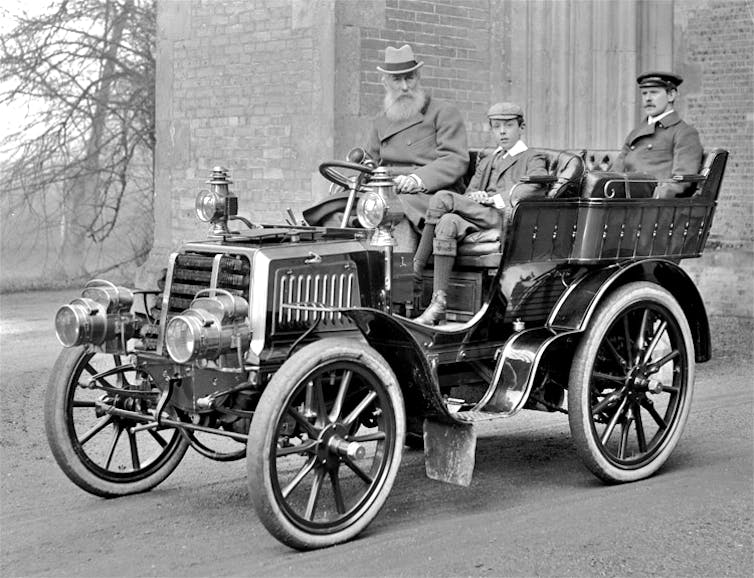
Here is what Wikipedia says when you search for “steering wheel”: “In an automobile, the steering wheel is the mechanical component that allows the driver to control the direction of the vehicle. The steering wheel is therefore part of the vehicle’s steering mechanism. It was first introduced in 1894, during the Paris-Rouen race, by Mr. Alfred Vacheron and his car, number 24.”
The car was a Panhard 4CV. Does this mean that the invention of the steering wheel followed the appearance of the first cars? It certainly seems so. In any case, it is reported that by 1905—a decade after its first appearance—the steering wheel had become virtually the standard in automobile production.
I saw *Data Driven: Hands-Free* and it reminded me of *Foundation’s Edge*, thefourth volume of Isaac Asimov’s *Foundation* science fiction series, published in 1982: “Trevize placed his hands against the contours drawn on the tabletop, contours positioned so that he could do so effortlessly.
“Close your eyes, please, and relax. We’re going to establish the connection.”
With the hands?
The hands? Why not?
It was the hands—the active surface of the body—that touched and manipulated the universe.
Man thought with his hands. It was his hands that satisfied his curiosity, that felt and pinched and turned and lifted and weighed.”
The expression “I’m getting behind the wheel” says it all: putting one’s hands on the steering wheel of a “nice car” is still a dream for some drivers. We can read this text by Asimov, written inthe 20th century, as a simple and immediate description of the driver’s relationship with the car—through the steering wheel, through the hands. There are countless movies and TV shows based on this relationship, featuring iconic scenes—such as car chases, among others.
The steering wheel as a symbol of the car culture of the “Trente Glorieuses.” After reading this, *Data Driven: Hands-Free* comes to mean, for me: steering wheels desperately trying—even if only “pretending”—to recapture the good old days, when they were kings, before drivers disappeared.
Between Alfred Vacheron’s invention in 1894 and the “Fondation foudroyée” in 1982, a miracle occurred. The steering wheel became the standard as early as 1905. Then it took the world by storm. Of course, there are many differences between today’s luxury cars and that original steering wheel, but they remain minor. It is still, as always, a car with a steering wheel to steer the two steerable wheels. Power steering complements the system, allowing it to perfectly match the driver’s precise movements, anticipations, and sense of the vehicle’s size and shape while in motion—even at high speeds.
[More than 80,000 readers rely on The Conversation’s newsletter to better understand the world’s major issues. Subscribe today]
Was Alfred Vacheron aware of this? With the steering wheel, he completed the car and literally made it an extension of the body through the hands. For Filipe Vilas-Boas, as for Isaac Asimov, driving always involves the hands, which establish this intuitive, sensitive—and, in fact, extraordinary—connection between the machine and its driver. How do we analyze the exceptional quality of the steering wheel’s role as an interface between the car and the driver?
The state of technology in 1982 allowed Isaac Asimov to envision this possible future for the steering wheel. Touch and haptic interfaces are still in their infancy, but they are already here, facilitating interactions between our hands and technology beyond keyboards. They continue to advance at a rapid pace. Vincent Hayward’s work on touch and haptics, which began back then, has now led him to the Academy of Sciences.
In fact, as Wendy Mackay demonstrated in her inaugural lecture on human-computer interfaces (HCIs) at the Collège de France in 2022, HCIs have undergone rapid evolution in recent decades and have accompanied the widespread adoption of digital technologies around the world. Ultimately, Isaac Asimov’s description may apply more to the touchscreens on our computers or smartphones than to the control panel of a modern automobile.
A car, a steering wheel, a driver: all configurations are now possible. Racing games use a steering wheel connected to a game console. They retain the driver and the steering wheel. The car is now nothing more than an avatar in a virtual world built from data. Filipe Vilas-Boas, on the other hand, removes both the real car and the driver. Streams of data flow from the virtual space—that of the car’s avatar—to the motorized steering wheel. In an absurd reversal, instead of being at the heart of the driving experience, it merely executes commands and spins idly. The third configuration is the autonomous car. No steering wheel, no driver. Is Filipe Vilas-Boas warning us of the fate that awaits us? That of the steering wheel?