

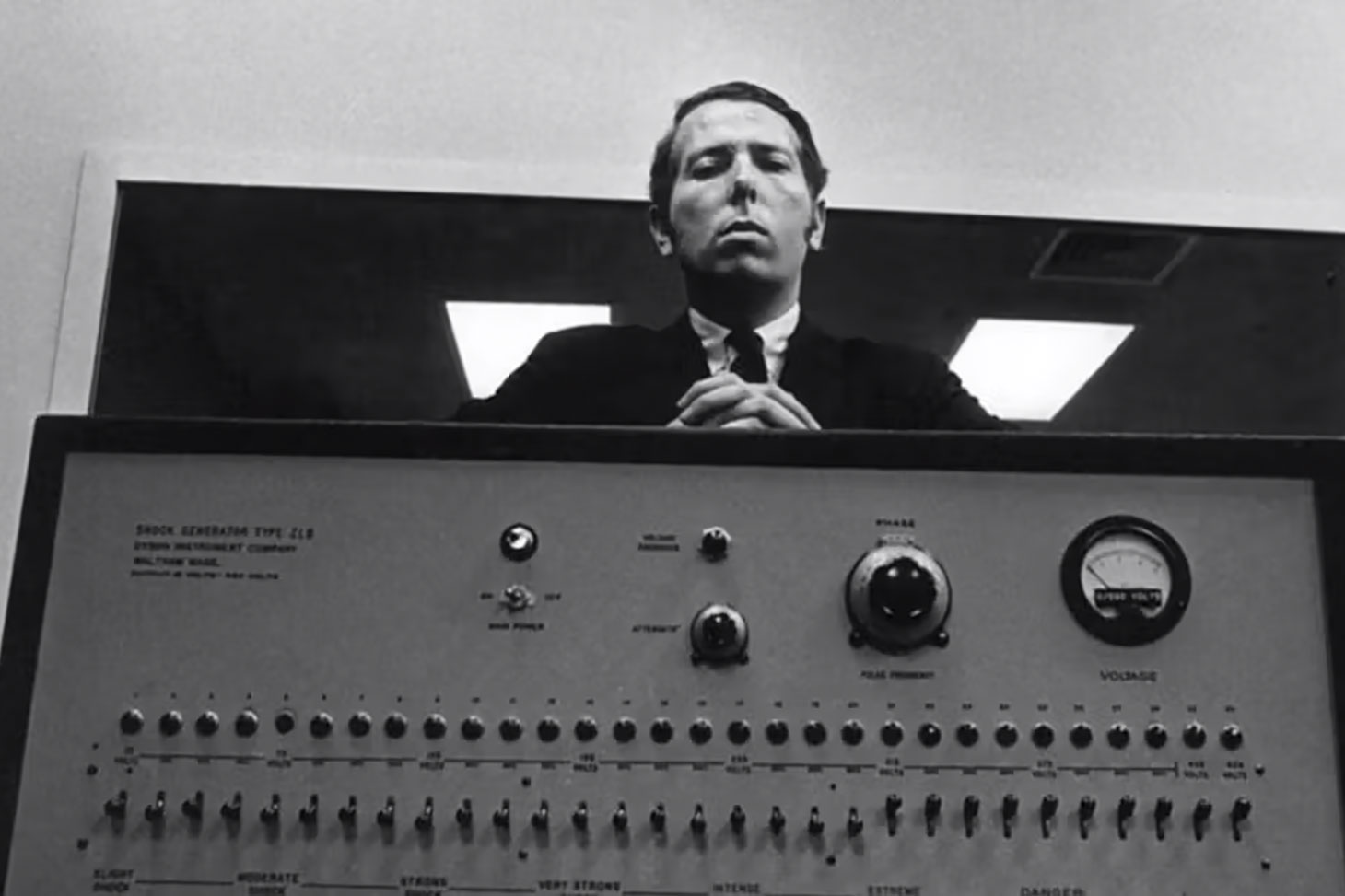
Research in social psychology refutes the “banality of evil” thesis. Violence within social hierarchies is perpetrated by individuals who are distinguished by one trait: their authoritarian orientation—and thus by behavior that is particularly coercive, unequal, and intolerant.
In 1964, social psychologist Stanley Milgram published the first experimental study on obedience to authority. His protocol involved asking volunteers to administer electric shocks to another participant (who was actually one of Milgram’s accomplices) as part of a study purportedly examining the effects of punishment on learning. A sample of psychiatrists predicted near-unanimous disobedience, with the exception of a few pathological cases that might go so far as to administer a 450-volt shock.
The results caused a sensation: 62.5% of participants obeyed the instructions, going so far as to administer multiple 450-volt shocks to a victim who had fallen silent after letting out intense cries of pain. This result was replicated in more than a dozen countries among more than 3,000 people.
These data illustrate the strong tendency toward obedience among the general population. They also reveal significant individual differences, as approximately one-third of the participants disobeyed. The sociodemographic characteristics of the individuals and the cultural context appear to have no influence on behavior in the Milgram experiment. How, then, can we explain the individual differences observed?
We conducted a new series of experiments in the 2010s. Our results show a similar rate of obedience as well as a notable influence of right-wing authoritarianism: the higher participants’ scores on the right-wing authoritarianism scale, the greater the number of electric shocks administered.
Research on Authoritarianism
Social psychology has been addressing the issue of authoritarianism for several decades. This branch of experimental psychology gave rise, as early as the 1930s, to an important concept: that of attitude.
An attitude refers to a set of emotions, beliefs, and intentions to act with regard to a particular object: a group, a social category, a political system, etc. Racism and sexism are examples of attitudes composed of negative emotions (fear, disgust), stereotypical beliefs (“Black people are dangerous,” “women are irrational”), and intentions to act hostilely (discrimination, aggression).
Attitudes are measured usingpsychometric instruments called attitude scales. Numerous studies show that the more conservative a person’s political attitudes are, the more negative their intergroup attitudes tend to be (e.g., racism, sexism, homophobia), and the more likely they are to engage in hostile behaviors (such as discrimination and aggression motivated by intolerance). Conversely, the more progressive a person’s political attitudes are, the more positive their intergroup attitudes tend to be, and the more likely they are to engage in prosocial behaviors (such as supporting disadvantaged people).
Political attitudes and intergroup attitudes are therefore correlated. One way to analyze a correlation between two variables is to postulate the existence of a common source of variation—that is, a more general variable whose changes are systematically accompanied by a change in the other variables. In other words, if two variables are correlated, it is because they depend on a third variable. Research in social psychology suggests that this third variable may be authoritarian attitudes. This concept encompasses attitudes that express complementary hierarchical orientations:
-
a social dominance orientation, an attitude focused on establishing hierarchical, unequal relationships between groups of people;
-
right-wing authoritarianism, an attitude oriented toward conservative support for dominant individuals.
Research in experimental psychology, behavioral genetics, and neuroscience consistently shows that authoritarian attitudes, more than any other variable (including personality, education, and culture), determine intergroup attitudes, political attitudes, and thus people’s behavior—whether it is coercive, unequal, or intolerant.
From Monday through Friday and on Sundays, receive free analyses and insights from our experts for a fresh perspective on current events. Subscribe today!
Authoritarianism in the Police Force
Let’s examine the case of one group: the police. Several studies show that newly recruited police officers score significantly higher on the right-wing authoritarianism scale than the general population.
This important finding suggests that authoritarian individuals are more likely to choose a career in law enforcement (self-selection) and/or that law enforcement agencies tend to favor authoritarian individuals in their recruitment (selection). Authoritarian individuals and the police institution appear to be mutually attracted, resulting in a selection bias toward right-wing authoritarianism, which, as we have seen, is responsible for conservative political attitudes and negative intergroup attitudes.
For research purposes, academics have developed a video game that simulates the situation of a police officer faced with an ambiguous target and having to decide whether or not to shoot. Black or white people appear unexpectedly on a screen in various settings (a park, a street, etc.). They are holding either a gun or a harmless object, such as a wallet. In a study conducted in the United States, researchers compared the speed at which police officers decide to shoot—or not to shoot—under four conditions:
(i) armed black target,
(ii) armed white target,
(iii) unarmed black target,
(iv) unarmed white target.
The results show that police officers were quicker to decide to shoot an armed Black target and not to shoot an unarmed White target. They were slower to decide not to shoot an unarmed Black target and to shoot an armed White target. These results demonstrate a racial bias in police decision-making. They refute the notion that police violence is perpetrated by only “a few bad apples.”
In every region of the world, marginalized groups are overrepresented among victims of police violence (e.g., ethnic minorities, people living in poverty). Social psychologists Jim Sidanius and Felicia Pratto have proposed the concept of “systemic terror” to describe the disproportionate use of violence against marginalized groups as a strategy for maintaining the social hierarchy.
Support from those who favor the status quo
One might question the representation of members of underrepresented groups (e.g., ethnic minorities, women) in the police force.
One explanation is the importance of coalitions in social hierarchies among both humans and non-human primates, such as chimpanzees, a species closely related to our own. A coalition is typically recognized when individuals threaten or attack other individuals in a coordinated manner. Primatologist Bernard Chapais has identified several types of coalitions, including:
-
conservative coalitions (dominant individuals support one another against subordinate individuals who might overthrow them);
-
conservative support for dominant individuals (subordinate individuals support dominant individuals against other subordinate individuals);
-
xenophobic coalitions (members of one group attack members of another group to defend or expand their territory).
The police force consists of subordinates motivated by conservative support for dominant individuals (as measured by the right-wing authoritarianism scale) and xenophobia (as measured by racism scales).
On the whole, research in social psychology refutes the thesis of the banality of evil. Violence within social hierarchies is perpetrated by individuals who are characterized by an authoritarian orientation—and thus by behavior that is particularly coercive, unequal, and intolerant.
The poor condition of the democracy around the world suggests a high prevalence of authoritarian traits. In our view, combating the current democratic recession requires an understanding of these traits.