

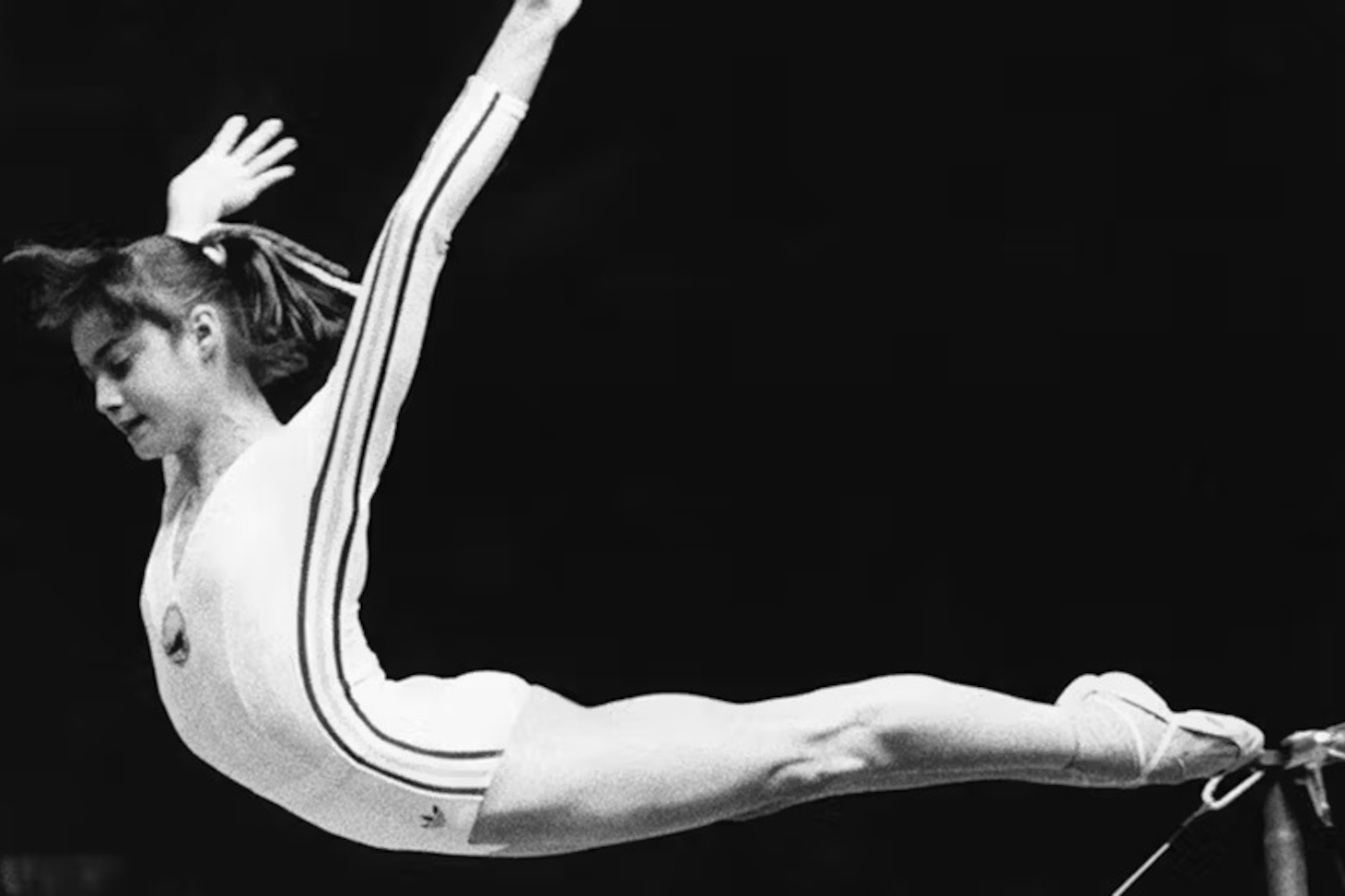
This serves as a reminder of the exceptional status that the sports world continues to accord the gymnast, nearly half a century after her performances in Montreal. But what was life like for this young girl, who was only fourteen at the time?
On the night of November 27–28, 1989, in sub-freezing temperatures, in total darkness and absolute silence, during a six-hour trek across icy terrain, half-frozen lakes, and dense forest, a group of seven people secretly crossed the border between Romania and Hungary, taking the considerable risk that one of them might be arrested or shot in the back. Her name was Nadia Comăneci, and she was a global icon of women’s artistic gymnastics, better known around the world than the Conducator of socialist Romania, Nicolae Ceauşescu!
Since 1976, when Nadia Comăneci burst onto the scene in the eyes of the general public (though not of experts) at the Montreal Olympic Games—as the first gymnast to earn a perfect score of 10.00 on the apparatus or floor exercise (seven times during those Games)— to the point that the electronic scoreboard—which wasn’t designed to display such a score—had to show 1.00—what could possibly have happened to cause the most iconic and positive international figure of the Romanian dictatorship to leave the country in this way?
Nadia Elena Comăneci was born on November 12, 1961, in Oneşti (Bacău County), in Romanian Moldavia, at the foot of the Carpathian Mountains, to Gheorghe and Ştefania Comăneci. Her father was an auto mechanic who had to walk nearly twenty kilometers every morning to get to work (and the same distance back in the evening), and her mother was a homemaker. She had a brother, Adrian, who was five years younger than her.
From a very young age, Nadia developed a wide range of motor skills that were undoubtedly crucial to her future athletic development: she would climb trees as high as she could, let herself fall, and swing from branch to branch; she loved playing soccer with the boys, went fishing with her grandmother, did cartwheels, roller-skated, rode a bike, jumped on her bed, spent her days and nights running around the village, and punched the boys who refused to let her play on the team…
To channel the boundless energy of this “tomboy,” her mother took her—while she was still in kindergarten— to the local gymnastics club, Flacără (The Flame): “When I walked into the gym, I knew I would become part of that world—or at least, that’s what I wanted. I was overwhelmed by its size, by my own shyness, and by the endless possibilities for play that every mat, vault, parallel bar, and balance beam offered.”
Nadia then began gymnastics under the guidance of Marcel Duncan, and later under Maria Simionescu, a specialist in women’s artistic gymnastics, with whom she learned the basics. The city’s mayor did a great deal to develop the club with the help of the coaches, and later with support from the National Council for Physical Education and Sports (CNEFS), as well as the Ministry of Education and the Romanian Gymnastics Federation (FRG), securing the construction of a specialized gym (inaugurated in 1968) and the opening of the High School of Physical Education in September 1969 (Olaru, pp. 36–39). It was this school that Nadia attended.
For their part, Béla and Márta Károlyi, both born in 1942, moved to Onești in 1968 after completing their physical education studies in Cluj, though they ended up at two different institutions. While Márta was assigned a position as an artistic gymnastics coach under the experienced Valeriu Munteanu, Béla took charge of the women’s handball team, which he led to the finals of a major national competition. It was not until 1971, following the departures of Marcel Duncan and then Valeriu Munteanu, that Béla Károlyi left handball and became the new gymnastics coach for the group to which Nadia belonged. He was therefore not the one who discovered Nadia, as he claims in his autobiography (Karolyi & Richardson, 1994, p. 43); this fabrication is one of his character traits , a way for him to cast himself in a favorable light.
The fact remains that it was indeed the Károlyis who, in a favorable local and national climate, built a team of young girls that would revolutionize women’s gymnastics. Béla Károlyi, even more so than Márta, was insanely demanding of the young gymnasts, monitoring their every move—and especially their diet—and making them repeat floor routines and routines on various apparatus until they were exhausted. He was also extremely harsh, resorting to insults, punishments, and even physical blows. After Montreal, Nadia would no longer put up with this, even though she would later return to him.
Although the Romanian gymnasts excelled at the 1975 European Championships in Norway (with Nadia winning four gold medals and one silver), the Olympics are on a different scale and have a different impact. However, gymnastics is not just a demonstration sport; it is also judged by officials who tend to give lower scores to lesser-known gymnasts compared to the more famous ones. And pressure from the public and the media can have an influence. So, during the podium training day (which precedes the start of the competitions), Béla employed the tactic of not bringing the team in immediately when the announcer called them, waiting until all eyes—both those of the spectators and the media—were fixed on the door. Nadia points out that “he also created an environment in which I could shine […]. Some coaches are simply coaches. Others, like Béla, are coaches, publicists, agents, and advocates—all rolled into one […]. In 1976, no one knew the Romanian team, and Béla knew that had to change if we were to have a chance at winning.”
Gymnastics quickly became a priority sport for those in power. As a result, sports professionals seemed to be walking around “with a detector for gifted children in schools, [recruiting] them early enough to turn them into champions,” which appealed to people from modest backgrounds, opening up opportunities for social mobility.
There was also a strategic interest for the state and the Party, according to Mihaela G., a sociologist quoted by Lola Lafon: “The gymnasts ate very little; they were highly profitable. Too young to form an opinion about what was happening in the country, they would not seek political asylum during any competition in the West.”
In the years that followed, Nadia’s body changed, and she had to adapt to her new, more feminine physique. As she left her teenage years behind, she also developed new aspirations for her social life and had to plan for her future. Nevertheless, she continued to win titles (European and World Championships, and the 1980 Moscow Olympics), despite personal difficulties and the ups and downs of her relationship with Béla. In 1981, during a gala tour of North America in which she was participating, Béla, Márta, and choreographer Geza Pozsar defected. “If Béla hadn’t fled, I would have always been under surveillance, but his defection turned the spotlight on my life, and it was blinding. I began to feel like a prisoner.”
Throughout the 1980s, Romania’s icon led a rather ordinary life: she worked for the FRG, held positions at the International Federation, but was barred from traveling outside the Eastern Bloc; and at the age of 25, the government withheld part of her salary because she had no children. In fact, Nicolae Ceauşescu had implemented a pro-birth policy (Anti-Abortion Decree 770/1966): “As soon as she came of age, Nadia couldn’t escape it; she was ‘inspected,’ like all of us, by the ‘menstrual police’—those doctors who examined us every month at our workplace and urged us to have more children,” as recounted by Madalina L., an academic, in *The Little Communist Who Never Smiled* by Lola Lafon.
For Nadia, life boils down to “surviving, taking care of [her] brother, and making sure the house stays at least partially heated for the winter.” In the fall of 1989, Nadia happened to meet a Romanian who had emigrated to the United States; he would encourage her to make a radical decision, and she told her brother aboutit: “You have nothing left to do in this country,” Adrian told me. “The way the government treats you is humiliating. If you want to escape, you should try.”
At that time, Nadia realizes that “the process of dehumanization in Romania, as well as the dangers and uncertainties of defection, showed me how little control I had over the circumstances of my life.” Today, married (in 1996) to Bart Conner (a two-time Olympic gymnastics champion in 1984), mother of an eighteen-year-old son, and living in Norman, Oklahoma, Nadia concludes : “I left because I wanted to find out what the future held for me. But at that point, I no longer had a future in Romania.”