

Around 1970, computer scientist Alan Kay, in a famous drawing, foresaw the new forms of human interaction that would emerge from the digital world to come. People would be disembodied, with their physical bodies rendered obsolete. This drawing is practically a prophecy, infinitely ahead of the reality of computers at the time! Most of the features envisioned for this Dynabook have now been realized, particularly wired and wireless connectivity.
Visionary Achievements
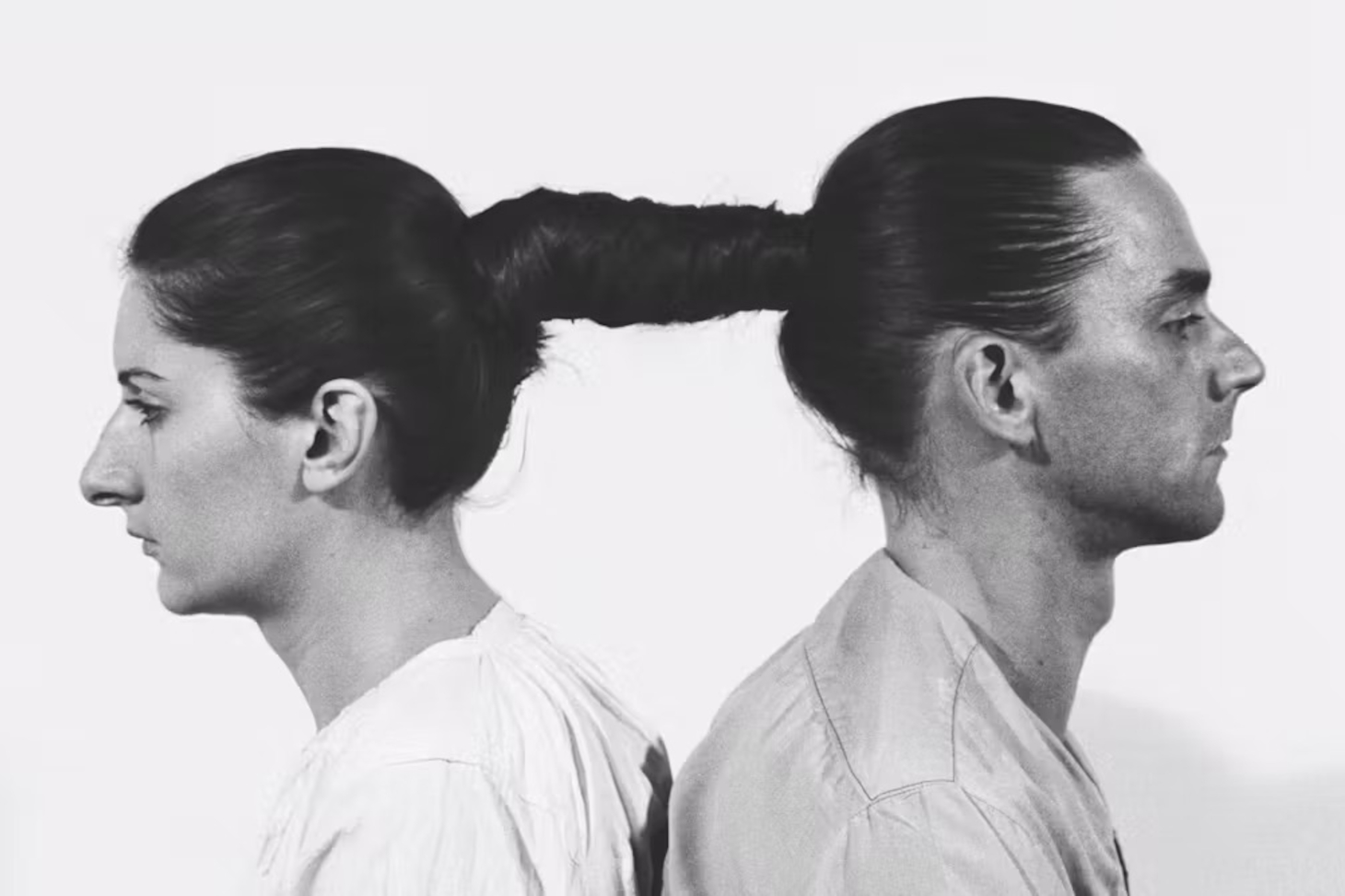
It was precisely in the 1970s that the digital age was conceived and laid the groundwork for its emergence. The word “computer” was chosen by IBM with the help of the French Latinist, philologist, and theologian Jacques Perret. In contrast, and independently, Marina Abramović and Ulay returned to the basics of physical interaction between two moving bodies.
[More than 85,000 readers rely on The Conversation’s newsletters to better understand the world’s major issues. Subscribe today]
Like any physicist, I specialize in describing interacting systems. The two-body problem is the most basic example: two planets—the Earth and the Moon—in classical mechanics; a proton and an electron forming a hydrogen atom in quantum physics. In both cases, there are two systems, and a physical interaction occurs when they come closer together. Considering the works of Marina Abramović and Ulay from this perspective may seem quite strange. Yet that is precisely what I am doing here. And I remain very surprised by the results of this comparison!
Silence! Performance in progress
Marina Abramović and Ulay see themselves as two interacting systems, but only through their two moving bodies. They have deliberately eliminated a fundamental form of interaction between them: language. During these performances, they do not speak or write. They eliminate this form of interaction, which is nevertheless at the heart of our exchanges in real life and, of course, in the world of smartphone-mediated communication. They also eliminate any form of representation on a medium. No painting, no canvas, and, of course, no screen. Marina Abramović quickly stopped painting when she discovered the power of performance “here and now” in front of an audience. Regarding the 1973 performance “Rhythm 10,” in which she frantically thrust knives between her fingers—and thus cut herself brutally—she wrote in her 2016 autobiography *Walk Through the Walls*: “I had experienced absolute freedom—I had felt that my body was without boundaries, without limits; that pain didn’t matter, that nothing mattered at all—and it intoxicated me. I was drunk on the irresistible energy I had received. That was when I knew I had found my medium. No painting, no object I could ever make, could ever give me that kind of sensation, and it was a sensation I knew I had to seek out, again and again and again.”
Physical interactions between two bodies
I look at you, you look at me, we touch each other, we clash, we strike each other, we bind ourselves together as we cling to one another, we exchange our breath in a kiss until we faint, we cast shadows over each other… or we do nothing but stare at each other without moving. Often the performance lasts for hours on end, drawing from pain and exhaustion an intensity that’s almost unbearable. It’s truly impressive!
Reading Marina Abramović’s autobiography gives the impression that her works were conceived without an overall plan.
And yet, watching this video, one might think they had compiled a list of all possible interactions between two bodies, created a performance for each entry, and practically exhausted the list. This idea first occurred to me while visiting the Marina Abramović exhibition at the Royal Academy in London in 2023.
With this retrospective spanning twelve years of performances—all of which are highly physically demanding—we are confronted, in the space of two hours and in a single venue, with the incredible and ever-renewed intensity of their collaborations.
Newton's Pendulum
In this performance, the two artists run toward each other, naked, and each time, they collide. For real, and of course they hurt each other. And as always with them, this is clearly largely due to Marina Abramović’s determination. They repeat these runs and collisions for an hour. Marina Abramović described the origins of this performance, which they staged in 1976: Newton’s pendulum served as their inspiration.
Newton’s pendulum is a star of physics. Two fundamental conservation laws in physics—the law of conservation of energy and the law of conservation of momentum—are used to describe the motion of the balls as they collide. Marina Abramović describes how Ulay found a Newton’s pendulum that they played with, and how that led them to this performance. These explorers of the physical interactions between bodies would then go on to create a series of performances.
The Macintosh and the Great Wall of China
In 1984, Apple unveiled the Macintosh. With its graphical user interface and mouse, it accelerated the transformation of how we interact with and through digital technology. Meanwhile, in the 1980s, Marina Abramović and Ulay were struggling to convince Chinese authorities to let them walk the Great Wall of China.
In 1988, they set out from opposite ends, walked about 2,500 km, and met in the middle. During the weeks that the walk lasted, there was no contact between them, but they knew they would cross paths. Here, another form of interaction is explored. On the Great Wall of China, you’re sure to cross paths. There is only one possible path. All that is needed is to set the starting conditions in advance: where each person starts from, in which direction, and when. Then a close bond exists between the two, and they walk with the certainty that they will meet. For a long time now, electromagnetic waves have enabled the transfer of information—an instantaneous and permanent link between two people. Marina Abramović and Ulay do not rely on these waves. It is a connection between two human beings—timeless and universal—that they rediscover in this walk. Deliberately free of any technology. The arrival will also mark the planned end of their relationship and their artistic collaboration.
"The Artist Is Present": Two People Looking Each Other in the Eyes
In 2007, the first smartphone—Apple’siPhone —was released. It would take the world by storm and become a major driver of humanity’s digital transformation inthe 21stcentury. Alan Kay’s vision came to fruition, and the body disappeared. In 2010, at MoMA in New York, Marina Abramović presented this performance: “The Artist Is Present.” It couldn’t be simpler. A table, two chairs. She sits motionless for hours, and anyone who wants to can sit across from her. No gestures, no words—just eye contact. Everything was photographed. The faces speak for themselves: intense human interaction conveyed solely through the gaze, without contact, without a single sound, without a single movement.
The performance “The Artist Is Present” was also a moving and unsettling moment of reunion between Marina Abramović and Ulay, two decades after their separation.
Through this exhibition, which strips relationships down to their bare essentials, Marina Abramović brings us back to the very heart of our humanity. A silent, patient “here and now” interaction between motionless bodies… a timeless, universal physical interaction that predates the technologies that have shaped our present world and transformed our lives.