

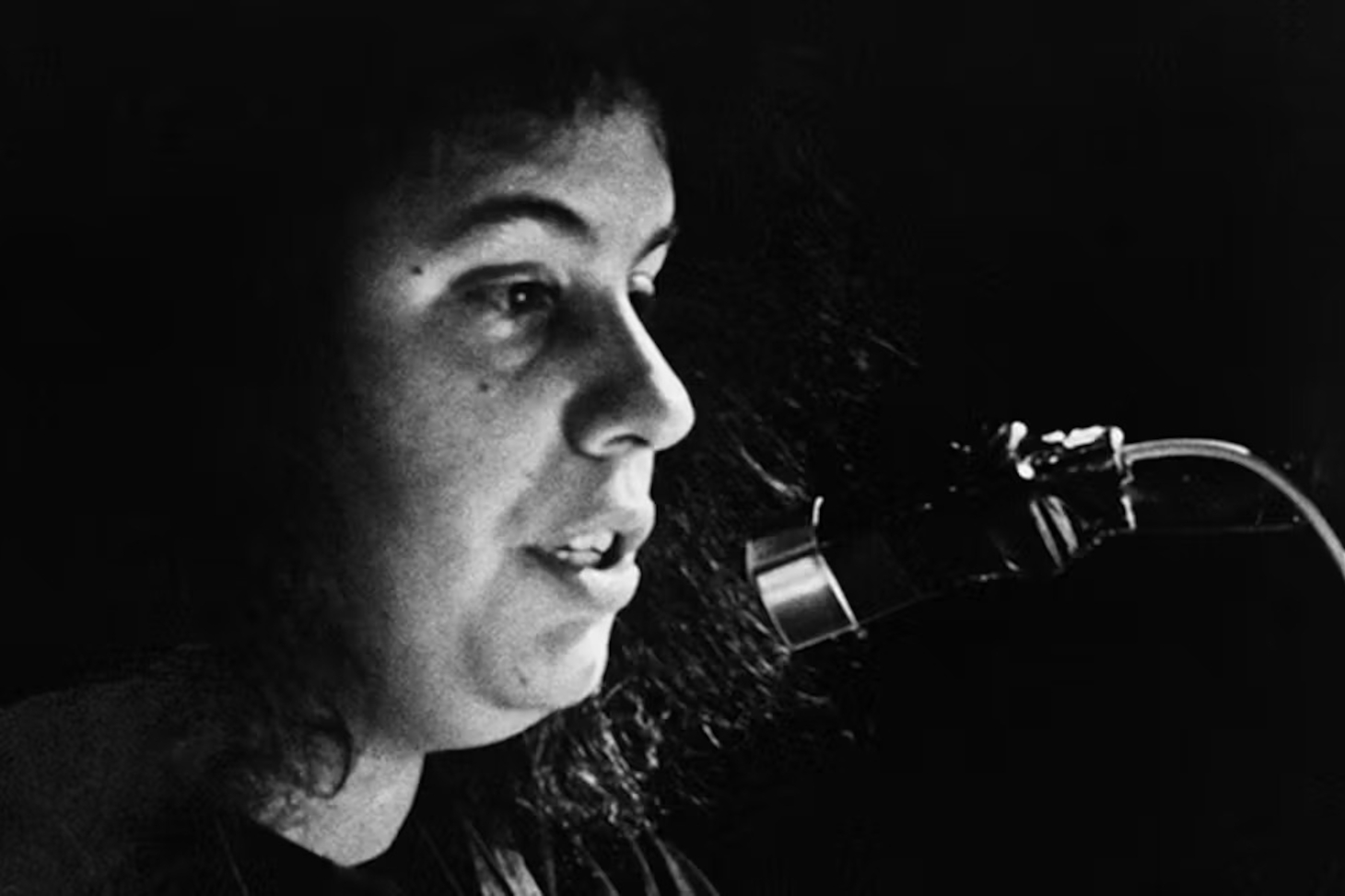
In 2005, Andrea Dworkin passed away. For 40 years, the feminist essayist and writer had captivated, stirred, or frightened the public with her ruthless and incisive writings, which seemed almost to come from another world. As her admirer Leonard Cohen so aptly put it in 1988, she was perhaps “[the first author], male or female, to display a defiance that is profoundly subversive in a sacred—alien—sense. […] The position she takes […] is so provocative and compelling that it creates another reality and might even bring it to life.”
Today, while gender studies—both in France and in the United States—are once again taking an interest in her work, she remains largely unknown to the general public. Why is it still relevant to read Dworkin today?
Born in 1946 into a Jewish family in New Jersey, Andrea Dworkin rose to prominence in the 1970s as a women’s rights activist, journalist, novelist, and essayist. Her writings are characterized by a blend of highly sophisticated theoretical reflections and a raw drawing on her own life experiences. Having herself experienced domestic and sexual violence, prostitution, and life on the streets, she made violence against women the focus of her work, all expressed in a distinctive voice that blends an academic style with very raw language. She also became famous as a public speaker, delivering numerous speeches at feminist events during the second and third waves of the feminist movement. Her activism extended to the struggle against the Vietnam War, apartheid in South Africa, and anti-Semitism. She continued to publish novels, essays, and articles until the final years of her life, culminating in the 2002 publication of her autobiography, *Heartbreak: The Political Memoir of a Feminist Militant*. In one of her final interviews, she stated that she hoped “that [her] work would serve as an anthropological record of an extinct primitive society,” once male domination had been abolished.
If Dworkin seems to have been forgotten by a significant portion of the feminist movement today, it is undoubtedly because a number of her positions run counter to those held by the majority within the current movement. Her radical critiques of prostitution and pornography make it difficult for a new generation of activists—most of whom are pro-sex—to appreciate her, as they defend both practices as potential paths to emancipation.
But these differences should not prevent her critics from taking an interest in her work. The American transfeminist video artist Contrapoints demonstrated this clearly last year with her video essay *The Witch Trials of J.K. Rowling*. Despite her pro-sex stance, she bases the majority of her argument in the essay on the book *Right-Wing Women*, in which Dworkin examines why certain women—particularly in the United States—maintain anti-feminist positions opposing divorce, contraception, or abortion. To justify her use of Dworkin’s ideas, Contrapoints states that “Dworkin is known for her radical ‘sex-negative’ views, with which I disagree. But she was an interesting writer, one of those half-crazy scholars who get under your skin, and whom you can’t help but think about.”
This kind of use of Dworkin’s work is living proof that feminists of very diverse perspectives can find value in her work and draw on her incisive thinking to inform their own arguments: here, Contrapoints uses *Women on the Right*, a 1983 book, to explain author J.K. Rowling’s recent conservative stances. In French feminism as well, we find traces or resurgences of this line of thought, whether conscious or not: to cite just one example, one of Ovidie’s latest essays, *La chair est triste hélas*, recalls in many ways the reflections developed in Dworkin’s *Coitus* thirty years earlier.
The recent resurgence of feminist theory in bookstores has led to several recent French translations of Dworkin’s works, notably by Syllepse Publishing in the wake of the #MeToo movement. So where should you start to discover her work? It all depends, of course, on your interests, given the wide range of topics she has addressed and explored in depth regarding women and the violence they face. *Women on the Right* is clearly a fascinating political essay—and perhaps more relevant than ever—at a time when the “tradwife” ” movement—short for “traditional wife”—advocating a return to the role of the married woman as a homemaker is gaining momentum on social media, and statistics show just how much the far-right vote is—also—a female vote.
His collections of essays and speeches, such as Remember, Resist, Don’t Give In or Our Blood have the advantage of offering a selection of short, impactful texts on a variety of themes, and are undoubtedly his most accessible works. As for *Coït*, her provocative essay that analyzes traditional heterosexual sexuality with a bluntness and radicalism that are arguably unmatched, is aimed more at more discerning readers who are already familiar with feminist theoretical literature, but it develops fascinating ideas about how patriarchal sexuality constructs and perpetuates gender norms.
Provocative, caustic, and at times politically incorrect: Dworkin is a unique thinker who has never left her readers unscathed. At a time when hard-hitting—and sometimes highly one-sided—feminist essays are enjoying immense commercial success, her subtle, profound, and sometimes disconcerting thinking—which takes her arguments to their logical conclusion without ever apologizing for them—deserves to be rediscovered, to inspire new generations in their quest for truth.
This article is republished from The Conversation under a Creative Commons license. Readthe original article.