

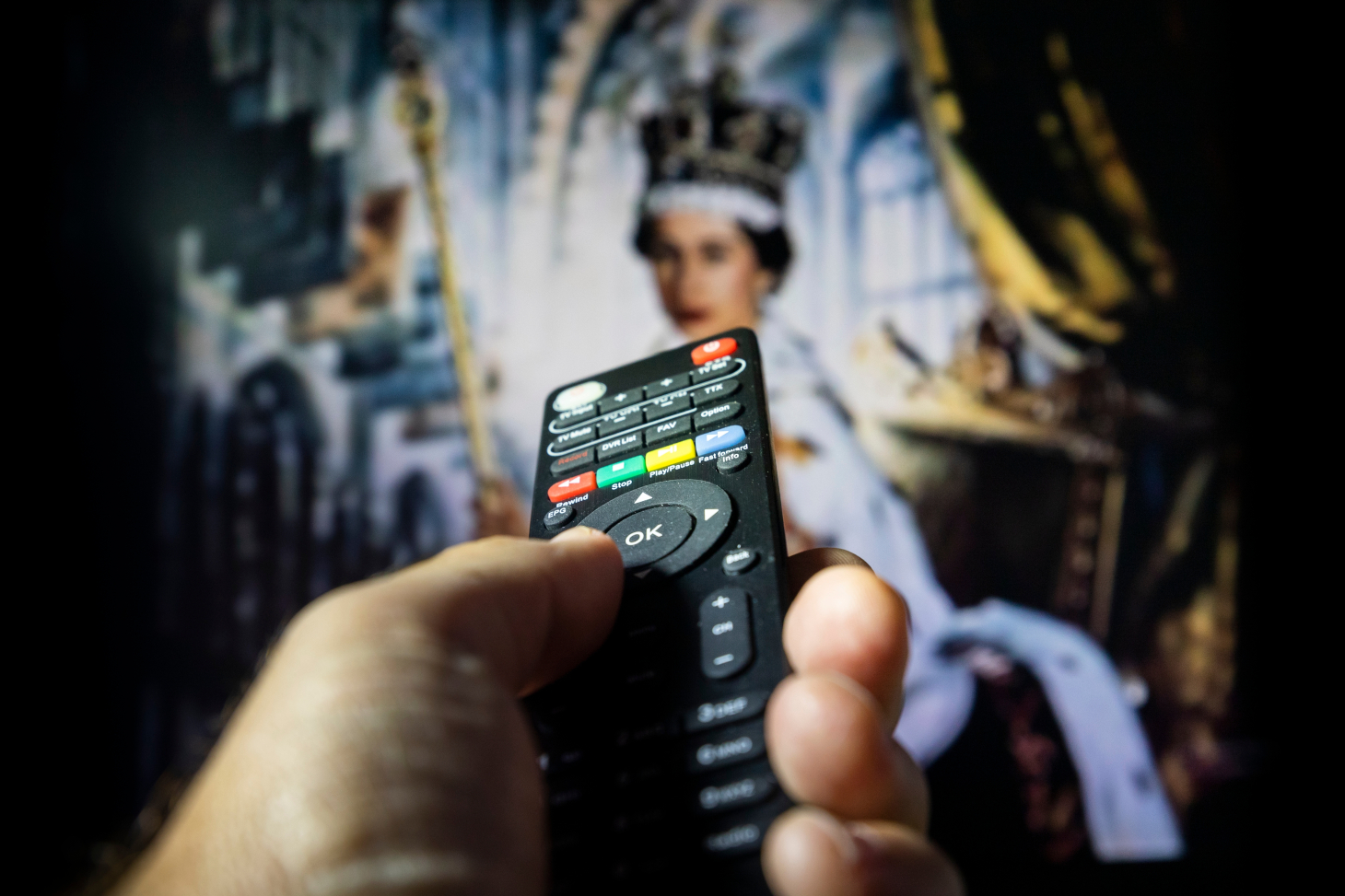
A compilation of colorized images from the 1953 coronation, created on YouTube and featuring an experimental use of 3D technology for the occasion, showcases all the elements of a sophisticated ritual.
Let’s quickly move on from the arrival of the royal carriage (an 8-kilometer route, microphones scattered along the way, 750 commentators providing descriptions in 39 languages, 29,000 military personnel in the parade, and another 16,000 clearing the way).
When the queen arrives at the abbey’s grand gate, where an archbishop draped in his cope and crowned with his miter awaits her, choirs strike up majestic hymns. The queen’s gown, lined with Canadian ermine and featuring a 5-meter-long train, is made of white silk embroidered with floral emblems. The queen pauses in silent reflection before taking her seat on a ceremonial chair, while the bishops, in procession, bring forward the Bible, the paten, and the chalice. Facing successively toward the four cardinal directions, high-ranking dignitaries ask the public to pay their respects to the queen, who returns the gesture with a curtsy.
Then, in a lengthy oath, Elizabeth II swears to govern each of the countries under her care according to their respective laws and customs. As she approaches the altar, she declares, “The things I have already promised, I will do and uphold. May God help me in this,” before kissing the Bible. A representative of the Church of Scotland takes the Bible and presents it to the Queen: “Our glorious Queen: so that Your Majesty may always keep in mind the law and the Gospel of God as the rule for all life and for the government of Christian princes, we present to you this book, the most precious thing this world has to offer. Here is Wisdom. This is the Royal Law. These are the living Oracles of God.”
This entire ritual has been very well theorized by the philosopher Ernst Kantorowicz, in what he referred to—in a non-inclusive manner—as “the king’s two bodies.” While the first body is human, made up of doubts, suffering, and passion, the ceremony, with its elaborate staging, celebrates the other body—that of the future head of the Commonwealth. The new sovereign is endowed with divine attributes by virtue of the power she will exercise and pass on. The choreography is orchestrated to demonstrate that she embodies the perpetual form of humanity, that she is the timeless guarantor of individuals’ consent to authority.
[More than 80,000 readers rely on The Conversation’s newsletter to better understand the world’s major issues. Subscribe today]
The very long reign that followed offers a glimpse into how this divine body coexists with the queen’s first body, made of flesh and blood. Between 1953 and 2022, her personality and daily life were constantly discussed, and her public appearances were extensively covered in the media. However, this colorized spectacle is akin to silent film: only her appearance and gestures offer any clue as to her style of governance. Over the course of her public appearances, an aesthetic of power takes shape, simultaneously evoking notions of emptiness, piety, conformity, and ethics.
The void is linguistic. A lexical analysis of the queen’s speech is of no interest, since her public addresses are very rare and lack substantive content. There is no trace of what she thinks or of what she wishes to reveal about her thoughts. The mystery of this invisibility is not limited to the public. Even those closest to her are kept at a distance from any confidences.
Her piety is liturgical. The Queen reads the Bible regularly. She attends Mass every Sunday. She consistently asserts her title as Defender of the Faith and “Supreme Governor of the Church of England.” She carefully selects bishops. She systematically opens synods. She meets regularly with popes (she would come to know five of them). The only known exception to her public silence concerns precisely a religious event—Christmas—when her lengthy addresses to the British people are written in her own hand. Finally, it is worth noting that early in her reign, she firmly opposed her sister Margaret—despite her pleas—when Margaret wished to marry a divorced man (even though he had been a heroic fighter pilot in the Royal Air Force during World War II…).
Neutrality is a political stance. For seventy years, the Queen met weekly with the Prime Minister of the Government. This wordless dialogue with fifteen successive prime ministers illustrates how the woman who had said “yes” to Churchill’s June 4, 1940, appeal—urging the British never to surrender to the Nazi regime—accepted the end of any personal opinion on public affairs: Elizabeth Alexandra Mary Mountbatten stepped aside to make way for Her Majesty Elizabeth.
We will never know how she might have used these weekly meetings to express any concerns she may have had about her country’s bellicose initiatives. This total depoliticization is characteristic of the House of Windsor. And even if the two Elizabeths are at odds internally, it is the Crown that officially wins the battle, with a message that is invariably marked by constitutional conformity. The Queen intervenes in British politics only to express her commitment to public service and to the authority of the existing system.
Ethics, finally, could be described as morality. The Queen has always made it a point, following in her father’s footsteps, to embody family values. In doing so, she upholds a conservative and traditionalist ethic. But the message of this morality is constantly undermined by the upheavals and tragedies linked to her children’s life stories. Celebrity magazines seem to play a decisive role here, disproportionately amplifying the royal family’s scandals and conflicts. The accidental death of Princess Diana in 1997 illustrates a paradoxical situation in this regard: we see a queen who is powerless and devastated in the face of a tragedy that triggers an unprecedented global media frenzy.
One constant unites the four expressions of this silent power: its presentation appears, in every respect, to be tailored for television. The iconic series that premiered in 2016, *The Crown*, which began airing in 2016, provides insights into this small-screen aesthetic. The outdated public image of royalty takes on a new dimension when the camera captures the Queen’s everyday life. While it is certainly the screenwriters’ perspective that narrates her daily routine, the series also reveals how television imagery reflects the Queen’s body language. She is known to be submissive and conservative, yet we also come to believe in the depth of her vision, her character, her resilience, and her convictions. Amid a life of media excess and public silence, the sovereign endures and adapts. Philosopher Sandra Laugier has effectively demonstrated how the small screen itself becomes part of the royal backdrop in the series. The Queen watches television, just like her subjects, in a reversal of perspective that makes her seem vulnerable and very close to the people. From episode to episode, *The Crown* portrays a head of the Commonwealth who is also the sovereign of ordinary citizens.
What do the divine coronation and seventy years of colorized aesthetics tell us about the taste for power at the turn of the20th century? In a way, Elizabeth II appears as a Clastrian heroine of power without power. As a reminder, Pierre Clastres observed in his Chronicle of the Guakakis Indians how the chief represented the tribe solely through reassuring speeches and emphatic gestures.
The Queen embodied a community of millions through her behavior and gestures, yet she never had access to—nor did she ever resort to—coercive power. The global wave of emotion currently being expressed in response to her passing underscores this ambiguous form of leadership, which the anthropologist had so aptly theorized in *Society Against the State*. Whereas, from Churchill to Gandhi, Martin Luther King, and Nelson Mandela, the fervor surrounding the funerals of statesmen was rooted in the myth of the savior, the global sovereign, by contrast, embodies a symbolism of political dominance that operates without control over or possession of power.
In this regard, the success of Queen Elizabeth II’s television image may be a harbinger of new forms of political embodiment that the Internet amplifies to an extraordinary degree. On a similar note, one thinks of the global media coverage of the Ukrainian president’s pleas on his Facebook account. The fusion of the leader’s two personas—a powerless military commander and an outraged citizen—creates an unprecedented symbolic mix.
To understand this phenomenon, researchers from various fields within the social sciences are exploring the paradigm of an “ affective turn .” In political science, this “emotional turn” marks a departure from the Enlightenment and the triumph of political reason. It compels political scientists to take seriously a more sensory understanding of democracy, in which individuals’ immediate feelings—without mediation or intermediaries—take precedence and shape perceptions. This “navel-gazing citizenship,” rooted in emotional experiences, does indeed have implications for the way politics is conducted: it encourages elected officials to play on people’s fears, anger, and desires.
The pace of change is dizzying. Politics thus becomes part of a vast fiction in the second sense a novel by Lewis Carroll. By stepping through the looking glass, the pawn-turned-ruler can ignore reality, for the chessboard now resembles a universe of nonsense built primarily on the emotions and imaginings conveyed through social media.