

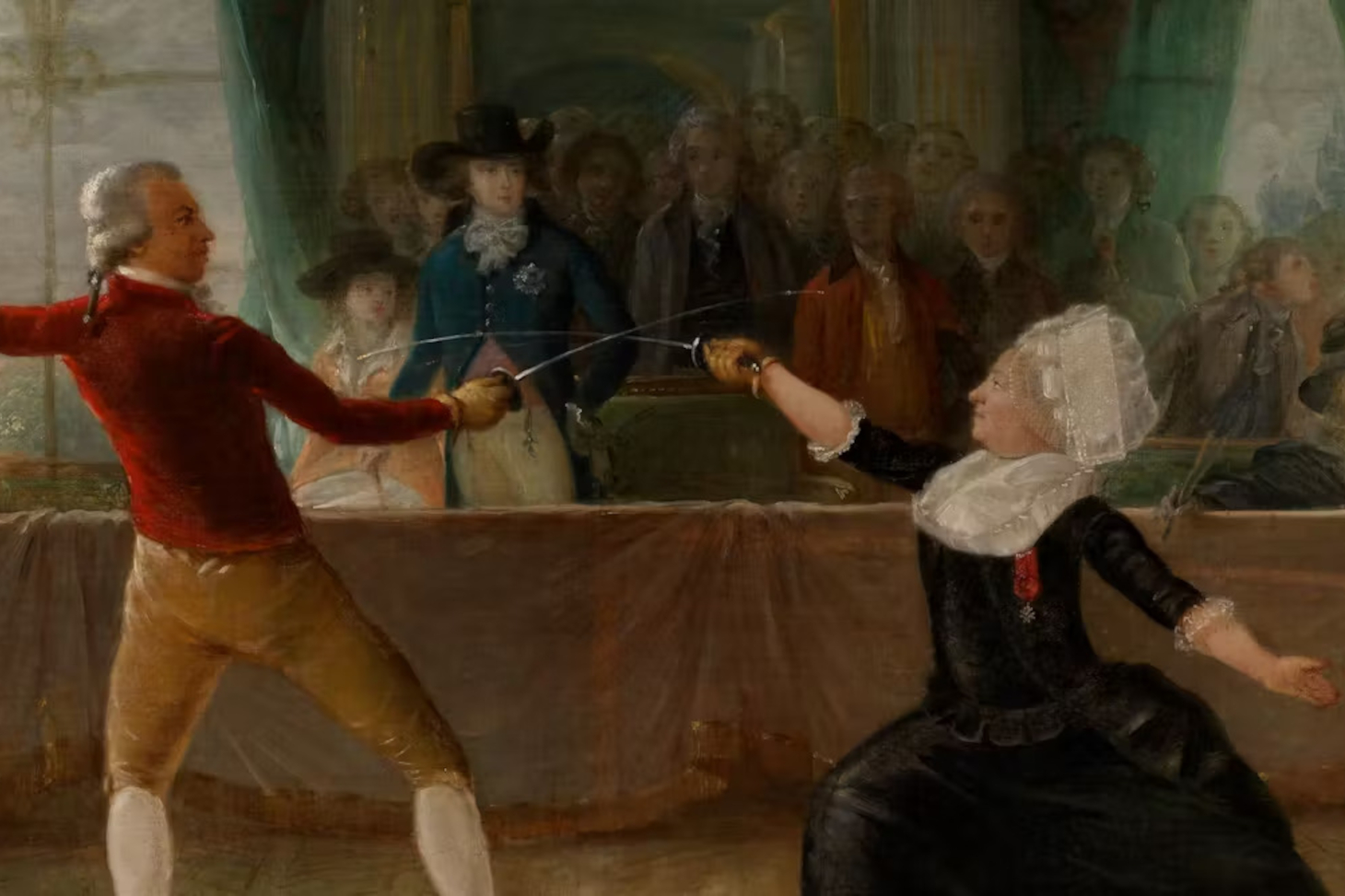
Foil, rapier, saber, sword, and blades of all kinds. One of the first display cases in the exhibition “Duels: The Art of Combat” will captivate those who appreciate the world of Alexandre Dumas, with gleaming weapons and the clanging of metal. But what makes the exhibition truly fascinating lies elsewhere. For this museum journey into the realm of martial virility—where honor is always placed above reason—focuses primarily on the fencers themselves, flesh and blood, rather than on their blades.
As I entered the exhibition, I expected a guided journey through the classical trappings of the duel—this “French passion” that has been practiced for nearly 15 centuries, with its customs and costumes, the crack of its percussion pistols on the meadow at dawn, and its bloody wounds.
But the duel goes beyond this familiar imagery. Discovering so many protagonists, places, and eras inflamed by the spirit of the duel is dizzying. We behold a crowd of plumed nobles, quarrelsome Scaramouches, touchy officers, tattooed thugs, nitpicking journalists, sensitive aristocrats, and fearless writers (Hugo, Lamartine, Proust, and Pushkin, alas). Not to mention the legions of anonymous figures seeking to make a name for themselves, precisely in the name of that highly malleable concept of justice known as a sense of honor.
Among the ranks of duelists, it’s also surprising to find so many prominent political figures who have pulled the trigger or crossed swords: Proudhon, Clémenceau, Gambetta, Jaurès, and, closer to our own time, Deferre…
Some bear the scar as a visible testament to indelible bravery or an anachronistic sensitivity. Others have kept the evidence of a fateful ordeal, such as the7thPresident of the United States, Andrew Jackson, who for forty years carried beneath his skin the bullet he received during a duel, lodged near his heart.
The field is also crowded with old men longing to die with weapons in their hands, or proud geniuses in the prime of life (such as the mathematician Evariste Gallois).
There were many men, but there was no shortage of women either— some of whom wielded swords (the fabulous Julie d’Aubigny, known as “la Maupin”), but more often than not, they were caught up in romantic rivalries; we’ll come back to that later.
[There are already more than 120,000 subscribers to The Conversation’s newsletters. What about you? Subscribe today to gain a better understanding of the world’s major issues.]
The physical scope of the ceremony also offers a fascinating testament to the ubiquity of duels of honor. Whether on a racetrack or an open bridge, such as a path in the Bois de Boulogne, a private mansion (to evade the police), or even above Paris, where, in 1808, an aerial duel resulted in the tragic death of one combatant whose opponent had pierced his hot-air balloon with a blunderbuss shot.
These contests are also timeless, embedded in foundational texts: biblical and Quranic accounts of David and Goliath, Homeric tales of Hector and Achilles, the legendary battles of the Horatii and Curiatii in Roman times, and judicial trials by ordeal in the Middle Ages…
Navigating the wide variety of forms of ceremonial violence—which were already present in pre-state societies—and grasping their principles and motivations is a daunting task. Is it possible to identify underlying logics that shed light on the ever-changing manifestations of such violent ritualizations?
The psychosocial perspective offers a framework that requires us to set aside the individualizing fascination with agonistic face-to-face interactions and instead seek to understand them within their social contexts and issues. To do this, I followed a lead: that of blood.
Blood is the scarlet hallmark of dueling scenes. While some end “at first blood,” many others end in tragedy. According to Jean-Claude Chesnais, a historian of violence, between 1826 and 1834, more than a third of duels were fatal. Today, when blood is spilled and a body lies on the ground, analysis of the “crime scene” leads forensic scientists to collect fluid samples: what was flowing through the protagonists’ veins at the time of the incident? Does hemoglobin hold clues to deciphering the apparent irrationality of a fatal quarrel?
Let’s rule out alcohol right from the start. Although it is probably the most aggressive liquid ever invented, it remains the most common substance found in the bloodstreams of both perpetrators and victims of homicides following an altercation.
In reality, its use is fundamentally incompatible with the stakes and the very meaning of a duel. For a duel is not a brawl. It requires both emotional self-control and physical dexterity. Moreover, it implies a temporal gap between the offense and its resolution by arms. Yet what intoxication fosters is the exact opposite of that: imprecision, impulsiveness, and a focus on the here and now. A drunken duel would be nothing more than a drunken suicide.
Sending a challenge, appointing a witness, choosing the weapons, setting a place and date: nothing in a duel is improvised. Violence in a duel is planned and governed by a martial ritual—the antithesis of a spontaneous brawl. There are certainly “duels” involving alcohol, but this is a misnomer. These juvenile drinking contests, which are essentially drinking games, certainly serve to showcase the virile prowess of the one who “can hold his liquor,” but they do not serve to restore honor, much less to resolve a dispute.
To follow the trail of blood is to search for other answers in that crimson fluid. Some might be tempted, taking a reductionist approach, to look for the hormone that is, by definition, masculine (although women are not without it): testosterone. It should be noted, then, that its production is highest at dawn and, above all, that it skyrockets in certain conflict situations.
One might add that she seems cut out for combat, as she builds muscle mass and is perfectly at home in the world of duels—a world saturated with machismo—whether the combat is waged with a rapier, a mace, a rondache, a whip, or bare fists or fists adorned with sharp rings.
For this typically male sex hormone seems to reflect the quintessential competitive confrontation. More than 60 studies have been conducted on its role during competition, and they show that a victory triggers a spike in secretion. But to claim to be discussing duels by citing a single hormone seems far too simplistic.
If one of the keys to a duel is dominance, the other is romantic conquest. In a book on honor, a count declared that “if honorable women resolutely and as a matter of principle turned their backs on all duelists, 9 out of 10 duels would no longer take place.” Today’s evolutionary psychology would not dispute this analysis, which shows that many confrontations are undertaken in the hope of being noticed by a woman—and sometimes on her behalf.
Gabriel Tarde, one of the founders of social psychology, wrote much the same thing in 1892: “It is largely through women that dueling persists […]. Men fight for the audience, but mainly for the female audience.”
The ideology of masculinity thus turns women into objects of conquest. In his seminal work on duels, historian François Billacoix noted that between 1560 and 1679, women were cited as the primary cause of duels. Tarde himself, author of *The Laws of Imitation*, also emphasized the power of mimetic logic, which kept declining traditions alive and led individuals seeking respectability to replicate aristocratic customs and noble ideals.
At the end of the exhibition, visitors can pick up the controller for *Street Fighter*, a 1980s fighting video game. The duel has become accessible to everyone and can now be played safely in a living room or bedroom.
Street Fighter is one of the most popular virtual dueling arenas of its kind, with over sixty million copies sold worldwide. You can play it at dawn, but also at any time of day, without risking the crime of lèse-majesté: the royal authorities banned duels and sometimes punished them. Let us recall the Count of Montmorency, a repeat offender in dueling who was sentenced to death for this passion on June 21, 1627.
Of course, virtual violence remains a subject of controversy : The expert report submitted last April to Emmanuel Macron on children and screen time concluded that “digital experiences […] could contribute to a form of desensitization that calls for vigilance.” These video game practices, which are more harmless, no matter how martial they may be, at the end of the broadcast, do not affect anyone.