

Drawing on vampire and zombie myths—that is, fears of contagion and monstrosity—the body horror genre embeds horror within the body: it is the body itself that, driven by desire and experimentation, is transformed into a monstrous form. Thus, *Shivers*, *Rabid*, *The Brood*, and *Scanners*—released between 1975 and 1981—depict the monstrous forms resulting from these experiments, which are at once medical, technical, psychiatric, and religious.
The films that followed continued in this vein. In 1983, Cronenberg directed *Videodrome*, which foreshadowed the rise of a society controlled by television; this was later echoed in *eXistenZ* (1999), named after a video game to which people plug their bodies.
Meanwhile, Cronenberg directed genre masterpieces such as *The Fly* and *Dead Ringers*, and adapted William S. Burroughs’ *Naked Lunch* and J.G. Ballard’s *Crash *. Beginning in the 2000s, moving away from the body horror genre, Cronenberg began delivering more “psychological” films for which he did not write the screenplays: he explored neuroses in *Spider* and *A Dangerous Method*, depicted criminal violence in his two biggest commercial successes, *A History of Violence* and *Eastern Promises*, and explored the anxieties of the ultra-rich in *Cosmopolis* and *Maps to the Stars*.
While the importance of the body in Cronenberg’s work is often highlighted, it is not merely because the body serves as the site of horror in his films. In Cronenberg’s cinema, the body is central because it embodies a power of transformation. Not only is the subject a body, but that body bears the marks, symptoms, and stigmas of its becoming—including its monstrous aspects.
Thus, an individual’s story is inscribed on his body: in *Eastern Promises*, Nikolai Luzhin’s (Viggo Mortensen) crimes are tattooed on his skin, anchoring the story of his life there. This somatization or embodiment of one’s becoming was first explored in *The Brood*, where Dr. Hal Raglan (Oliver Reed) develops the technique of “psychoplasmy,” which involves externalizing the patient’s psychoanalytic wounds onto the surface of the body. Thus, the body is not confined within a membrane; the division between inside and outside is constantly threatened, and the body demands to open up, to expose itself—or to explode, as in *Scanners*.
The body is thus always undergoing a transformation, driven by a deep impulse. Medical care is never simply aimed at restoring the body’s state of balance: it is always about transforming it so that it becomes something else. The role of the doctor in Cronenberg’s work is therefore always ambiguous: while effectively combating an ailment in the patient, the doctor nevertheless sees the need for a procedure that is often experimental and strange, one that simultaneously expresses a desire to open up the body, to penetrate it, and to make it perform in order to explore all its possibilities, as in the unsettling short film *The Nest* (2013).
Such a scopic drive, which underlies the desire to open up the body, results in the creation of a monstrous figure in the sense of what is shown—torn from its seclusion and exposed to the light of day. In this sense, it is not because the monstrous is dangerous that it horrifies us, but because it reveals to us what was kept secret within us.
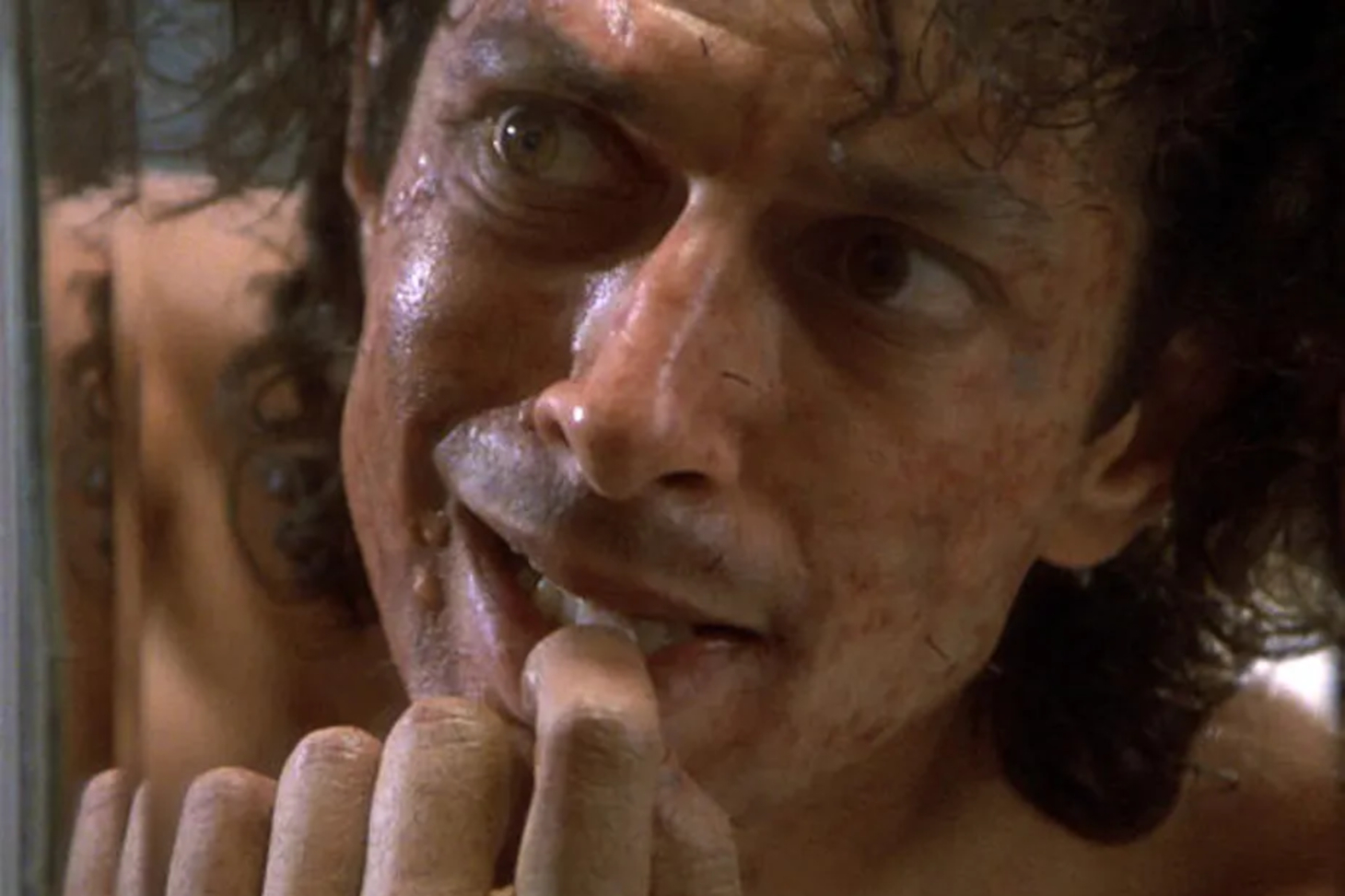
The metamorphosis of the body does not end with the acquisition of a new, definitive form: it is endless, in the sense that it has no predetermined end or goal. A constant theme in Cronenberg’s films is that metamorphosis leads to the crossing of all boundaries and the shattering of all forms: it propels us toward the fusion of bodies. The film *The Fly* masterfully illustrates this drive toward fusion: when Seth Brundle (Jeff Goldblum) activates his teleportation machine, his energy is amplified tenfold, and he believes he has been purified.
Upon discovering that a fly had gotten into the machine and that he was gradually merging with it, he paradoxically saw this as confirmation of his purification. He then sought to force his pregnant partner, Veronica (Geena Davis), to merge with him to form “the ultimate family.” Ultimately, however, it was with the machine itself that he would merge. The drive toward fusion knows no bounds and seeks to abolish all boundaries, including the one that separates the organic from the mechanical.
These frenzied impulses that punctuate Cronenberg’s films are orchestrated around rituals that belong as much to the erotic as to the religious. In *The Fly*, Brundle’s desire is first and foremost sexual, rather than one of fusion. But it goes further: to merge is to “be destroyed and recreated,” to plunge into the “plasma” to be purified there. Baptism, but also a new Adam and the transfiguration of the body into a body of glory: the same motif recurs in the grandiose finale of *Videodrome*, where a fanatic sacrifices himself while crying out for “new flesh” (new flesh). Here, a certain Christian theology is translated into worldly terms and parodied through the motif of the glorification of the flesh, its transformation, and its disintegration with no prospect of salvation. Here we catch a glimpse of Cronenberg’s profound atheism (sometimes hastily labeled, even by himself, as “existentialism”): if there is neither God nor salvation, then all that remains is the desire for the body and its transfiguration as a parody of salvation. This sheds light on the epigraph from the film *The Naked Lunch*: “Nothing is true; everything is permitted.”
Fusion abolishes the distance that separates me from others; but others are not me and offer resistance. This is where violence begins—a theme that runs through Cronenberg’s entire body of work. In Cronenberg’s work, there are no relationships between subjects, nor even power dynamics; there are only forces of desire that collide. These forces do not necessarily coincide with “individuals”: in *The Brood*, Nola’s (Samantha Eggar) psychoanalytic wounds give rise to murderous creatures that carry out the desire that has taken hold of Nola; the twin gynecologists in *Dead Ringers* are also driven by the same desire—a desire for sameness, to be identical, and to be one. These desires abolish individuality. Violence permeates everything and reflects the impossibility of any social bond.
The masterful editing of *A History of Violence* illustrates this well: one little girl is killed, another is comforted by her family, and yet violence is still there, everywhere—even in a seemingly innocent family scene. It is this very family—whose members are close to one another yet unable to communicate—that will unleash their violence on one another, culminating in the brutality of marital rape.
This abolition of all social bonds culminates in the impossibility of politics. Every organization becomes an organism: there are no laws, no subjects endowed with free will—only desires that connect to one another, hypnotized by a guru through a television screen (Videodrome) or bound by the secrecy of a criminal organization (Eastern Promises). There is no place for the law: everything is permitted.
In this regard, the concept of control developed by Burroughs and as interpreted by Deleuze is embodied in Cronenberg's films: in Videodrome and eXistenZ, bodies enter a technical and organic system that connects to them, controls them, transforms them, and draws them into a fusion. As for the disciplinary societies that he so admirably described A Clockwork Orange In 1971, holding companies took over as described by Videodrome in 1983. In just over a decade, the change has been dramatic.
This article is republished from The Conversation under a Creative Commons license. Readthe original article.