

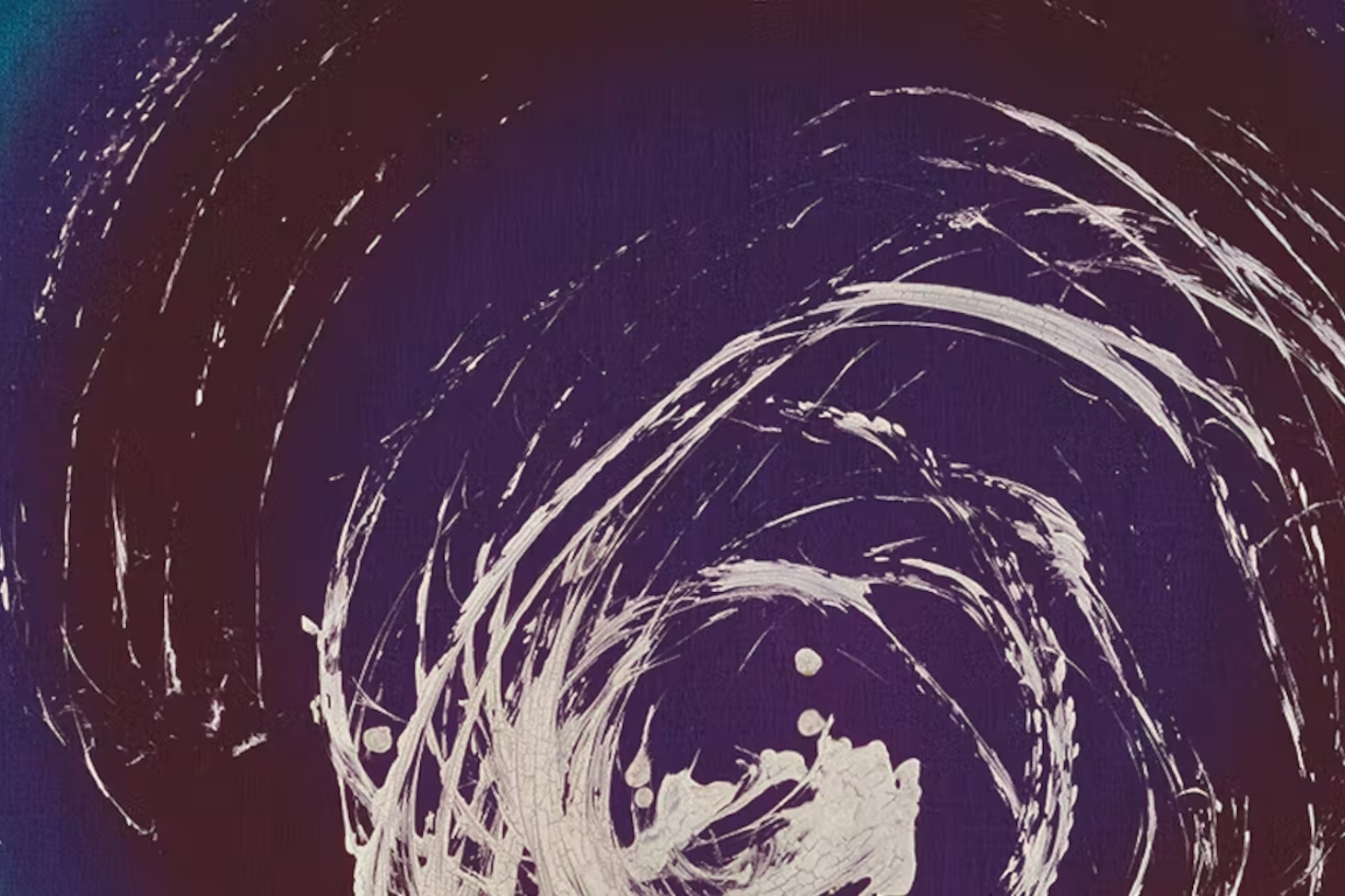
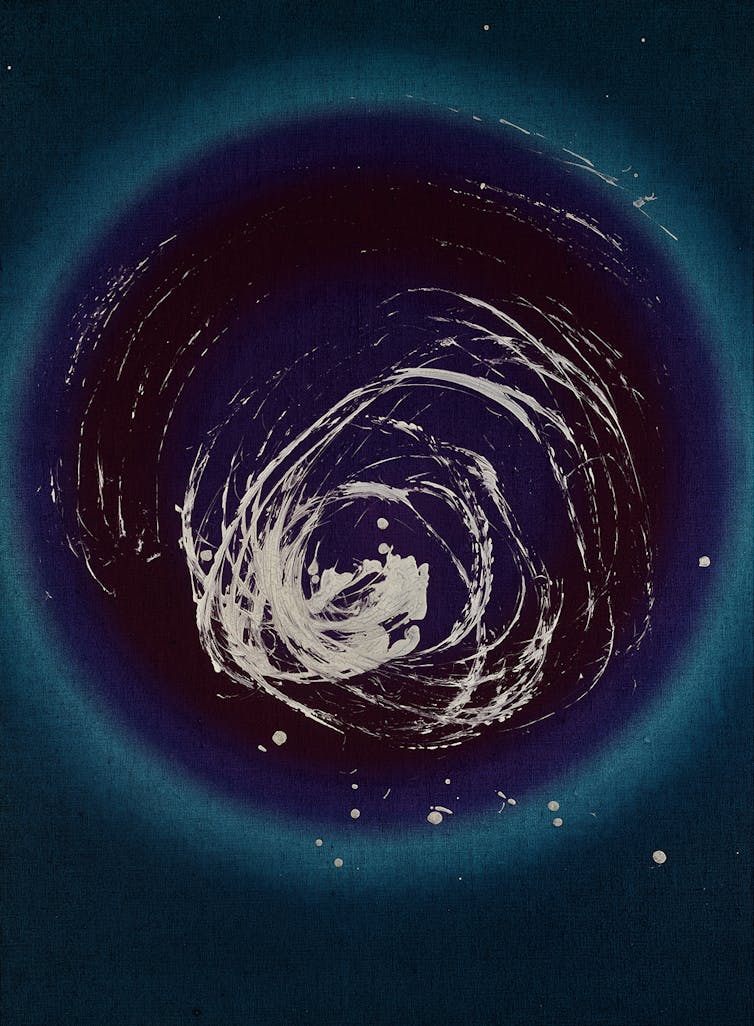
First, I look at this fascinating blue ring. It delineates a sphere that contains movement. Certain artists, such as Fabienne Verdier, amaze me deeply. It is, first and foremost, a physicist’s amazement. How does she—alone on her artistic journey—recognize the importance of this symmetry in relation to movement within this empty space? I don’t know. As a young researcher—that is, through what I learned from colleagues during discussions that left a lasting impression on me—I discovered the essential role of symmetries in our description of reality, its transformations, and its movements.
Physics has studied symmetries to turn them into an incredibly powerful tool for exploration. The gravitational interaction has the property of being exactly the same in all directions of space. Planets and stars are spherical. Symmetries are at work everywhere—from the growth of crystals with their astonishing facets to the shapes of planets, and also, in more abstract forms, in relativity and particle physics. The study of spontaneous changes in symmetry—known as “symmetry breaking”—has been central to many20th-century discoveries, foremost among them the Higgs boson.
As I look at this table, a scientific train of thought takes shape in my mind. The state of an electron is described by quantum numbers. This “quantum leap” in our understanding dates back to Niels Bohr, winner of the 1922 Nobel Prize. This leap, which occurred just a little over a century ago, paved the way for a coherent description of a stable atom!
Depending on whether an electron is confined to a region of space by the attractive force of an atomic nucleus or by a cubic-shaped semiconductor quantum nanobox (they really do exist!), the quantum numbers characterizing the electronic state are not the same. The structure of the electronic states depends on the symmetry of the problem. And a shoebox and a soccer ball do not have the same symmetry.
To arrive at this description of an electron’s quantum state, we had to abandon the very notion of a trajectory in space. From time to time, this question is posed as a game: What are the 10 most important experiments in physics?
We find ourselves trying to figure out how to move beyond questions like, “So does an electron have to pass through two widely separated holes at the same time?” For physicists grappling with this, the lecture by physicist Philippe Grangier on this type of experiment—conducted “for real” with single photons—is a real highlight.
[More than 80,000 readers rely on The Conversation’s newsletter to better understand the world’s major issues. Subscribe today]
Philippe Grangier began his career as one of the physicists who participated in the quantum mechanics experiments that earned Alain Aspect the Nobel Prize this year. The manipulation of a single quantum particle—in this case, a photon—described here is a continuation of that work.
The so-called Young’s slit experiment, conducted particle by particle, raises these kinds of questions. It almost always appears in this top 10 list. Whether conducted with electrons, neutrons, photons, or any other quantum object, the experimental result is indisputable: the radical abandonment of the very notion of a trajectory in the classical sense—a concept that is nevertheless so familiar. Through the fundamental concepts associated with it—kinetic energy and momentum, coupled with conservation laws rooted in the fundamental symmetries of spacetime—motion itself remains. But without a trajectory. This rejection can come as a terrible shock, even to a physics student. Is it a shock for Fabienne Verdier? Looking at her work, I don’t think so, and that astounds me.
I look at Fabienne Verdier’s painting: while the blue halo reveals the importance of symmetry, the light traces in the center suggest movement within. The movement of… well, the movement of nothing, really.
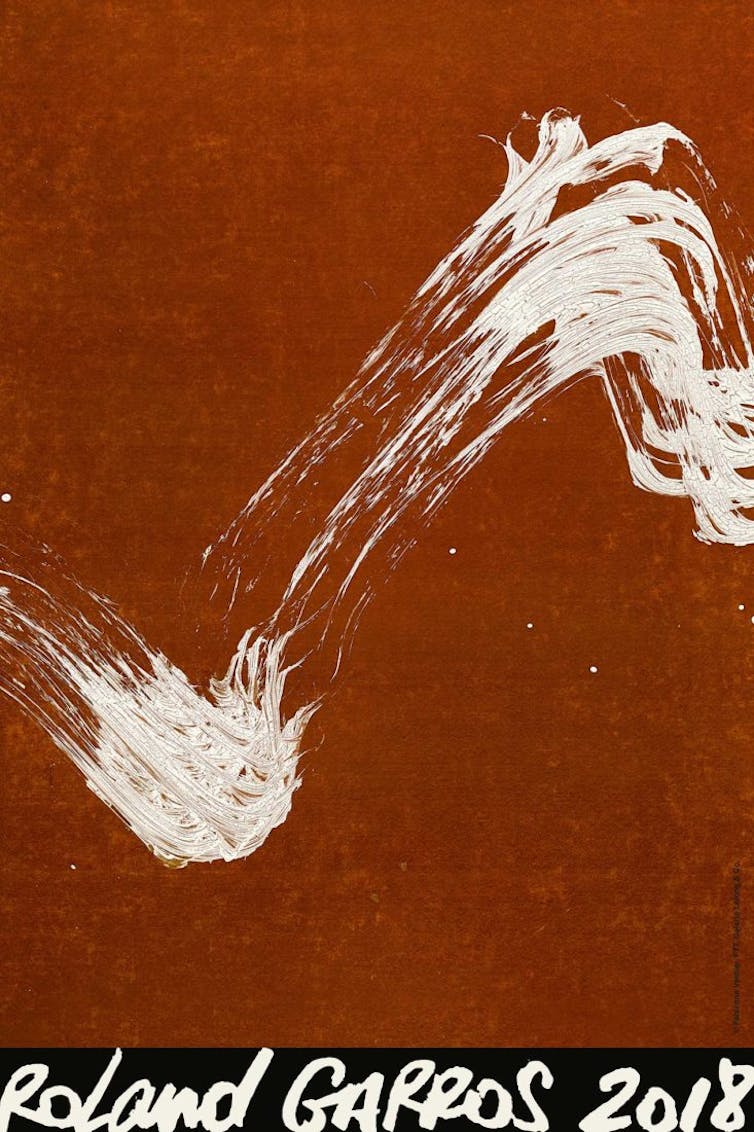
I was struck by Fabienne Verdier’s poster for the 2018 Roland Garros tennis tournament. Against a “clay court”-colored background, you can obviously see a ball with a trail that highlights its trajectory and speed. Except that there is no ball in this poster. You can choose to imagine it, but it isn’t depicted. In tennis, the ball, the rackets, the players, and even the audience are all in motion. Who can say which of these movements Fabienne Verdier is bringing to life for us here? All of them, perhaps?
Physics and its formalism are so powerful, and its precision so formidable, that when I teach, I forget. I suffer from the amnesia of one who is shaped by hard-won knowledge. Newton’s abacus is a star of classical mechanics.
People also buy it online just for fun. It’s a key experiment for exploring the conservation of energy and momentum with students. First and foremost, before this display of force, Fabienne Verdier reminds me to simply watch: one marble comes to an abrupt stop upon impact, and another shoots off with exactly the same motion. The motion has been transferred from the first ball to the second. Neither ball has changed. Only the motion has been transferred. With this painting, with the Roland-Garros poster—and, in fact, with many of her works—Fabienne Verdier, on her own, through her unique and singular creation and this sensitive approach, starts from perception to delve deeper into and question movement: things move around us and interact, but isn’t it first and foremost movement that manifests itself in this way through these objects? A permanent, universal, and fundamental movement.
In a video posted on Universcience, Étienne Klein discusses E=mc², and its application to experiments conducted at CERN. Two particles traveling at speeds close to the speed of light are brought into a head-on collision.
Étienne Klein describes it this way: “This collision causes a very large number of particles to be produced. When we measure the total mass of all the particles created by the collision and compare it to the mass of the incoming particles, we find it to be much greater—up to 200,000 times greater. How can we understand this? By saying that the kinetic energy of the incoming particles—the energy derived from their motion—has been converted into mass. Kinetic energy has been transformed into mass—into a new particle created during the collision. This is an extraordinary situation in which the properties of an object—in this case, a particle’s velocity—are capable of transforming into an object, that is, another particle.”
He concluded with a mischievous smile: “That should be of interest to philosophers like you.”
In any case, from a physics standpoint, there are no surprises. The description is complete and perfect. The formalism of relativity and the laws of conservation are unyielding here. They serve as a rock-solid foundation. And the painter Fabienne Verdier must appreciate this: “How can we understand it? By saying that… the energy they derive from their movement has materialized.”
I could find no better way than to adopt a scientific perspective to try to approach artist Fabienne Verdier’s experience of movement—the sensitive and contingent approach she offers us, particularly in this painting. The things around us are in motion. We see the movement of these things, but isn’t it extraordinary to consider that these things manifest a movement that exists for its own sake—temporarily belonging to these objects, yet passing from one to another, and even merging into the complexity of reality, so that in the end it never truly disappears…
Coming from different worlds, everyone is free to prepare themselves in their own way to encounter Fabienne Verdier’s work. The lexicographer and linguist Alain Rey He demonstrates this in a short book titled *Sur le motif*. He does so, of course, through words. First, using the Latin verb “movere,” he explores the etymology of “motif.” Movere simultaneously conveys movement and emotion in French. He then concludes: “There is no music without temporality—that much is obvious—whereas in painting, there is an illusion of timelessness: once a painting is finished, when we look at it, we get the impression that it is a static object. Yet it is not an object; it is a motif, it is movement. ”
The exhibition “Fabienne Verdier: The Song of the Stars” is on view at the Unterlinden Museum in Colmar through March 27, 2023.