

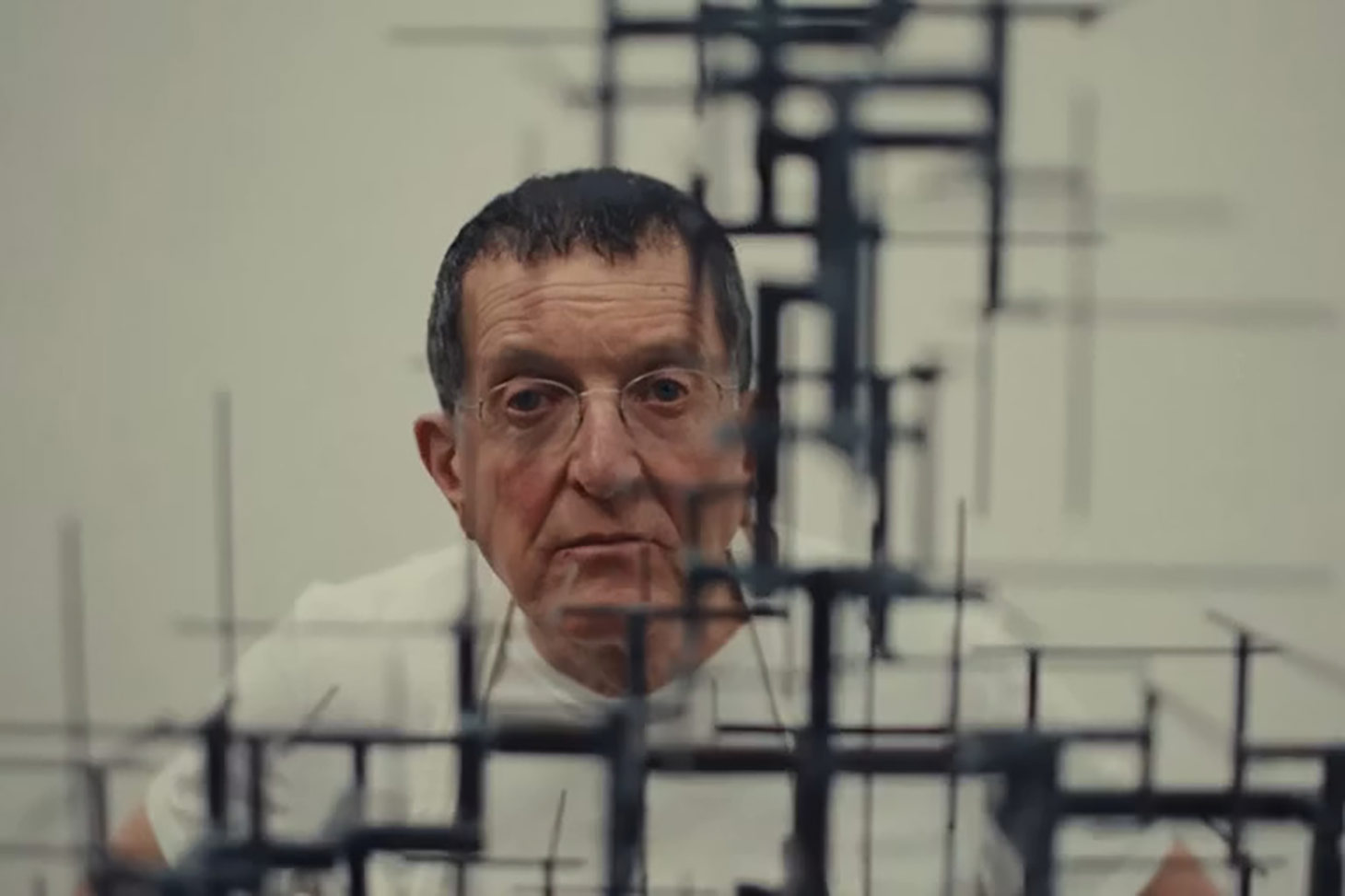
Antony Gormley studied anthropology, archaeology, and art history at Trinity College, Cambridge, and then spent three years in India. His work, which is primarily found in the United Kingdom, is part of a quest that has always been at the heart of sculpture: the human body. By deconstructing its representation, he explores—beyond the body itself—our relationship to space and to others, using a wide variety of materials: steel, iron, stone, concrete…
His sculptures immediately raise a question: Where are the limits of the human body? Does it even have limits? In his work, sculpture becomes a physical staging that explores our presence beyond our physical form. Yet sculpture usually relies on an immediate characteristic of solid matter: its surface.
Physicists, chemists, and biologists describe the surface of dense matter—solids as well as liquids—as a zero-thickness interface: the transition from solid to void occurs over an atomic distance. This surface is the same for everyone, scientists and artists alike. Sculpture, like the physics and chemistry of surfaces in particular, is built upon this characteristic of most of its materials: marble, metals, wood, wax, plaster… The works of Richard Serra and César Baldaccini explicitly explore these notions of interior (dense matter), exterior (air, which can be seen here as a void), and surface as the site of the abrupt separation between the two.
For sculpture to use these materials to reproduce the human body, these concepts of empty and solid—separated by an abrupt surface—must apply to the soft human body just as they do to dense, hard matter. And this is indeed the case—in the body’s case, this surface is the skin. Materials physicists, on the other hand, take different approaches here. There are specialists in soft condensed matter(which includes, in particular, biological matter composed of carbon) and in hard condensed matter(such as silicon, which forms the basis of digital technology and artificial intelligence, or steels).
Copying Nature's Shapes
One of the enduring challenges of sculpture has been the reproduction of forms found in nature, including human bodies, often by idealizing or interpreting them. Over the centuries, the variety of styles has been extraordinary, and the carving of marble or wood, as well as the casting of plaster, wax, or metals, has revealed an impressive—even staggering—range of techniques and mastery. This also creates a sense of a temporal shortcut: with the Charioteer of Delphi, the age of Pericles is right here before us, today.
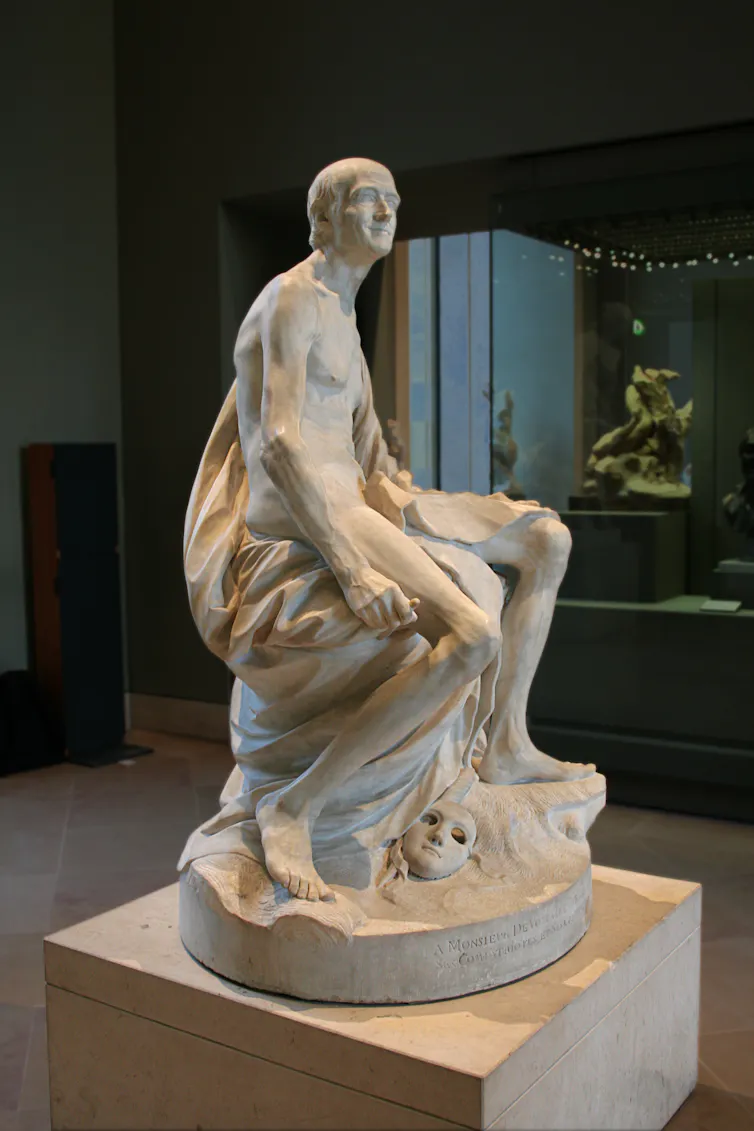
In 1770, Voltaire gave Jean-Baptiste Pigalle permission to depict him as a nearly naked old man. The realism of the portrayal is striking. This precision in rendering the surface of the body—just as we still see it today—also made it possible to capture a fascinating facial expression. With this strikingly lifelike statue, Voltaire is still with us. Seven hundred thirty-five kilograms of marble made this feat possible. This statue is obviously solid—how could it be otherwise when carved from marble? But it might just as well be hollow and look exactly the same. All that matters here is the outer surface, which defines the form in every detail. More precisely, the only details that matter are those that our eyes are capable of perceiving… but our vision is very demanding.
"Not just form, but life"
In the book *Rodin: The Centennial Edition*, art historian Catherine Lampert, former director of the renowned Whitechapel Gallery in London, quotes an anonymous source as saying: “My principle,” Rodin said, “is not merely to imitate form but to imitate life. “I seek this life in nature, but by amplifying it, by exaggerating the hollows and bumps, in order to bring out more light; then I seek a synthesis in the whole.”
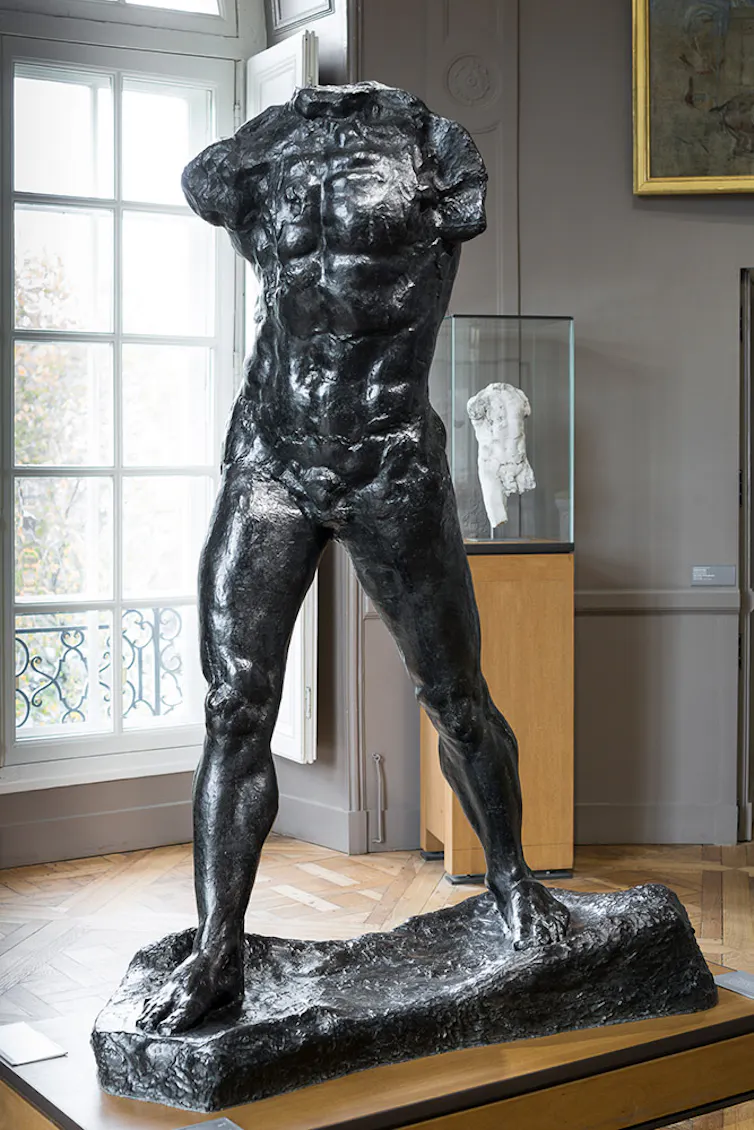
The Walking Man reveals these indentations and bumps, which serve the purpose of imitating life and its expressions. Indeed, we see, on the one hand, how life seems to emerge in this way from inert matter, and, on the other hand, how far Rodin strays here from Jean-Baptiste Pigalle’s original design. There are no holes or bumps on the statue depicting Voltaire other than those of tired skin and muscles!
With Antony Gormley, we explore the full scope of this living body
Antony Gormley exhibited at the Rodin Museum in 2023.
Paradoxically, it seems to me that the works shown in the video below bring Antony Gormley much closer to Rodin’s artistic vision, whereas his work Feeling Material XIV —like so many others—seems to me to represent a radically different vision. I see this as a testament to the richness of Antony Gormley’s work. Also in *Rodin: The Centennial Book*, Sophie Biass-Fabiani, curator at the Rodin Museum, notes in her article “Expressionism Today: Affinities and Confrontations,” regarding Antony Gormley: “Antony Gormley, while limiting himself to the human form, shifts the focus of his work toward the relationship between the body’s space and the surrounding space.”
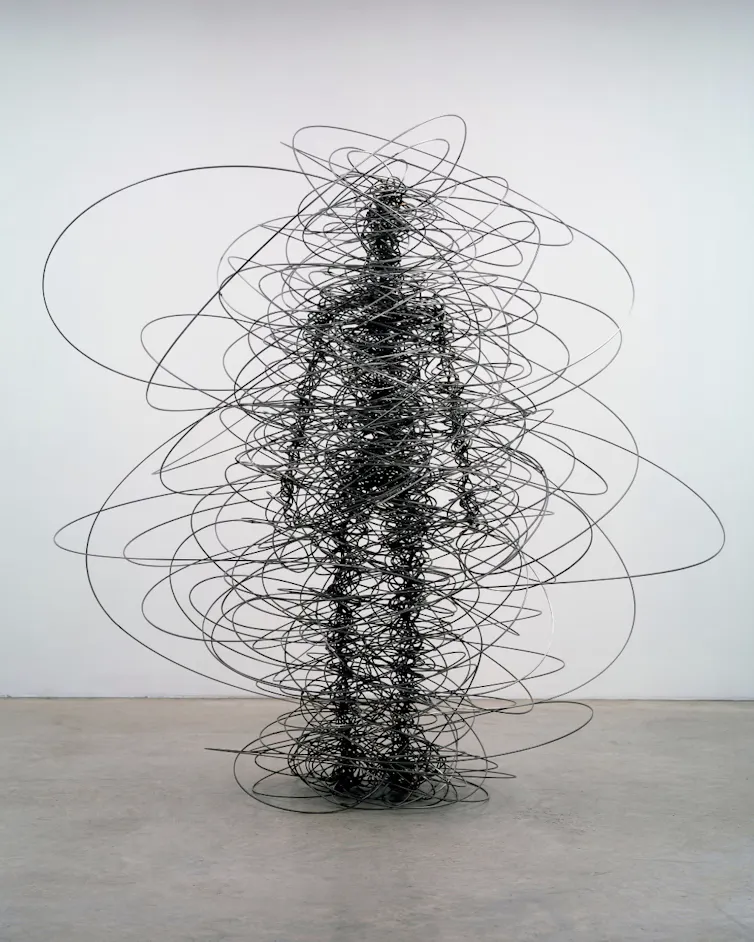
In my language as a physicist, following Jean-Baptiste Pigalle and Auguste Rodin, we move here to a third model that establishes a new form of sculpture and a different way of perceiving the object. Here, to represent it in space, the artist returns to the very nature of a living body—its presence and its extension. The work no longer presents the empty and the full, the exterior and the interior, as such obvious distinctions. On the contrary, it immediately calls them into question through the choice of materials.
It is virtually impossible to create a compact mass using the metal wire employed by the artist. To achieve a compact metal structure, one generally goes through a liquid phase, as explained on the Rodin Museum’swebsite: “There are two processes for transforming a plaster model into bronze: the lost-wax casting method and sand casting, which was used in Rodin’s time but is very rare today. In both cases, molten bronze is poured into a mold around a core, which is then removed. The resulting bronze work is hollow, which reduces its weight and cost.”
Like many of this artist’s works, the metal wires in *Feeling Material XIV* place a human figure at the center of the piece. All around and in the distance, the same wires swirl to represent a living body that cannot be confined to its physical form. This is because a living body speaks, moves, and shifts, but also breathes, sweats, and constantly emits particles of various types and sizes—water vapor, even liquids, and so on. But of course, Antony Gormley invites us to consider an infinite number of other interactions between a person and the rest of the world, beyond the scientific view of the body.
A body constantly transformed by technology—but is it still human?
Among Gormley's sculptures, these "pixel bodies" seem to ask us whether a body transformed by technology is still human.
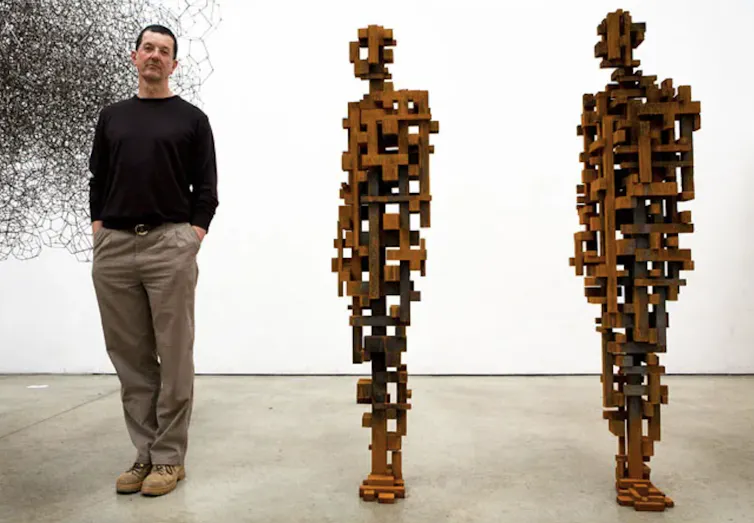
In this image, we see Antony Gormley and two of his life-size sculptures—they are the same size as the artist. They are not robots, even though one might think so at first glance. The distinction between the body’s interior and exterior is no longer so clear, as the two interpenetrate one another. And while the body is formed by a network of very dense, extremely rigid metal bars, these bars enclose a void—we can see spaces between them. A living human body, on the other hand, consists of soft organs that connect and intertwine—organs with rounded, smooth, compact, round, or elongated curves that leave no empty space.
The two statues on the right seem to systematically negate the artist’s body: straight vertical and horizontal lines, nothing but right angles. The empty spaces serve to emphasize the brutality of this structure. These very similar bodies seem to have been restructured by an omnipresent technology that favors nothing more than obvious, binary forms—the very opposite of complexity, singularity, subtlety, finesse, and even suppleness. Consider, for example, Jean-Baptiste Pigalle’s *Voltaire *.
As a physicist specializing in rigid solids, whose work touches on the physics of soft matter—that of living organisms—I feel a certain affinity here. This is how I perceive these works and this second metaphor: the depiction of a world that is becoming ever less human…