

To understand how young people contributed to building this reputation, we must take a closer look at Victorian-era Glasgow from the 1850s to 1900, a time of rapid change.
The Victorian era (1837–1901) marked a decisive turning point in Glasgow’s social and cultural history. As the industrial heart of Scotland, the city attracted an increasingly large and diverse population.
In the 1850s, Irish people from Ulster arrived in droves at the port of Glasgow, driven by the Great Famine and in search of better living conditions. Similarly, the people of the Highlands were victims of the famine, but they were also affected by land reform, which forced them to leave the countryside. Then, for economic reasons, immigrants from the Baltic states, Eastern Europe, and finally Italy gradually began to settle in the city.
Between 1851 and 1901, the population grew from 329,097 to nearly 800,000, nearly half of whom were under the age of 25. Thanks to this influx of young, unskilled, and therefore inexpensive foreign labor, Glasgow became Scotland’s largest city and, economically speaking, the second-largest city in the British Empire.
[More than 85,000 readers rely on The Conversation’s newsletters to better understand the world’s major issues. Subscribe today]
Nevertheless, the city is not prepared to accommodate such a large population so quickly, and the new arrivals are hastily crammed into cramped and unsanitary housing. In the city center, open sewers flow into the polluted waters of the River Clyde, and poverty adds to the bleak picture of factory smoke, community and religious conflicts, epidemics, alcoholism, corruption, crime, delinquency, and prostitution.
It is in the midst of this urban and social decay that, transcending everyone’s cultural differences, a unifying force driven by young people will gradually emerge: popular entertainment.
The need for entertainment is not a phenomenon unique to the second half of the 19th century. But in Victorian Glasgow, a society affected by so many socioeconomic upheavals, the development of entertainment was necessary. It helped restore social norms for people from working-class neighborhoods, who found in entertainment an outlet for their difficult daily lives.
This is especially true for adolescents, whose working hours are gradually being reduced by the enactment of laws regulating the employment of women and children in factories—the Factory Acts. Most of these teenagers were born or raised in Glasgow, and they took advantage of this newfound free time to come together, far from the burden of social rejection and discrimination that many of their poor and/or immigrant parents faced.
Among the most popular venues for young people are, first and foremost, music halls and open-stage theaters, known as “free-and-easy.” Next come dance cabarets, which serve as prime venues for meeting and socializing through music and dance. “Penny theaters,” meanwhile, offer young people the chance to see plays that are a bit more sophisticated than those performed on the streets.
Expanding significantly starting in the 1860s to meet demand, these establishments share the distinctive feature of offering very low cover charges year-round. In contrast, admission to “hybrid pubs” is free. To compensate, drink prices are higher in these pubs, whose name suggests that their back rooms have been converted to accommodate customers.
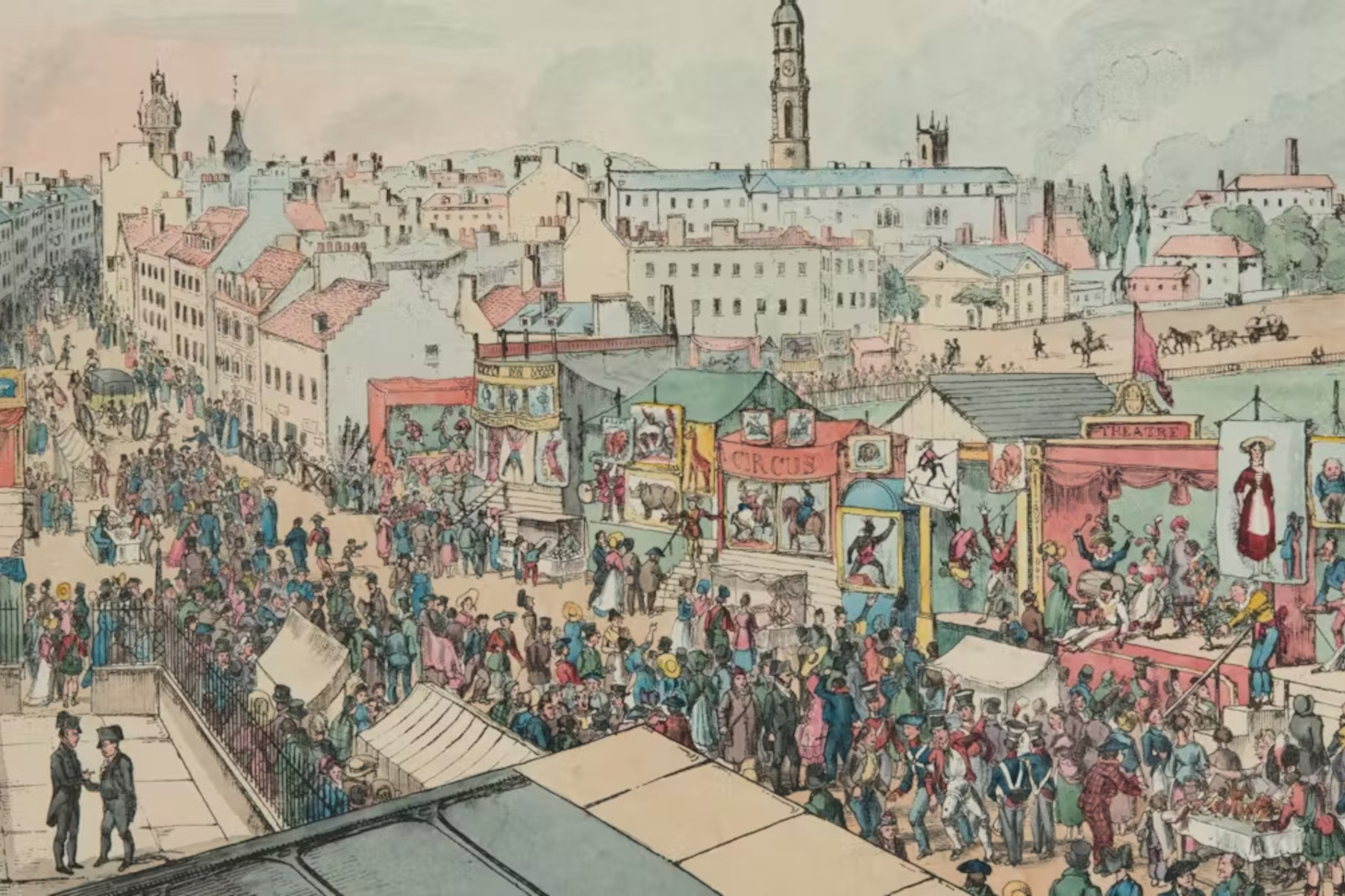
Finally, one of the annual events that most attracts young people from working-class neighborhoods is the Glasgow Fair, which is gradually taking on the character of a carnival. Numerous rides and circuses began appearing there in the 1870s: swing boats (cabs suspended from wires), Miss Lily Day’s lions, Willie Campbell “the Giant of Glasgow,” and Mr. Tche Mah “the Chinese Dwarf.” These attractions embodied subjects of curiosity, fantasy, and dreams that the youth of Glasgow’s poor neighborhoods embraced.
For adolescents, who are on the verge of adulthood, entering the public social sphere is a way to break away from the family unit and assert their individuality within society. These outings thus represent an opportunity to discover others and to discover themselves. Young men construct their masculinity through flirting, drinking alcohol, or sometimes through violence during conflicts in which they physically confront authority figures or their peers.
Conversely, young women are shaping their femininity by breaking free from the moral constraints that society imposes on women. Through dancing, drinking alcohol, or even promiscuity with the opposite sex, they defy social taboos and assert themselves as independent women. Carried along by the winds of change, the young working-class generation uses a new urban and cosmopolitan culture to assert its emancipation from the authority of a world it considers a thing of the past.
Starting in the 1860s, the wealthy classes and religious organizations—particularly Protestant ones—began to express concern over the rise of these new entertainment venues, which they viewed as places where the working-class youth engaged in debauchery. Because these young people were seen as the key to the city’s economic and social future, they sought to control the ways in which they entertained themselves.
For example, the directors of the Magdalene Institution—where young women perceived as deviant were institutionalized—rose up against Parry’s Theatre, which they considered the most dangerous establishment in downtown. The theater was subsequently closed and then purchased by John Henderson Park, who, as head of the institution, converted this “vile temple of the devil” into a place of worship for the working class.
In 1863, J.H. Park and members of the Glasgow Temperance Mission—an anti-alcoholism organization—also attempted to have the Glasgow fair banned; it was subsequently relocated to the Parkhead neighborhood. The reason given was that the shows were of a dubious nature and that the rides were run by members of the traveling community, who were deemed “unsavory,” as evidenced by an article published in the Glasgow Herald in 1869: “The fathers lead lives of idleness and dissipation, the mothers possess few maternal qualities, and their children are raised without an education and are completely ignorant of the difference between right and wrong.”
In the 1870s, the upper classes, for their part, denounced the behavior of foreign women performing on the stages of Glasgow. Their frivolous costumes and makeup were deemed vulgar and indecent. Consequently, the French cancan shows presented by the Whitebait music hall in 1875 sparked an outcry in the local press, and the city banned their performances.
Despite these efforts to control how young people spend their leisure time, the city cannot completely ban popular entertainment venues from Glasgow, as they are economically essential to the flourishing of a society that, through the development of railroads and tourism, is gradually opening up to the world. Even today, this urban and cosmopolitan culture is reflected in the facades of pubs and theaters. It comes to life during the lively concerts and festivals that the city hosts throughout the year.