

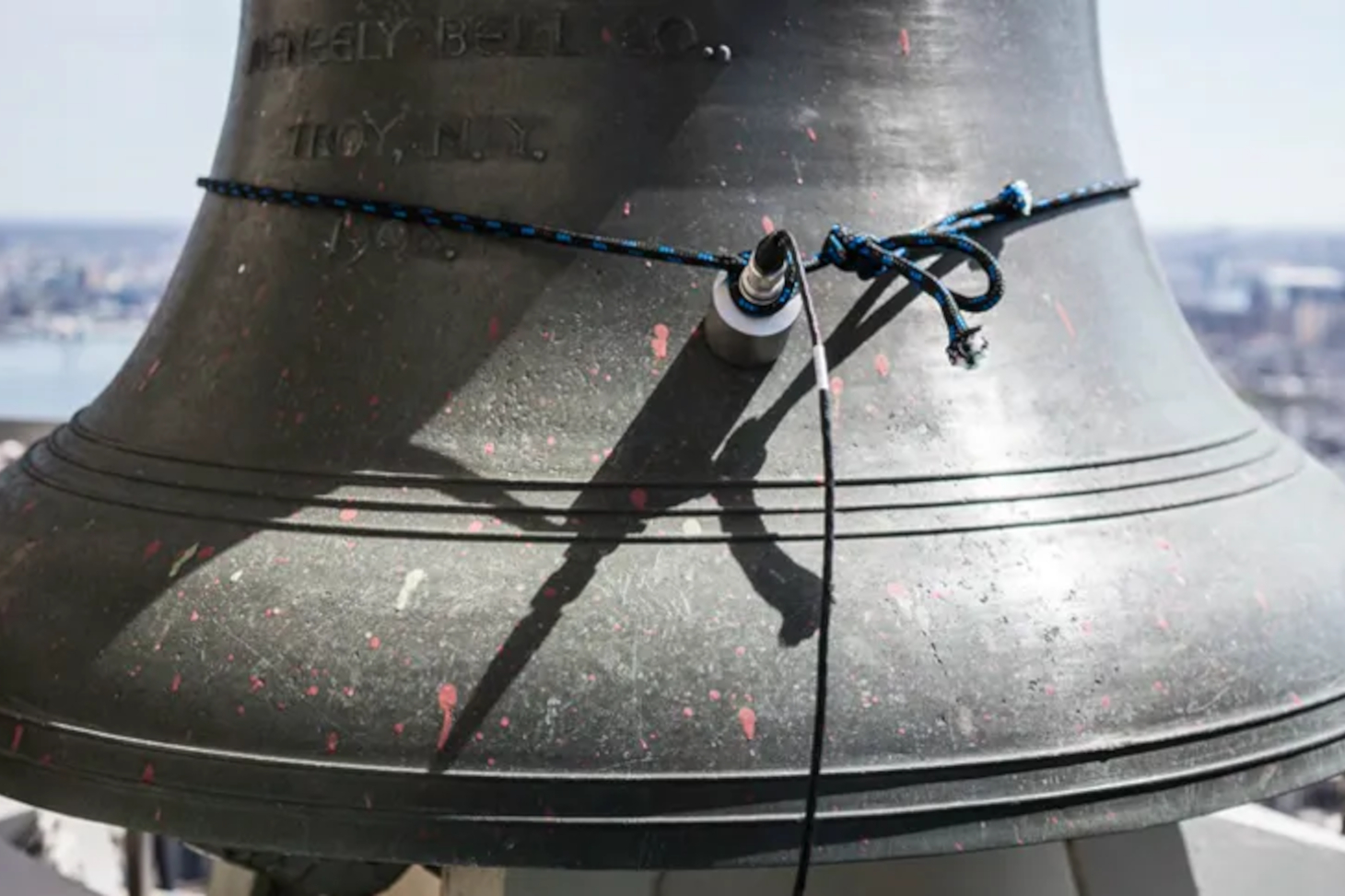
In 2016, in an article titled “Bill Fontana, the Artist Who Sculpts the Sound of the World,” I wrote—as a physicist—about how much Bill Fontana’s work as a sound sculptor interested me: “Everything vibrates around us, but most of the time we don’t perceive this vibration of the world. Yet one can spend a lifetime playing with these vibrations and making them perceptible. This is what the artist Bill Fontana has been doing for 45 years—for example, by recording the sound of the bells at the Basilica of Saint-Denis, caused solely by the sounds of the market in the square below.”
Bill Fontana has spent his life attaching accelerometers to a wide variety of monuments, bells, gongs, bridges, and other structures around the world to reveal their mechanical vibrations caused by ambient noise.
Because everything is in motion around us. While these vibrations are normally inaudible and go unnoticed, they are very much present and well known to scientists and engineers. These noises can creep into signal measurements and are therefore usually a nuisance… Micro-accelerometers sensitive to these vibrations emerged from micro/nanoelectronics at the end ofthe 20th century. They are now everywhere on Earth, and notably in every smartphone. You can thus play like Bill Fontana and record these sounds of the world. To visualize this noise, you can use the PhyPhox app developed by physics professors, which allows you to control all of the smartphone’s sensors. The physicists behind PhyPhox plot graphs but do not process these mechanical sounds to enhance our perception. That’s what Bill Fontana and IRCAM did to let us hear the constant ringing of Notre Dame’s bells here.
When I discovered a few days ago that Bill Fontana had installed *Silent Echoes*—the name of his work, which has been in the works for years—between the Centre Pompidou and Notre-Dame, I initially showed only polite interest. After the bells of the Basilica of Saint-Denis, the Millennium Bridge in London, bells in temples in Japan, and so on—we could certainly go on, but why bother, one is tempted to ask? We’ve gotten the point. I’d loved it, but I’d moved on to other things.
My approach to Bill Fontana’s work is first and foremost that of a physicist specializing in the thermal vibrations of micro- and nanostructures. This may seem a world away from the bells of Notre Dame. And yet, for all physicists, all mechanical engineers—and ultimately everyone, including researchers at IRCAM—for whom the phrase “study of the frequency response of a linear system subjected to broadband noise at its input” has a clear meaning, it ultimately amounts to the same thing.
In many situations, physicists work tirelessly to, if not eliminate, at least isolate their experiments from the noises described by Bill Fontana. One of the most impressive systems—protected as never before from all external mechanical vibrations, regardless of their source—is the European Virgo observatory for the detection of gravitational waves. Physicist Alain Brillet, recipient of the CNRS Gold Medal in 2017, spends a great deal of time in these lectures discussing the instrument at the heart of Virgo, explaining how its mirrors constitute one of the most isolated systems on Earth.
So I was initially fascinated by this artistic application of micro-accelerometers—devices that are now part of our daily lives but stem from technology of an unprecedented level. That was likely the core of my interpretation of his work a few years ago. The terrace of the Centre Pompidou, with this new installation, reminded me that an interesting work of art is multifaceted and can take on a completely new meaning in the eyes of the viewer. It was a real eye-opener.
In fact, my experience with Bill Fontana’s work came solely through his videos and writings, as well as through the work of students I had mentored on “Learning by Doing” projects that were heavily inspired by his creations, such as “Good Vibrations: The Jelly Vibration, No Tech! Project.”
So I had never experienced one of his works “live,” with both body and mind fully engaged. As a result, despite the heat wave in June 2022, I spent two hours on the terrace of the Centre Pompidou across from Notre-Dame, listening to the constant vibration of the bells, which could be heard there for the first time. First of all, even though I’m not able to appreciate all its subtleties, I admired the sound design of the terrace space, with speakers encircling it that—even outdoors—plunge the audience into the heart of the sound. It is everywhere—enveloping, hypnotic, ever-changing, yet constant. “The sea, the sea, always beginning anew!” wrote Paul Valéry. This is also true of the ringing of Notre Dame’s bells. They have rung this way since they were first cast, and will continue to ring as long as they exist, in response to the sounds of Paris.
Like everyone else, I haven’t been inside Notre Dame since the fire, and my next visit will likely have to wait a while. On the afternoon of April 15, 2019, along with researchers, professors, and students, I stood facing Notre Dame in flames from the Marais neighborhood, on the roof of the Center for Interdisciplinary Research at Paris Cité University—stunned and frozen in place like everyone else, devastated when the spire collapsed. And now, three years later, I’m on this terrace at the Centre Pompidou, with Notre Dame right there in front of me. Paris and its sounds are everywhere. The sound of bells comes from the speakers all around me, transporting me to the heart of the cathedral that survived despite the extent of the destruction.
It’s a sound I’ve never heard before, but it’s obviously the sound of bells. It’s there. Always there. And it brings back those moments that define who you are. At that moment, there’s nothing you can do about it. In *Corto Maltese*, Hugo Pratt has a Scottish soldier say: “I’ve always felt sorry for those who listen to bagpipes… without being Scottish.”
You’re overwhelmed: Notre Dame, Victor Hugo, the images of the Liberation of Paris, and that terrible moment—yet there we were together on that rooftop in the spring of 2019. On March 3, 2022, in remembrance of war-torn Ukraine and in prayer for peace in Europe, the bell of Notre Dame rang out, joining other bells across the continent. After the fire, the clapper had to be operated by hand.
Of course, I also used my smartphone. The PhyPhox app allowed me to record the sound from the speakers and calculate dozens of audio spectra. To establish my full presence in this work, I needed to ground myself by trying to identify the resonance frequencies of the different bells—that is, their notes. Very beautiful curves. Everyone approaches a work of art however they wish… or however they are! The artist Bill Fontana managed to turn me upside down, and I was very happy about it.