

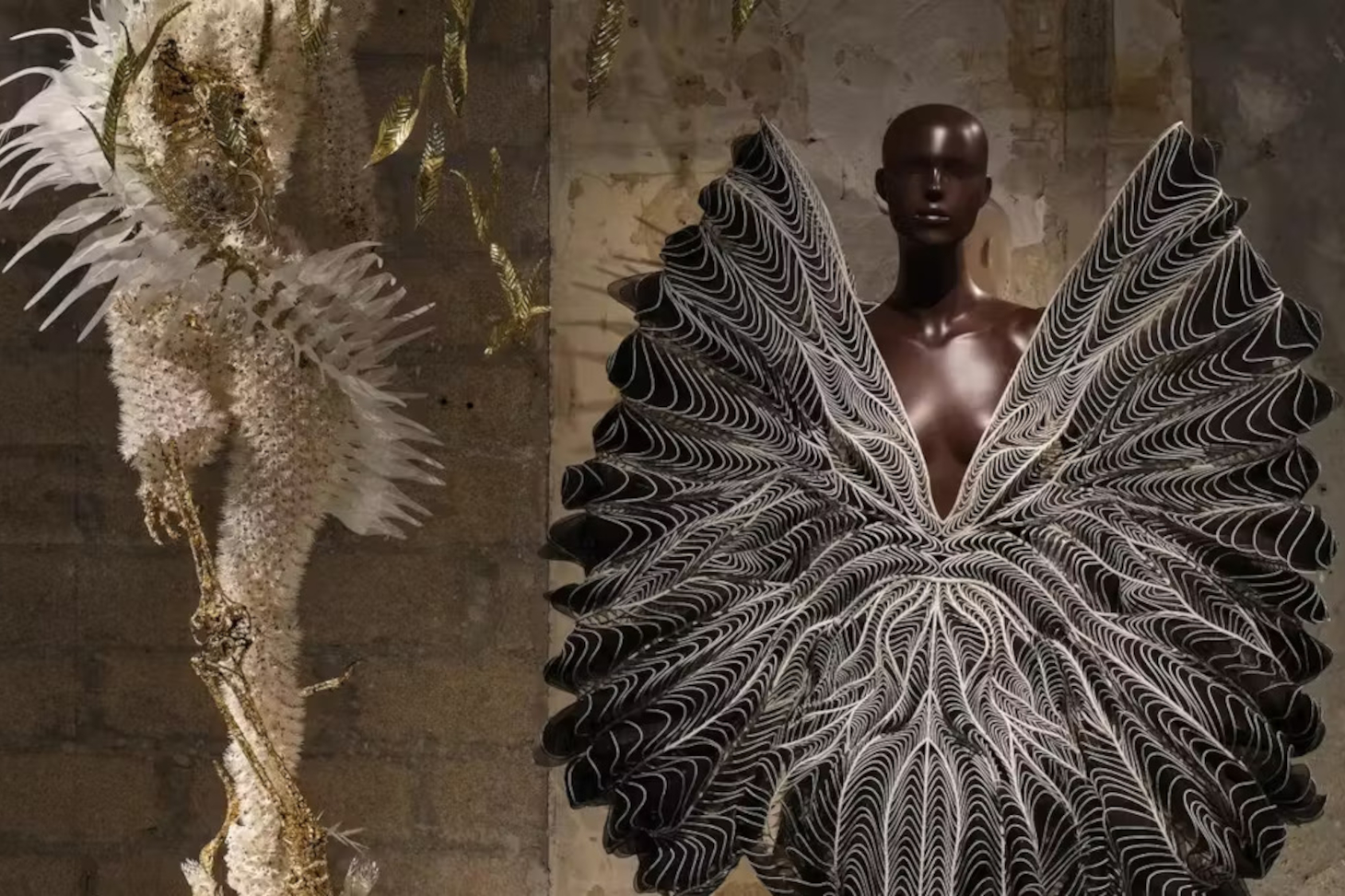
Iris van Herpen, 40, is a Dutch fashion designer. Her breathtaking creativity blends digital technologies and traditional haute couture craftsmanship with shapes and materials deeply inspired by the biosphere.
The visit immediately raises a question in my mind: “This dress, made of glass lace resembling diatoms—microscopic algae with glass skeletons and shapes that are fascinating for their delicacy and complexity—how is it possible to wear it?” But that is not the point. Here, the vehicle for artistic expression isn’t painting or sculpture of the body, but rather the dress on a woman’s body. And ultimately, fashion shows and exhibitions demonstrate that models can wear these dresses, which then transform their bodies and their relationship to the world.
[There are already more than 120,000 subscribers to The Conversation’s newsletters. What about you? Subscribe today to gain a better understanding of the world’s major issues.]
These dresses form a silent yet very intense connection between the body and the world around it. They are therefore not “simply” meant to clothe a body or set it off. Some dresses seem to be a true weaving of reality beyond the body, with often very delicate and complex extensions made of glass, paper, and a wide variety of materials and shapes. They extend the body into space, create an aura, and ultimately transform the intimacy and closeness of that body with its environment.
The21st-centuryworld is one of technological transformation in human interactions. And this occurs regardless of our physical bodies, since these interactions take place primarily through sound and screens. The body, on the other hand, is the focus of fashion and clothing. They thus appear—perhaps paradoxically—as a space of resistance to these forms of mediation. They shape the way our clothed bodies present themselves, expose themselves, and interact with the world and others. At a time when billions of digital devices have invaded our lives, Fashion Week runways highlight just how marginal digital technologies have remained in the world of fashion to this day.
Digital technologies are essential to the creation of Iris van Herpen’s dresses. She explores a form of symbiosis between the world of craftsmanship—related to sewing, textiles, and all “flexible materials,” as textile designers or the Compagnons du Devoir call them—and the world created primarily by physicists and chemists: the world of additive manufacturing via 3D printers, laser cutting, and CNC machines—the world of FabLabs.
As such, it serves as a platform of astonishing creative power but also of fascinating delicacy when it comes to working with a wide variety of rigid and flexible materials, and on a wide range of scales—from the size of the human body to the limits of the visible, such as diatoms (microscopic organisms that live in water).
In this video, we can also clearly see how the symbiosis between these two worlds exists solely through human actions that make the most delicate assemblages possible.
Presented in the form of a documentary, the exhibition also showcases a rich and diverse collection of pieces and samples that highlight the materials, shapes, and their diversity and sophistication. It is on this foundation that Iris van Herpen is able to explore all her references to living organisms, fungi, plankton, corals, and jellyfish.
These inspirations allow her to highlight in her dresses the branching patterns and structures on different scales that physics and mathematics have explored through scale invariance. Here, in her collaboration with the artist Rogan Brown, I see her exploring this very powerful and astonishing scientific concept, formalized through the notion of the fractal.
Bérangère Dubrulle, a physicist and 2022 recipient of the Académie des sciences’ Irène Joliot-Curie Prize, illustrates this beautifully by tracing the path of vortices: “Vortices are everywhere, at every scale. There are vortices at the quantum level. On the meter scale, we catch them—betrayed by soap particles—as we drain our bathtub. Let’s zoom out even further: there are eddies, once again, churning the atmosphere with their swirls of water vapor—these are hurricanes. And when we take in the entire Universe, galactic eddies dominate the cosmic landscape.”
Using digital tools, haute couture craftsmanship, and biomimicry, Iris van Herpen can explore, create, and work with ramifications and bifurcations ranging from the very limits of the visible to the scale of the body and its environment.
And even though she obviously can’t make a dress grow, she emphatically highlights the universality—particularly within the living world—of growth phenomena on all scales. The website of artist and designer Neri Oxman boldly proclaims: “What if human-made and Nature-grown were indistinguishable?” So it comes as no surprise that they have announced their collaboration.
While Iris van Herpen has invited artists to exhibit alongside her, scientific references are also evident throughout: anatomical drawings by Santiago Ramón y Cajal depicting neural structures in the brain (Nobel Prize in Medicine in 1906, shared with Camillo Golgi “in recognition of their work on the structure of the nervous system”), and a stunning image of a giant detector at CERN in Geneva, with a model wearing one of her dresses in the foreground. Images from the Hubble Space Telescope reveal the shapes of objects in the universe, pushing the boundaries even beyond Iris van Herpen’s own audacity. On the one hand, we see here how extensive scientific research across a wide range of fields contributes to the designer’s inspiration, helping to shape multiple and highly varied visions. And, on the other hand, alongside the guest artists, science serves here as an additional revelator: it is indeed about the interactions between us and reality, on different scales, across different timeframes—whether organic or inorganic, conscious or unconscious.
Iris van Herpen’s work leads me to reflect on these words by Jens Hauser in a curatorial proposal titled “From Performance to Microperformativity”: “The concept of microperformativity refers to the current trend in performance art toward destabilizing the typically dominant position of the human scale. It explores the microscopic world and its biological and technological agents as new actors in art.”
At a time when performance is playing an increasingly significant role in art, these contemporary experiments in microperformativity are redefining what art, philosophy, and technoscience consider a “body” today, by bringing in new actors: genetic sequences, cellular mechanisms, bacteria, fungi, enzymes, and other proteins; the “vibrating matter” of physics; as well as high-frequency trading algorithms and deep learning networks in artificial intelligence.”
Iris van Herpen reveals an open and receptive humanity in all her interactions with the outside world and with living beings of all forms, sizes, and backgrounds.