

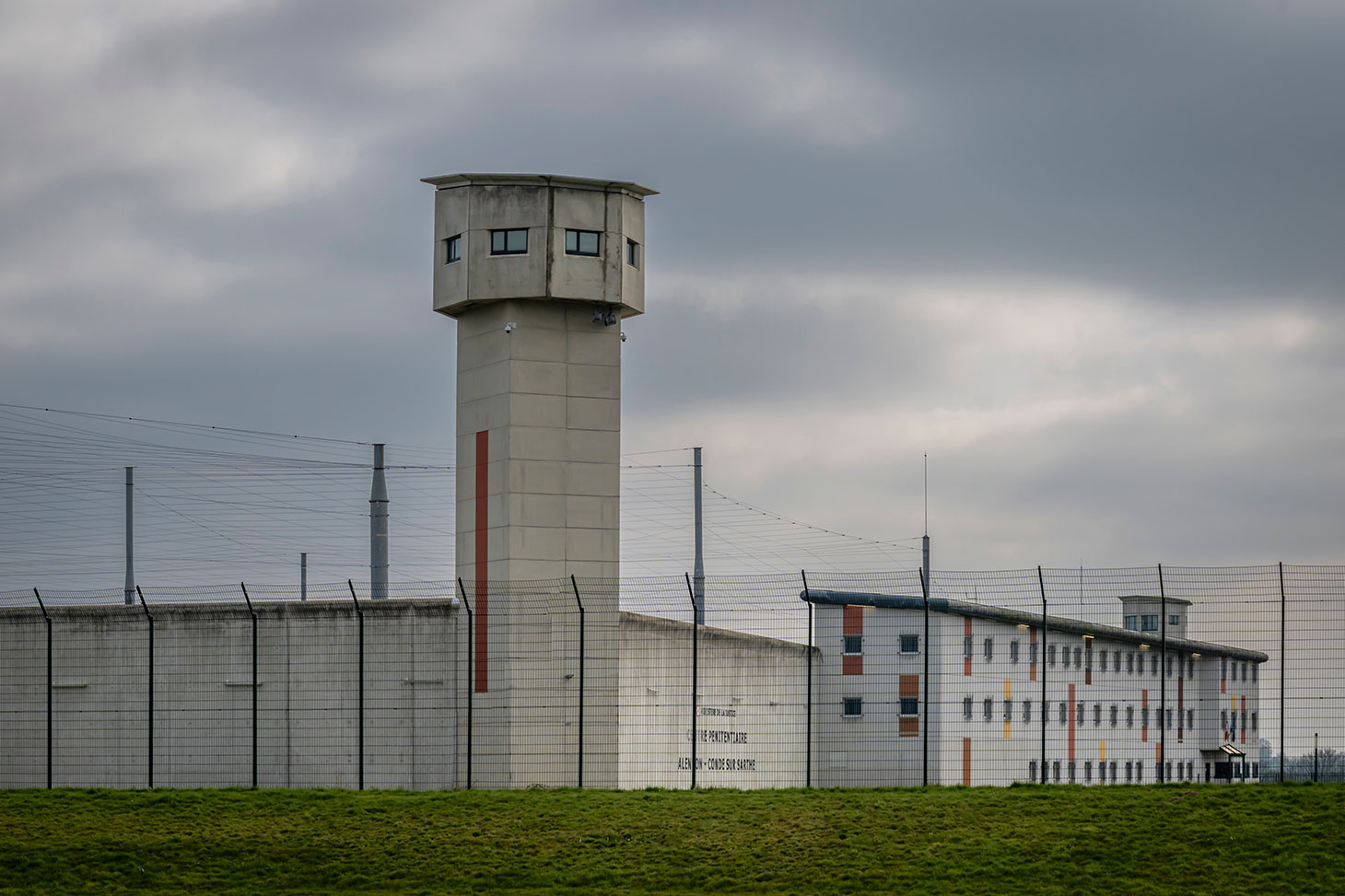
A significant number of inmates at the high-security prison in Vendin-le-Vieil (Pas-de-Calais) have been on hunger strike since this summer, protesting their conditions of incarceration. This new measure, aimed specifically at drug traffickers, has raised concerns among human rights advocates and experts on prison policy. What can we learn from the history of high-security wings, which the government established in the 1970s and then abandoned in 1982? Have similar measures—in the United States, the United Kingdom, or Italy—proved effective in combating organized crime operating from within prisons?
Justice Minister Gérald Darmanin stated in late 2024 that he wanted to “cut off the 100 most dangerous drug traffickers from the outside world” by locking them up in “high-security prisons.” This summer, he announced a “radical overhaul of the prison system” from the Vendin-le-Vieil prison in Pas-de-Calais.
On September1, a significant number of inmates transferred to the new high-security facilities in Vendin-le-Vieil began a hunger strike. A show of solidarity, the protest was described as an “act of desperation” by attorney Delphine Boesel. Another hundred inmates are set to be incarcerated by mid-October 2025 in the new Organized Crime Unit (QLCO) in Condé-sur-Sarthe (Orne), whose extraordinary security regime has already been widely documented. These events have reignited the debate over the justification andeffectiveness of high-security prisons in combating organized crime.
"Twenty-one hours a day in a cell, all alone"
High-security wings (QHS), also known as enhanced-security wings (QSR), were [established in 1975] by decree on May 23, 1975, during the presidency of Valéry Giscard d’Estaing, amid security concerns marked by a series of spectacular prison breaks and rising violence in detention facilities].
Minister of Justice Alain Peyrefitte adopted a resolutely security-oriented approach and consolidated the use of QHS as a means of increased repression. These units are designed, in particular, to contain insubordinate inmates, reaffirming the stance of a strong government for which security is an absolute priority. Inmates deemed “dangerous by nature” and those whose behavior is intended to seriously disrupt the proper functioning of correctional facilities are eligible for placement in QHS.
These facilities operate under an extremely punitive regime. Solitary confinement is frequently used, particularly against inmates who have attempted to escape. During the 1978 trial in Lisieux (Calvados), four defendants who had attempted to escape described the harsh conditions in the high-security wings (QHS). Georges Ségard testified that he had been confined in a QHS for thirty-five consecutive months, eleven of which were spent in complete isolation. Daniel Debrielle added: “The high-security wing means twenty-one hours a day in a cell, alone. It’s one hour of exercise a day in a concrete courtyard with two layers of barbed wire overhead. At night, a spotlight shines on the bars and casts their shadows everywhere. You open your eyes and all you see are bars.”
The famous Jacques Mesrine likened high-security prisons to a slow death sentence: “High-security prisons are the futuristic form of capital punishment. They assassinate the mind by implementing a system of extreme prison oppression, leading to death by psychological suffering.”
At the same time, intellectuals such as Michel Foucault, human rights organizations, and certain judges and correctional officers are also speaking out against the QHS.
These neighborhoods quickly became a symbol of unjustified institutional violence. The QHS were officially abandoned in 1982 after the left came to power.
The Use of High-Security Prisons for Drug Traffickers
Forty years later, Gérald Darmanin is reopening high-security prisons for drug traffickers, now called “long-term sentence and operational control units” (QLCO). Admittedly, these are no longer isolated sections within existing prisons, but rather the creation of high-security prisons in their own right. The rationale remains the same: to segregate and neutralize certain types of criminals. Above all, the aim is to demonstrate—as was the case in 1975—the government’s firm stance against organized crime in the context of drug trafficking.
This brings to mind the “war on drugs, ” launched by President Nixon in the 1970s and recently revived by President Trump.
This approach does not aim at the rehabilitation and reintegration of inmates. Rather, it seeks to firmly and completely reject what some criminologists in the United States refer toas “total incarceration.” This term describes a penal model in which incarceration becomes an end in itself—a tool for permanent neutralization based on the severing of all social, family, professional, and cultural ties—rather than a temporary step toward eventual reintegration. In his analysis of the rise of mass incarceration in the United States, researcher Jonathan Simon describes this paradigm as the expansion of the prison system to functions that go beyond the logic of imprisonment itself: an expression of state power that prioritizes security above all else.
The creation of high-security prisons—rather than simply high-security wings—also echoes the model in the United Kingdom , which has long institutionalized “high-security” facilities . While these facilities were originally intended for inmates whose escape was deemed a threat to the public, the police, or national security, they have since become places of detention for individuals deemed potentially dangerous to the prison system itself, its staff, and the state more broadly. Typically, prisoners sentenced to the harshest penalties, such as life imprisonment, and those who have committed sex crimes are held there and grow old there, raising numerous management issues.
However, the British high-security model is, at least in theory, intended to be only temporary. The plan is for inmates to be transferred to prisons with lower security levels as their level of danger decreases. It does not appear that a similar progression mechanism is being considered in France.
Unlike traditional isolation units, which are often criticized for their dilapidated buildings, lack of staff, and absence of specialized training, the two high-security prisons announced by Gérald Darmanin are intended to address these shortcomings. The facilities are either new or have been completely renovated to prevent unauthorized communication and to accommodate the enhanced isolation regime.
Modeled after the Italian “carcere duro” system designed to combat the mafia, they are equipped with state-of-the-art facilities (drone detection systems, jammers, watchtowers, intercoms, and widespread videoconferencing). Each inmate will be supervised by three or four correctional officers—a ratio unprecedented in the French prison system—and the officers will undergo two months of specialized training focused on managing organized crime and preventing corruption risks. In addition, a system to ensure the anonymity of correctional officers and targeted recruitment efforts are designed to limit turnover and enhance staff stability.
Although the 2025 law specifically targets drug traffickers, Michel Foucault’s 1978 critique of the vagueness of the concept of “dangerousness” remains relevant today. In practice, the criteria set forth by the law are so broad that they allow for sweeping, undifferentiated classifications, potentially applicable to inmates with no connection to drug trafficking, as denounced bythe International Prison Observatory (OIP). Indeed, the decree grants the Minister of Justice the authority to place a person in administrative isolation as a preventive measure in order to “prevent the continuation or establishment of ties with organized crime and delinquency networks, regardless of the purposes and forms of such networks,” which remains extremely vague. The judge’s role is merely advisory (in the case of a conviction) or informative (in the case of preventive detention), with the possibility of filing an objection within only eight days, which severely limits the scope of judicial oversight over a decision that is potentially arbitrary in nature.
How can we combat drug trafficking in prisons?
The problem of drug trafficking from within prison walls is a genuine global phenomenon that governments and prison authorities are struggling to control, particularly in the context of prison overcrowding, staff shortages, anda lack of ongoing support for reintegration.
With regard to the use of solitary confinement, sociological research and official reports are in agreement in highlighting its ineffectiveness. Studies on “supermax” (short for “super maximum security”) prisons confirm that high-security units have never been shown to reduce violence or recidivism; on the contrary, they tend to radicalize distrust and exacerbate inmates’ mental health issues.
However, there are alternatives to solitary confinement and high-security measures for addressing the problems posed by drug trafficking in prisons. First, it is possible to cut off illicit communications without necessarily cutting the inmate off from the outside world. This includes targeted jamming and legal, monitored telephone services. Social ties, in fact, remain central to rehabilitation. Second, prison intelligence units make it possible to monitor financial flows and suspicious communications without resorting to systematic isolation. Individualized plans—such as psychological counseling, post-release support, and supervision by a team of an educator and a correctional officer—have been shown to reduce recidivism, including in organized crime.
Addressing the problem of prison overcrowding is obviously key, since it contributes to staff turnover and reinforces informal power structures and rising levels of violence (Baggio et al. 2020). The UN (2016) thus emphasizes the need to reduce prison overcrowding and retain staff. Finally, prioritizing the use of alternative sanctions (e.g., targeted fines, asset forfeitures, or alternative sentences for those involved in trafficking) could relieve overcrowding in correctional facilities and refocus resources on the actual ringleaders.
Although it has only just begun, the reopening of high-security prisons in France is already sparking controversy, particularly regarding the risks associated with prolonged isolation, mental health, and respect for fundamental rights. Research on comparable systems shows mixed results in terms of security and the prevention of recidivism, leaving open the question of the actual effectiveness of this policy choice in combating drug trafficking.