Although predicted more than sixty years ago, oscillations in the Earth’s inner core have never been definitively observed. Two studies conducted by a team of CNRS researchers show that their viscous and magnetic damping is too weak to explain, on its own, this lack of detection.
At the center of the Earth, the solid inner core could move slightly within the liquid metal that surrounds it, particularly after a major earthquake. As it is pulled back toward its equilibrium position by gravity, it would then oscillate with a period of a few hours. These movements, known as Slichter modes, were predicted more than sixty years ago but have never been observed with certainty. Could they be disappearing too quickly? Our two studies show that the drag exerted by the liquid and the magnetic field would be too weak to explain this lack of detection on its own.
Laboratory involved
• Institute of Earth Sciences (ISTerre/OSUG - UGA/CNRS/IRD/USMB/UGE)
To estimate this braking effect, we must understand how the motion of the inner core drives the liquid metal. The movement of this conductive liquid within the magnetic field generates electric currents that dissipate energy as heat. We approached this problem in two complementary ways. One study describes the forces acting on a solid sphere oscillating in a rotating conductive liquid, combining theoretical analysis with simulations. The other combines simulations of Slichter modes with scaling laws to estimate their damping in the Earth’s core.
In the liquid core, magnetic dissipation far outweighs viscous dissipation, but remains weak: depending on the mode, the damping time ranges from four to sixteen years, compared to several centuries for viscosity. A previous study had estimated the damping time associated with anelastic deformations in the solid regions to be approximately one year. If this estimate is confirmed, this damping would then be the dominant factor. These time scales remain very long compared to the few hours of an oscillation. The lack of detection could therefore be due to insufficient excitation or to the sensitivity of the instruments. If these movements were ever observed, their periods would provide information about the density contrast between the two parts of the core, more than 5,000 kilometers beneath our feet.
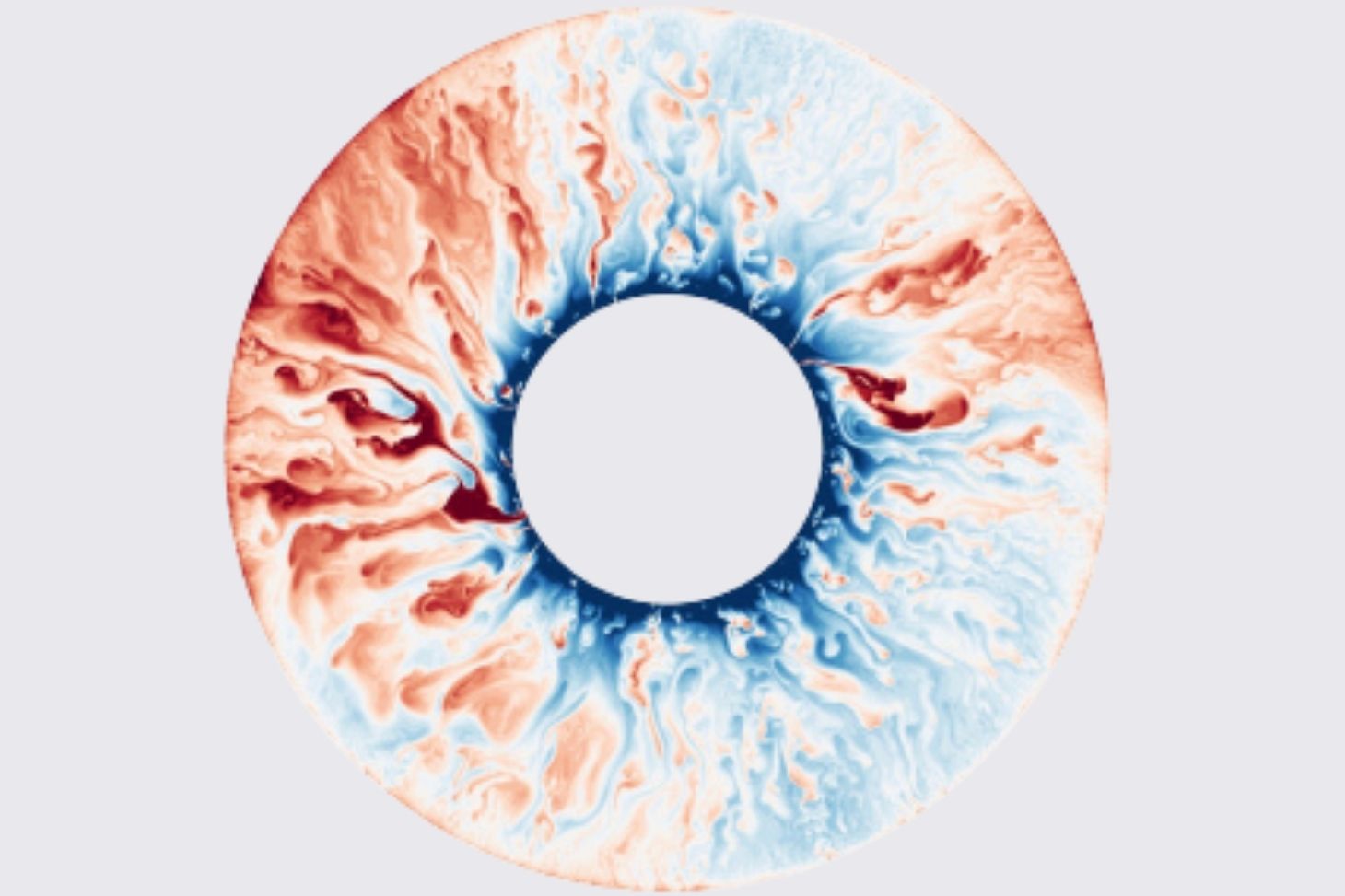
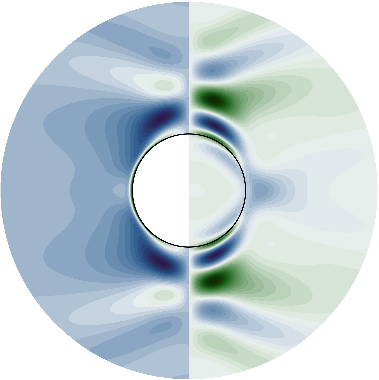
Simulation of an oscillating inner core within a liquid core. Left: liquid velocity; right: magnetic perturbation. Credit: David Cébron & Paolo Personnettaz, 2026.
Published on November 6, 2026
Updated on November 6, 2026
References
Magnetohydrodynamic drag on an oscillating sphere in a rotating spherical cavity.
Cébron, D. and Personnettaz, P. (2026). Journal of Fluid Mechanics, 1045, A13.
https://doi.org/10.1017/jfm.2026.12095
Ohmic and viscous damping of inner core translational oscillations.
Personnettaz, P., Cébron, D., Schaeffer, N., Deguen, R., and Mandea, M. (2026). Earth and Planetary Science Letters, 690, 120156.
https://doi.org/10.1016/j.epsl.2026.120156
Share the linkCopyCopiedClose modal windowShare the URL of this pageI recommend this page:Available at this address:The page will then be accessible from your "My Favorites" menu.Stop the videoPlay the videoMutePlay soundChat: Have a question?Robo Fabrica ChatbotMatomo Traffic StatisticsX (formerly Twitter)