Parkinson's Disease: Activity in the Subthalamic Nucleus Changes Before the First Symptoms Appear
Search
23, September 2026
In a progressive model of Parkinson’s disease in macaques, researchers at the Grenoble Institute of Neurosciences have shown that activity in the subthalamic nucleus changes before the onset of motivational, cognitive, and motor impairments. They also reveal that the effects of deep brain stimulation vary depending on the targeted region and the frequency used. These findings pave the way for stimulation strategies better tailored to the specific symptoms of each patient.
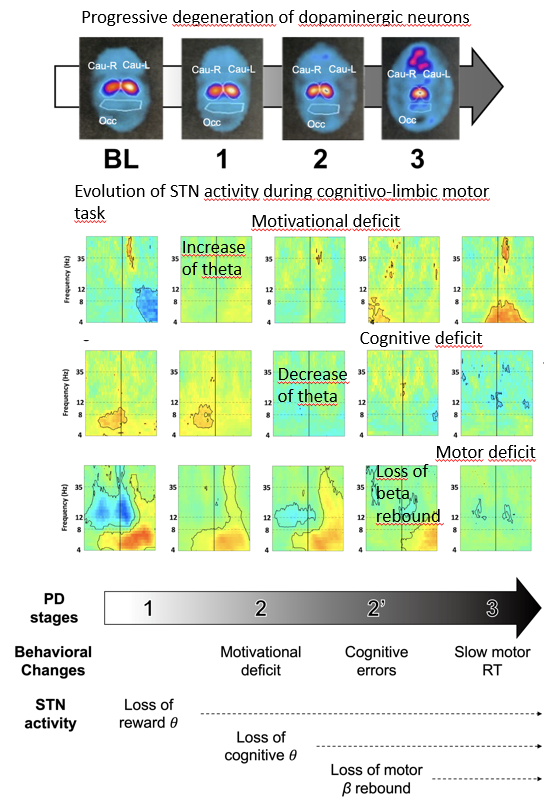
A study conducted at the Grenoble Institute of Neurosciences (GIN—UGA/CEA/CHUGA/Inserm) describes, using a progressive model of Parkinson’s disease in macaques, the sequence of changes in subthalamic nucleus activity as the disease develops.
Researchers show that certain electrical abnormalities in this nucleus appear before observable deficits and subsequently accompany motivational, cognitive, and motor impairments. They also reveal that the effects of deep brain stimulation differ depending on the targeted region and the frequency used: high-frequency stimulation of the dorsal region improves motor performance, while low-frequency stimulation of the ventral region restores motivation in this model.
These findings contribute to a better understanding of the early stages of Parkinson's disease and support the development of stimulation strategies tailored to each patient's symptom profile.
Published on 23 September 2026
Updated on 24 September 2026
References
Behavioral changes preceded by alterations in subthalamic nucleus activity in a progressive macaque model of Parkinson’s disease
Mathilde Bertrand, Stephan Chabardes, Jessy Hugues Dit Ciles, Nicolas De Leiris, Julien Bastin & Brigitte Piallat. npj | parkinson's disease - July 31, 2026,
doi:10.1038/s41531-026-01498-2
Share the linkCopyCopiedClose modal windowShare the URL of this pageI recommend this page:Available at this address:The page will then be accessible from your "My Favorites" menu.Stop the videoPlay the videoMutePlay audioChat: Have a question?Robo Fabrica ChatbotMatomo Traffic StatisticsX (formerly Twitter)