Low-Carbon Concrete Through the Carbonation of Recycled Construction Debris
Search
November 4, 2026
The CO2 contained in the exhaust gases from a cement plant can be captured in recycled construction debris through a carbonation reaction. A team has elucidated the underlying mechanism using a combination of neutron tomography and X-ray tomography. These findings, which are expected to facilitate the development of low-carbon concrete production, are published in the journal Communications Materials.
Concrete production alone accounts for 8% of global CO2 emissions. Reducing concrete's carbon footprint is therefore a major challenge in the fight against climate change.
An innovative solution for producing low-carbon concrete involves trapping CO2 in demolition rubble intended for recycling through a carbonation reaction, which also has the advantage of increasing the rubble’s strength. But until now, the mechanism behind this process remained poorly understood. A study by researchers has fully elucidated this mechanism, which turns out to be far more complex than simply the gas permeating the material.
This research was conducted by:
• Soil, Solids, Structures, and Risks Laboratory (3SR - UGA/CNRS)
• Laboratory of Mechanics and Multiscale Multiphysics (LaMcube - Centrale Lille/CNRS/University of Lille)
• Holcim Innovation Hub
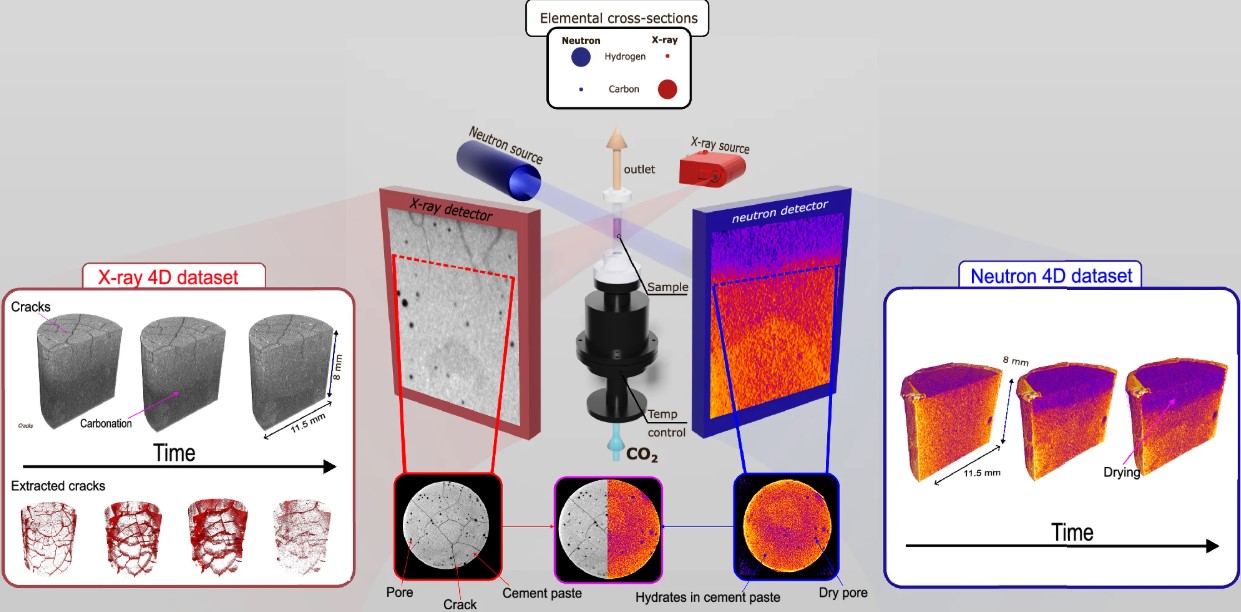
To study the carbonation process, an experimental setup consisting of an innovative test cell simulates realistic industrial conditions, directly utilizing the exhaust gases from a cement plant at a temperature of 80°C and with high concentrations of CO2. The cell was designed to be transparent to radiation, allowing for real-time analysis of the mechanism by which CO₂ is captured within the material.
The originality of the study lies in the simultaneous use of two analytical techniques—neutron tomography and X-ray tomography—to monitor the process in real time over several hours. This is a first, achieved using the NeXT instrument, co-developed by the 3SR Laboratory at theInstitut Laue-Langevin. Neutron radiation allows researchers to track the behavior of water within the sample, while X-rays visualize changes in its mineral structure. Combining these two techniques revealed the interaction between several phenomena that influence one another. For example, when CO₂ reacts with cement, it releases water that was chemically bound within the material. The movement of this water alters how CO₂ can move through the sample. The reaction also causes microcracks to form, which facilitate the passage of the gas before sealing shut. Understanding these complex mechanisms is essential for accurately predicting the actual effectiveness of carbon capture.
These unprecedented results demonstrate that conventional diffusion models are insufficient to capture the reality of the phenomenon. As such, they represent a significant step forward in the design of an optimized carbonation process, which could lead to the industrial application of this CO₂ capture method and the large-scale production of low-carbon concrete. The study was conducted in collaboration with the Holcim industrial group. It is continuing with the development of new analytical and numerical models that account for the complexity of the carbonation mechanism, as well as through new tests using different concrete formulations.
Published on November 6, 2026
Updated on November 6, 2026
References
Operando 5D tomography uncovers carbonation-driven water transport and cracking in hydrated cement paste.
Chakib El Faqir, Alessandro Tengattini, Bruno Huet, Matthieu Briffaut & Stefano Dal Pont. Communications Materials, published January 14, 2026. https://doi.org/10.1038/s43246-025-01060-2
Article available in the HAL open access repository
Share the linkCopyCopiedClose modal windowShare the URL of this pageI recommend this page:Available at this address:The page will then be accessible from your "My Favorites" menu.Stop the videoPlay the videoMutePlay soundChat: Have a question?Robo Fabrica ChatbotMatomo Traffic StatisticsX (formerly Twitter)