

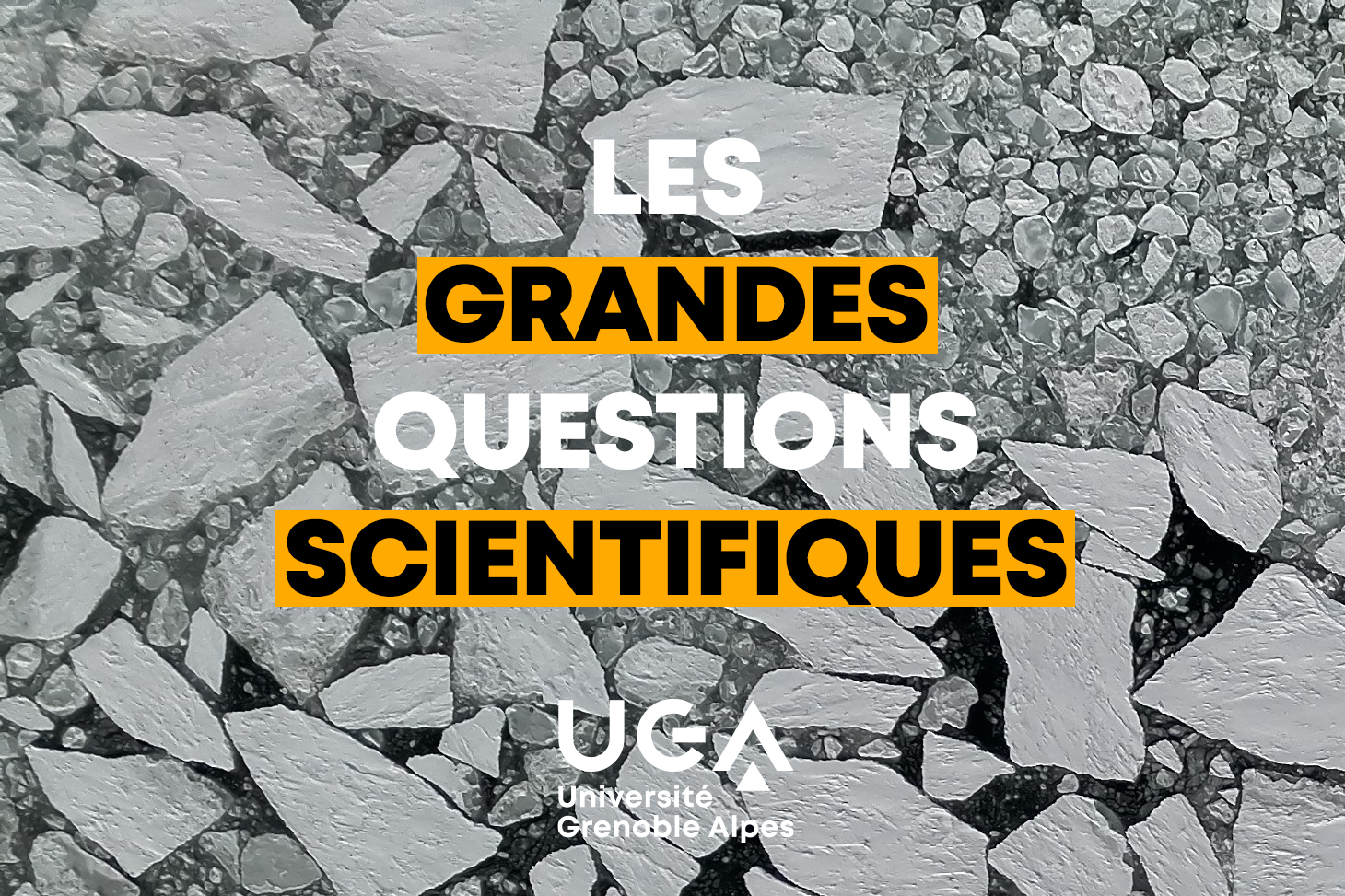
The sea ice isn’t melting just because it’s getting warmer. It first breaks up under the force of the waves, and this fragmentation accelerates everything else. Small fragments melt faster than large ones, drift more easily, and are more exposed to the waves, which break them up even further. This chain of events is as crucial as it is little understood, and major climate models are not yet able to accurately reproduce it. Véronique Dansereau has set out to overcome this scientific hurdle.
Sea ice is not a simple material. Depending on its degree of fragmentation or the scale at which it is observed, it can behave like a rigid solid, shatter like glass, or flow like a granular fluid. This gradual shift from one state to another—which Véronique Dansereau calls the granularization transition—is at the heart of her research.
The mechanism is as elegant as it is alarming: waves break the sea ice into increasingly smaller fragments. However, small ice pieces melt much faster than large ones. Fragmented sea ice drifts more easily, is more exposed to the waves that further break it up, and therefore melts faster. This is a vicious cycle whose combined effects significantly accelerate the retreat of Arctic sea ice. Recent observations indicate that this fragmented state, which is still in the minority today, will become largely predominant during Arctic summers before the middle of the century.
To capture this phenomenon, Véronique Dansereau and her team developed SWIIFT, an original model based on an energy-based approach that characterizes the exact conditions (ice thickness, wave height, wavelength) leading to sea ice fragmentation (Mokus et al., 2026). At the same time, research conducted as part of a doctoral thesis has shed light on a little-explored mechanism: during the transition from a solid state to a granular fluid state, the material’s mechanical properties gradually degrade due to internal rearrangements at the microscopic scale (Rigotti et al., 2025)—an original finding with implications beyond sea ice.
What makes Véronique Dansereau’s work particularly valuable is its dual objective: to better understand physical processes that are difficult to observe directly, and to incorporate this knowledge into the large-scale climate models used for forecasting. Currently, coupled sea ice–ocean–atmosphere models are not yet able to accurately represent this transition to granularity, which undermines their ability to predict sea ice evolution and its impacts on the global climate.
But sea ice is not the only system involved. Tectonic faults, landslides, the snowpack, and all these geophysical phenomena share similar mechanical behaviors when they fragment and begin to move. It is this common thread—seeking what seemingly different phenomena have in common—that has guided Véronique Dansereau’s scientific approach from the very beginning.
Arctic sea ice plays a fundamental role in regulating the climate: it reflects a large portion of solar energy, regulates heat exchange between the ocean and the atmosphere, and influences ocean currents on a global scale. Its gradual disappearance is not only an indicator of climate change—it also amplifies it. Better modeling of its fragmentation therefore allows us to better anticipate one of the most feared tipping points in the climate system.
Figure ?
There are many open questions. How can we integrate into a single model the source of fragmentation, its effects on the state of the sea ice, and the impact of that state on its mechanical behavior? How can we incorporate these developments into major climate modeling platforms? And how can we transfer the methods developed for sea ice to other geophysical phenomena that pose risks, such as landslides and seismic faults?
Based in two complementary UGA laboratories—ISTERre for mechanics and geophysics, and IGE for glaciology and climate—Véronique Dansereau is ideally positioned to foster dialogue between these disciplines and train the next generation of researchers capable of thinking of the Earth as a complex, evolving system.