After two years of observing the auroras from space and a successful scientific mission, AMICal Sat—the first nanosatellite from the Grenoble University Space Center (CSUG)—burned up in Earth’s atmosphere on the night of January 10–11, 2025, after transmitting its final telemetry on January 10 at 9:25 a.m. (UT). The images collected have enabled scientists to better understand the disruptions caused by solar particles on human activities and are already paving the way for new projects.
Après presque 23 000 tours de la Terre depuis son lancement le 3 septembre 2020, plusieurs dizaines d’images d’aurores polaires, plus de 90 000 « paquets » redescendus sur Terre par les radio-amateurs, une dizaine d’images exploitées scientifiquement et deux ans de bons et loyaux services (pour une mission initiale d’un an), AMICal Sat a tiré sa révérence. En effet, le premier nanosatellite du CSUG arrivant en fin de vie et ayant rempli sa mission scientifique, initialement à 530km, il a progressivement subi le freinage résiduel de l’atmosphère jusqu’à ce qu’il se désintègre complètement (voir courbe Celestrak). L’équipe du
CSUG is proud of this successful deorbiting, which allowed the satellite's end-of-life to be managed in accordance with mission projections and without creating new space debris.
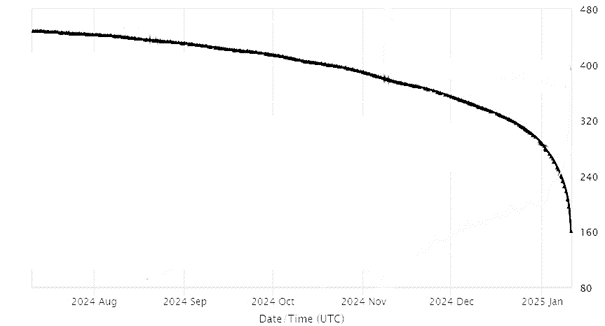
Caption: AMICal Sat altitude (km) curve over the last 6 months
Despite a failure of the orientation system within the first ten days of the mission, from a scientific standpoint, the analysis of AMICALSat data was the subject of a chapter in a dissertation (Elisa Robert, defended in March 2023) and a scientific article (Barthelemy et al., JMASS, 2022) discussing its design and the analysis of images used to reconstruct the particle fluxes that create the polar auroras. In other words, these images have enabled scientists to advance their understanding of the formation and quantification of particle flows emanating from the Sun (known as the solar wind), passing through the magnetosphere, and plunging into the atmosphere.
From a societal perspective, these results represent another step toward a better understanding of solar wind-related disturbances, such as the degradation of satellites in orbit, the disruption of terrestrial power grids, and the interference with radio communication networks. By better describing—and thus better anticipating—the effects of solar activity, we can improve the protection of our technological systems (GPS, power grids, cellular communications, etc.).
This scientific, technological, and human endeavor, carried out in a very short timeframe (2 years of development and 1 year of delays due largely to COVID), would not have been possible without the participation of the sponsors at the time, brought together by the UGA Foundation (Air Liquide, Teledyne e2v, Nicomatic, Lynred, Gorgy Timing, NPC SYSTEM), all the partners (IPAG / OSUG, CEDMS, IUT1 GMP, S.Mart), the many students from UGA and Grenoble INP - UGA involved in this project, and the amateur radio community (notably the
Amsat-Francophone and the
ADRI 38).
To continue this adventure and take it further scientifically, the CSUG is already working on new projects to observe the polar auroras from space and the ground—such as the ATISE-Wind, All Sky Antarctica, and Tomoaurora projects—as well as other more operational projects, which will continue to evolve based on the results of the data analysis from AMICALSat. Stay tuned...