

Thenineteenthcentury was not a period entirely hostile to sexual depictions. While the rise of Romanticism may have encouraged the portrayal of chaste love and emphasized modesty in depictions of eroticism, many authors addressed their characters’ sexuality head-on. Examples include Barbey d’Aurevilly and Balzac, in whose works extramarital affairs are common and often form the core of the plot.
While the sexual act itself is not described explicitly, it is very clear that it takes place, and the characters do not hesitate to express their desire. In a sometimes less trivial way, romantic authors such as George Sand were able to address the issue of desire—both male and female—and make it an important element of the relationships between characters.
In Hugo's novel, abstinence reigns
None of this is found in Hugo’s work. His novels are generally dominated by male characters who are distinguished by their total lack of sexuality: Quasimodo, Jean Valjean, Javert, Enjolras, Gilliatt, and Cimourdain, to name a few. Explicitly described by the author as completely sexually inactive—much like Javert, the “virgin snitch” from Les Misérables, these characters sometimes feel and express thwarted desires, but not always; some appear to be simply asexual.
They generally devote the energy usually spent on romantic pursuits and starting a family to a cause that transcends them, for better or for worse. The tireless police chief Javert is never distracted by his personal affairs; the revolutionary Enjolras devotes himself to his political cause as if it were a lover; as for Quasimodo, he alone will show Esmeralda pure, selfless love and protect her.
While these characters are not unambiguously good—since the sublime in Hugo’s work often coexists with a form of monstrosity—they are nonetheless deeply idealized and border on the superhuman. The absence of sexuality serves as a way to distinguish these characters from ordinary mortals and to highlight their exceptional nature.
A Negative Portrayal of Desire
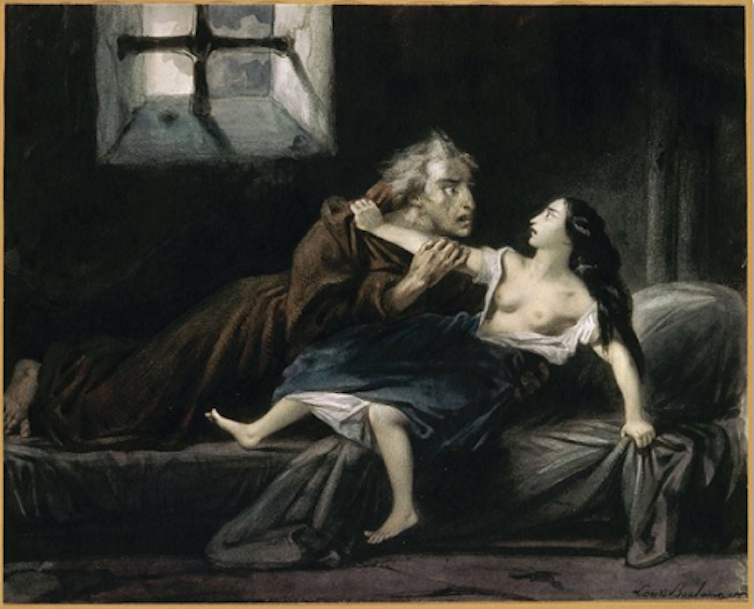
What about the others? There are certainly characters who escape this epidemic of chastity, but the way they are portrayed raises just as many questions. The few depictions of desire in Hugo’s work aren’t exactly appealing, ranging from Claude Frollo’s vicious and destructive obsession with Esmeralda in The Hunchback of Notre Dame and Duchess Josiane, who, in The Man Who Laughs, seems to bewitch the hero Gwynplaine with her charms and drive him away from his true love, Déa.
Sex always seems to be associated with triviality and perversion—or even outright selfishness—in contrast to the self-sacrifice of the chaste heroes mentioned above. It also appears to be destructive for women: one thinks of Fantine, forced into prostitution and tormented by bourgeois men who use her to satisfy their desires until they bring about her downfall and, ultimately, her death. Positive erotic portrayals are rare in Hugo’s novels; he seems almost to be terrified by the subject of sexuality.
There might be exceptions among the young couples who populate his fictional world: Marius and Cosette (*Les Misérables*), Gwynplaine and Déa (*The Man Who Laughs*), Ordener and Ethel (Han of Iceland)… But these characters’ sexuality is very understated and implied, and bears a strong resemblance to that found in medieval courtly romance. In other words, young women are praised for their virginal qualities, and young men must control their desire and undergo a series of trials that will ultimately allow them to unite with their beloved—all portrayed in a consistently prudish manner, with intimate details remaining hidden. Frank and genuinely positive eroticism, on the other hand, is conspicuously absent.
Was Victor Hugo afraid to talk about sex?
How can we explain this reserve in an author whose turbulent personal life is, after all, well known—so much so that he was once at the center of a sex scandal? It’s hard to say.
Some literary scholars have attempted to explain this discrepancy. For some, Hugo valued in his characters a quality—chastity—that seemed all the more admirable to him because he felt quite incapable of adhering to it himself. For others, he created these chaste characters out of nostalgia for his youth, during which he, too, was perfectly chaste and devoted to his studies.
It is probably impossible to settle on a definitive explanation, since the author never spoke out on the matter himself. There is no doubt that his characters’ asexuality is linked as much to personal factors as to an external cultural context, in a 19th century torn between liberation of discourse on sexuality, political upheavals and the importance of religious culture, and who saw the foundations of our modern sexuality taking shape in both novels and medical treatises.
This article is republished from The Conversation under a Creative Commons license. Readthe original article.