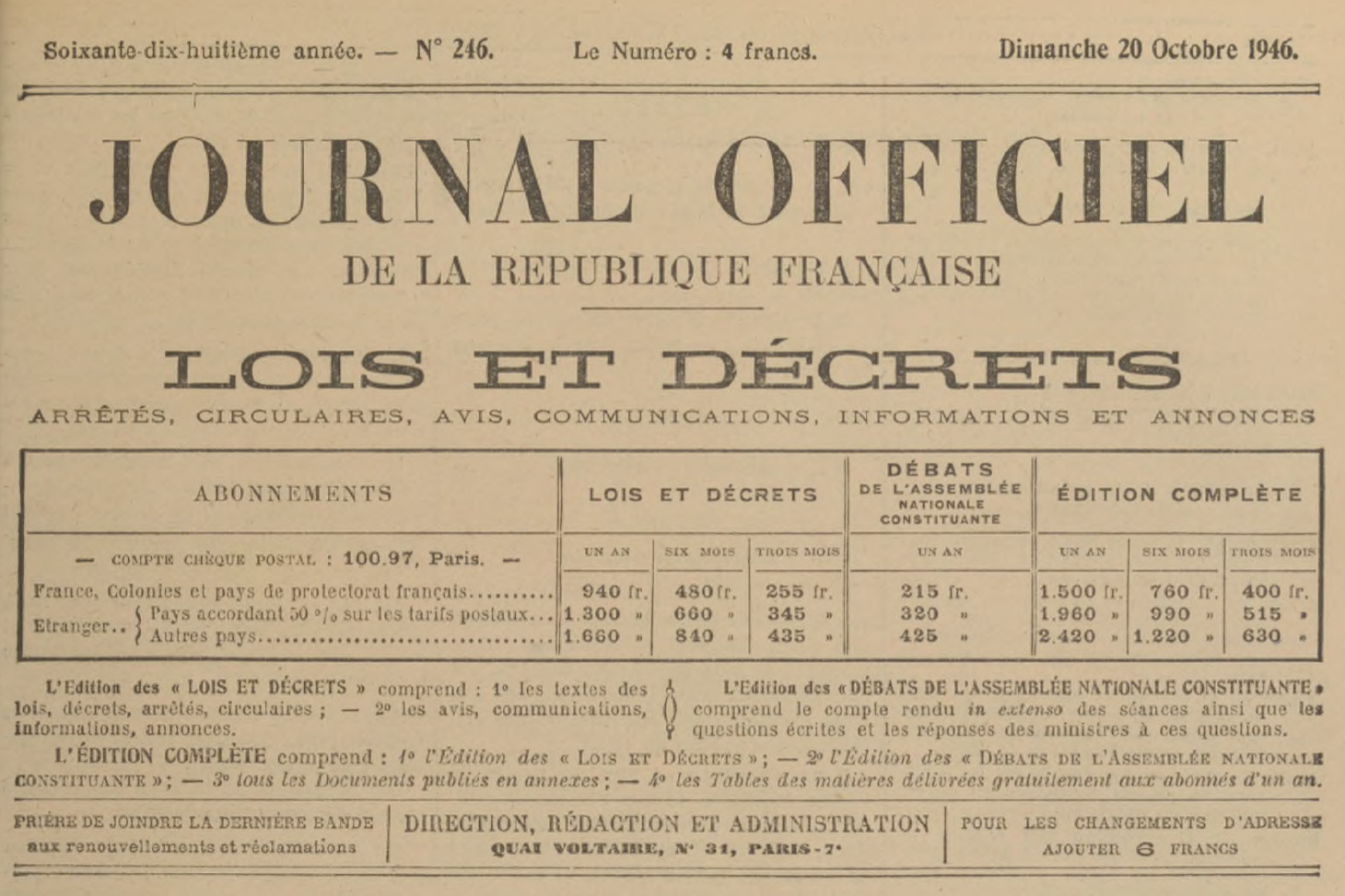
Eighty years after the 1946 law, what remains of the civil service status? Join us on October 19, 2026, at Sciences Po Grenoble for a symposium that reexamines the role and future of public servants.
Thirty years ago, Jacques Chevallier began his article on the anniversary of the Civil Service Statute with these words: “Fifty years later, the Statute has become a fundamental component of the French civil service system. This is undoubtedly the greatest achievement of the 1946 statute: the fact that its difficult conception, its hard-fought birth amid the political context of the Liberation, and its relative youth have been so quickly forgotten; this exceptional acceptance clearly attests to the perfect alignment between the 1946 statute and a certain conception of the administration and the state.”
1 Unification, professionalization, and the recognition of civil rights will form the foundation of this new status.
The law of July 13, 1983, on the rights and obligations of civil servants—known as the Le Pors Law—which constitutes Title 1 of the General Civil Service Statute, brought about changes to that statute. On the one hand, historian Emilien Ruiz notes that while this statute “included a plan for permanent appointment, it also expanded the range of possible exceptions to statutory employment.”
2 ". On the other hand, the constraints associated with decentralization are taken into account, as are the specific characteristics of hospitals. Fragmentation reemerges.
In the final decades of the twentieth century, and even more so in the wake of the so-called “Civil Service Transformation” Act (2019), public administrations have been marked by a constant renewed focus on “modernization.”
3 ", which would reflect the emergence of a "state-centered concern for the self"
4 ". These profound changes have thus undermined the status and conditions of public-sector employment
5. In the mid-twentieth century, particularly for employees from the working classes, the status of civil servant could be associated not only with “material security” but also with symbolic resources, both in terms of collective identity and (…) those essential resources known as collective protections and social rights
6 ". At the turn of the 20th and 21st centuries, the "new" public management emerged as an unrivaled model; outsourcing and contracting became the preferred methods of managing public services—welcomed by some and imposed on others who could no longer bear the "burden" of the "payroll." RGPP, MAP, RéATE, and other mergers have continually disrupted the civil service and its employees.
Beyond employment conditions, these modernization measures are transforming the actual working conditions in public administrations
7, calling for a better understanding of the “‘materiality’ of the work [on which] operational deployment relies”
8 "successive reforms." The implementation of modernization plans and new public management tools is profoundly disrupting the actual practices of civil servants: "The disillusionment of civil servants thus stems from the difficulty of reconciling the ideal of a commitment to serving the public interest with the realities of a profession that managerial reforms prevent them from practicing in accordance with their convictions."
9 ".
This conference thus aims to examine—by bringing together the perspectives of professionals and academics—the changing status of these public service roles, which serve as a true barometer of changes in the administration and the state. Open to professionals in the field, this event will allow a broad audience to participate in this discussion, which has begun but is far from over.
1 Jacques Chevallier, “The 1946 General Civil Service Statute: A Lasting Compromise,” *La Revue administrative*, The 50th Anniversary of the Civil Service Statute, 1996, pp. 7–21.
2 Emilien Ruiz, *Too Many Civil Servants? The History of a French Obsession*, Paris, Fayard, 2021, pp. 113 and 116.
3 Valérie Boussard, Emmanuel Martin, Nadège Vezinat, “Constancy Amid Change? The Renewed Uses of ‘Modernization’ in Public Enterprises,” Sociétés contemporaines, vol. 97, no. 1, 2015, pp. 5–23.
4 Philippe Bezès, Reinventing the State: Reforms of the French Administration, Paris, Presses de Sciences Po, 2009.
5 Aurélie Peyrin, Sociology of Public Employment, Paris, Armand Colin, 2019.
6 Marie Cartier, Jean-Noël Retière, Yasmine Siblot (eds.), Statutory Employment. Origins and Cultures, Rennes, PUR, 2010, p. 15.
7 Jean-Marc Weller, Crafting Acts of State: An Ethnography of Bureaucratic Work, Paris, Economica, 2018.
8 Éléanor Breton, Gwenaëlle Perrier. “The Politics of Reformist Slogans: Administrative Work in the Face of the State’s Modernizing Mandates,” Politix, vol. 124, no. 4, 2018, pp. 7–32.
9 Alexis Spire, Legitimate Distrust, Paris, PUF, 2026, p. 281.