In the Face of the Climate Crisis, the UGA and Sherbrooke Are Relying on Science Diplomacy
International, Partnerships, Research
June 1, 2026
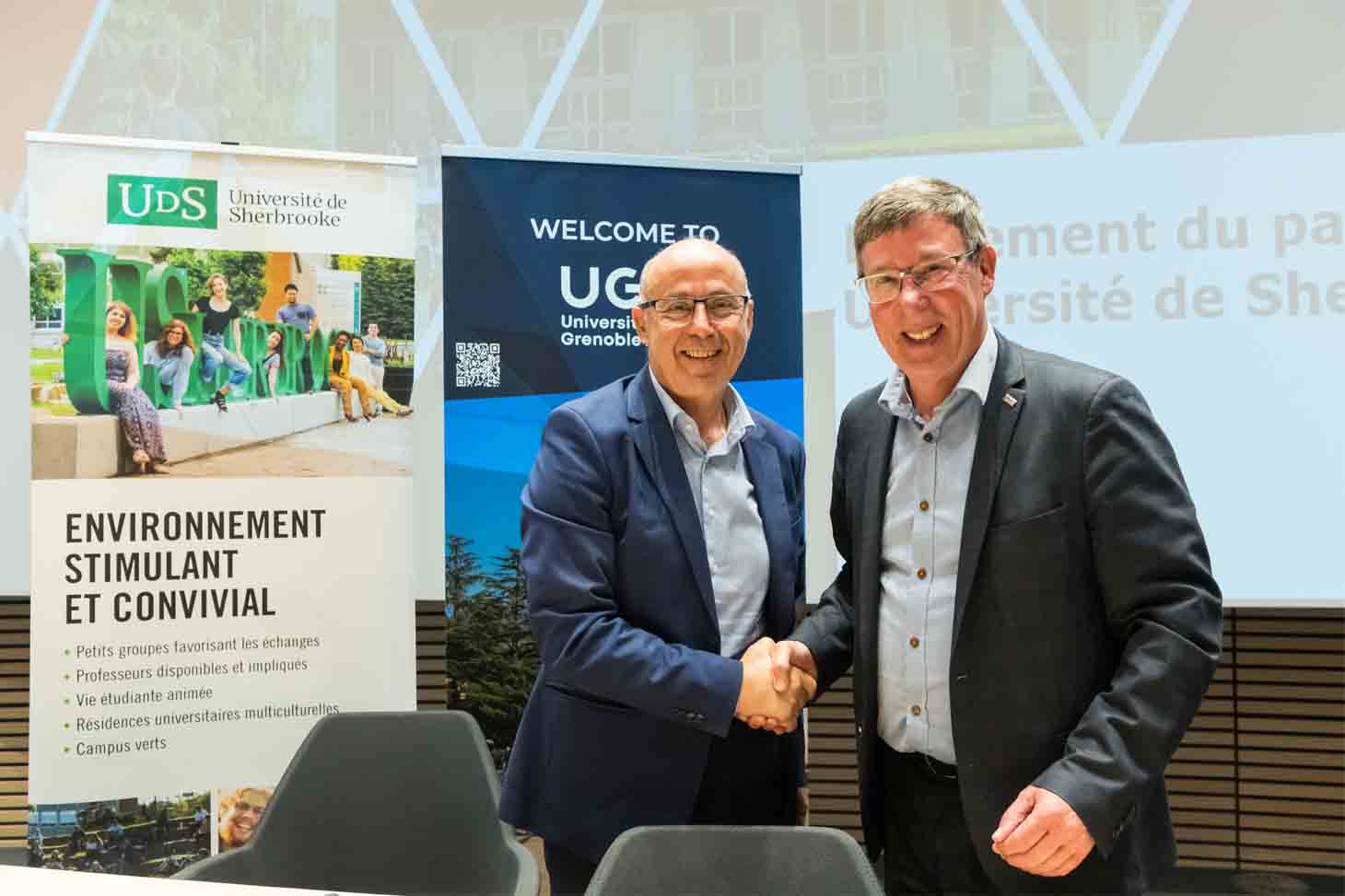
Against a backdrop marked by the climate emergency, the widespread circulation of misinformation, and growing distrust of scientific institutions, scientific rigor is a major democratic issue. Based on this conviction, theUniversité Grenoble Alpes s (UGA) and the University of Sherbrooke are formalizing an international strategic partnership after more than ten years of cooperation.
With this partnership, the two universities are taking a significant step forward: establishing a Franco-Canadian space for research, education, and dialogue to strengthen the role of science in international climate decision-making. At the heart of this initiative, UGA and Sherbrooke are launching a Research Chair in Climate Science Diplomacy, designed as an academic response to crises of confidence in science.
A Chair to Make Science a Tool for Decision-Making
The climate crisis encompasses not only environmental dimensions but also political, social, economic, and democratic ones. It raises questions about how knowledge is produced, shared, challenged, and mobilized in public policy.
The Research Chair in Climate Science Diplomacy is specifically designed to strengthen ties between researchers, policymakers, diplomats, international organizations, economic stakeholders, and citizens. Its goal is to disseminate robust, understandable, and actionable knowledge in order to inform climate-related decisions at the international level.
His work will focus in particular on the role of emerging technologies in climate governance, the dissemination of scientific knowledge in the public sphere, the inclusion of citizens in knowledge production, and the mobilization of expertise to support coordinated climate action.
The chair will bring together climate science, political science, law, economics, the social sciences, emerging technologies, the environment, and citizen participation.
This interdisciplinary approach is at the heart of the partnership between UGA and the University of Sherbrooke. It allows us to rethink climate decision-making as a dialogue among different fields of knowledge, institutions, technologies, and society.
It will also help train students and doctoral candidates—both male and female—as well as researchers to operate at the intersection of science, diplomacy, and public policy.
A Strategic Partnership Between Europe and North America
From June 1 to 3, 2026, the UGA hosted a delegation from the University of Sherbrooke in Grenoble to formalize this strategic partnership. These meetings provided an opportunity to review existing collaborations and to establish new partnerships in research, education, and innovation.
The discussions focused on several key areas: health, neuroscience, aging, materials, energy, quantum science, science diplomacy, and climate. They were complemented by visits to laboratories and centers of excellence within the Grenoble research ecosystem, including the Grenoble Institute of Neuroscience, the CEA, the Néel Institute, the LEPMI, and the Maison de la Création et de l’Innovation.
The official launch of the partnership took place on June 2, 2026, with Yassine Lakhnech, president of theUniversité Grenoble Alpes, and Jean-Pierre Perreault, rector of the University of Sherbrooke, in attendance.
For UGA, this partnership is part of a bold vision: to affirm the role of a major research university as a force for social transformation and to strengthen a Franco-Canadian scientific partnership capable of fostering dialogue between Europe and North America on major climate, technological, and societal issues.
In the face of the climate crisis and mistrust of science, universities have a special responsibility: to generate rigorous knowledge, disseminate it, foster debate around it, and help ensure it is applied in public policy.
By partnering with the University of Sherbrooke on climate science diplomacy, the UGA asserts that science must help inform collective decisions, strengthen democratic trust, and empower both citizens and decision-makers to take action in the face of the climate crisis.
A Cooperation That Is Already Shaping the Future
The Nanotechnology and Nanosystems Laboratory, located in Sherbrooke, exemplifies the depth of this collaboration. Led by UGA, the University of Sherbrooke, the CNRS, INSA Lyon, and Centrale Lyon, LN2 is dedicated to nanoscience and quantum engineering.
With multiple sponsoring organizations, an international scope, and an interdisciplinary approach, it serves as a concrete example of sustainable scientific cooperation between Europe and North America. It also plays an important role in transferring innovations to the socio-economic sector through projects carried out with academic and industrial partners.
Published on June 12, 2026
Updated on June 15, 2026
Share the linkCopyCopiedClose the modal windowShare the URL of this pageI recommend this page:Available at this address:The page will then be accessible from your "My Favorites" menu.Stop the videoPlay the videoMutePlay audioChat: Have a question?Robo Fabrica ChatbotMatomo Traffic StatisticsX (formerly Twitter)