Was an ocean of magma responsible for Earth's ancient magnetic field?
Search
December 16, 2025
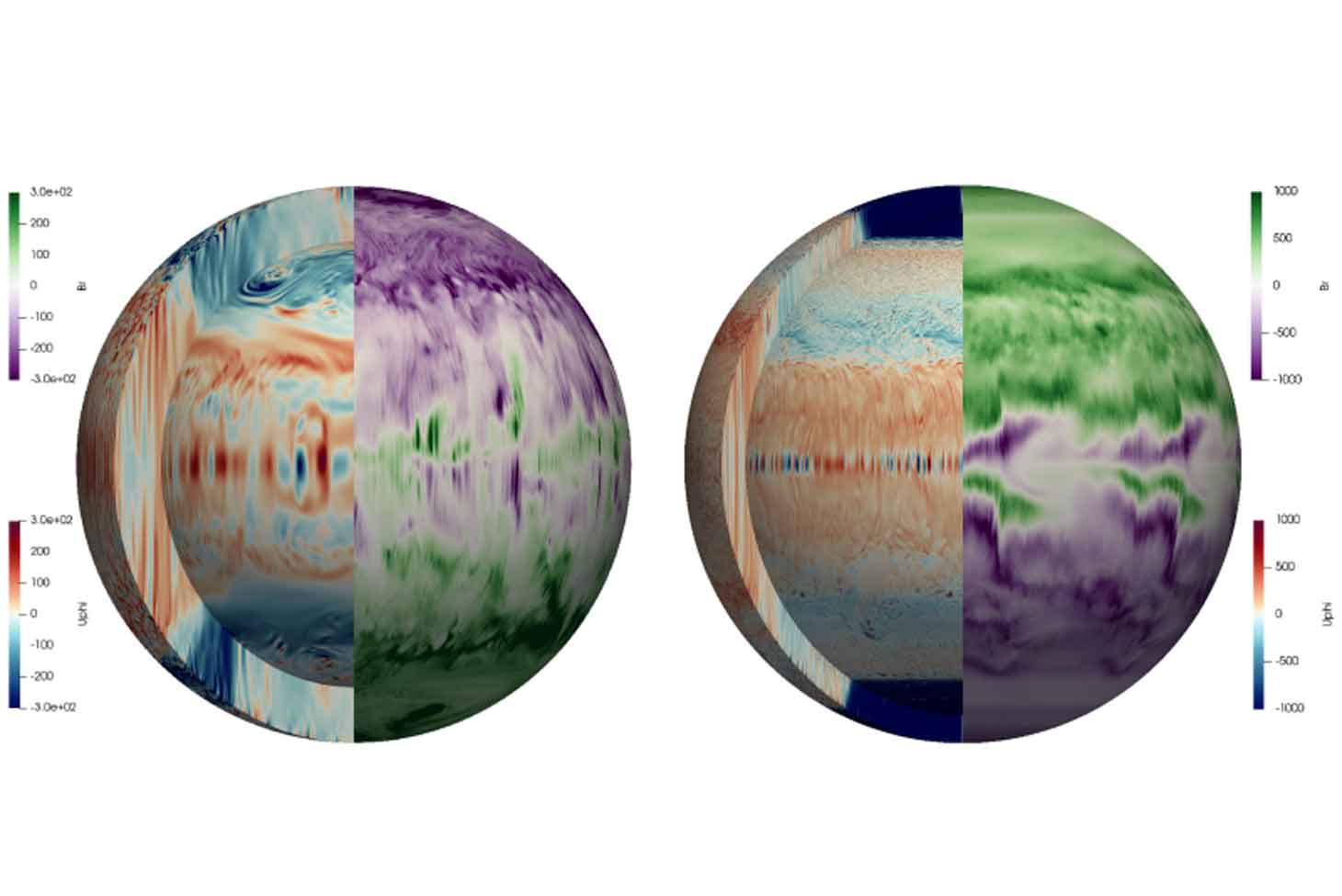
A study published in the journal PNAS explores the hypothesis that the Earth’s early magnetic field may have originated in the underground magma ocean that surrounded the core at the base of the Earth’s mantle. Using high-resolution numerical simulations run on French supercomputers, the scientists demonstrate that the electrical conductivity of such an ocean would be insufficient to explain the magnetic field recorded in ancient rocks. The mystery of the origin of Earth’s magnetism therefore remains unsolved.
The Earth’s oldest rocks bear traces of a global magnetic field that was already present more than 3 billion years ago. Yet at that time, the depths of the Earth’s mantle were still liquid, forming an ocean of magma several hundred kilometers thick. Its gradual solidification (until it became the solid mantle we know today) released a large amount of heat, preventing the metallic core from cooling through convection—a process that is necessary for the generation of a magnetic field.
Conductivity too low to generate a strong field
The results show that, based on current knowledge, magma convection velocities would be too low. To produce a magnetic field comparable to that recorded in ancient rocks (4 billion years old), the magma’s electrical conductivity or heat flux would have to be much higher than those assumed for a realistic magma.
A Mystery That Remains Unsolved
This study reignites the debate over the origin of the Earth’s primitive magnetic field. If the basal magma ocean alone cannot explain the magnetism of the oldest rocks, other scenarios will have to be considered. The mystery of the Earth’s primitive magnetism therefore remains unsolved.
Published on December 15, 2025
Updated on January 6, 2026
Bibliography
N. Schaeffer, S. Labrosse, & J.M. Aurnou, “Energetically Expensive Dynamo Action in Earth’s Basal Magma Ocean,” Proc. Natl. Acad. Sci. U.S.A. 122 (45), 2025
DOI:10.1073/pnas.2507575122
Scientific Contact
Nathanaël Schaeffer, CNRS Researcher at the Institute of Earth Sciences (ISTerre – CNRS/IRD/UGA/Gustave Eiffel University/USMB)
Share the linkCopyCopiedClose the modal windowShare the URL of this pageI recommend this page:Available at this address:The page will then be accessible from your "My Favorites" menu.Stop the videoPlay the videoMutePlay audioChat: Have a question?Robo Fabrica ChatbotMatomo Traffic StatisticsX (formerly Twitter)