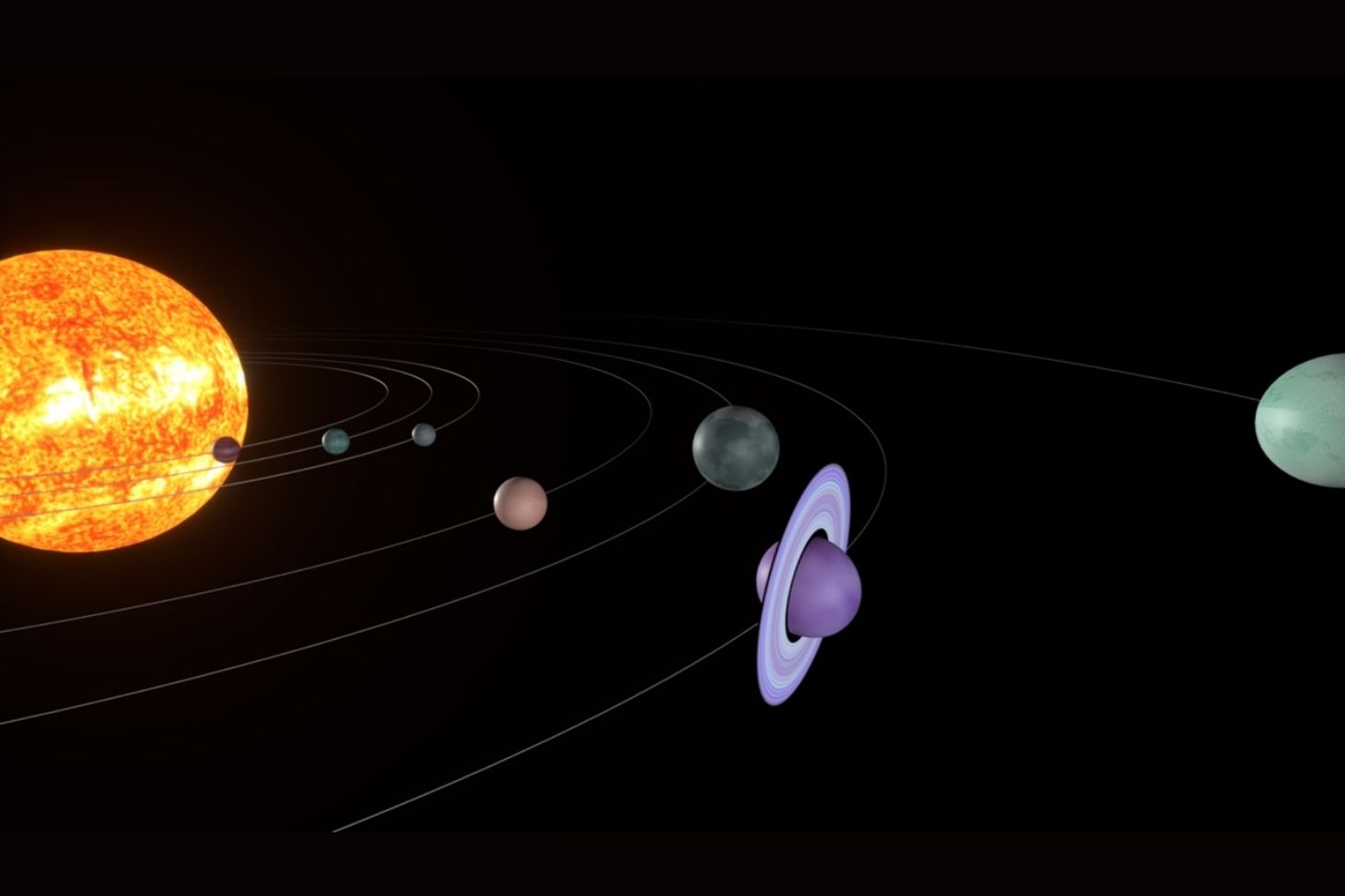
After ten years of observations, an international team analyzed the HIP 41378 planetary system. Comprising at least six planets with exceptionally long orbits, this rare system—which is perfectly aligned with Earth—offers a unique opportunity: to study exoplanets in an environment similar to our own solar system.
An international team led by Salomé Grouffal of the Marseille Astrophysics Laboratory (Aix-Marseille University/CNES/CNRS) and IPAG (UGA/CNRS) spent ten years studying an exceptional planetary system comprising at least six planets with long orbital periods, the outermost of which reaches the orbit of Mars. Such a rare system offers a new window into understanding the diversity of planetary systems. The planets in the HIP 41378 system transit in front of their star[1], requiring an almost perfect alignment with Earth. However, only one out of every 200 systems, such as HIP 41378, has this configuration, and most known transiting planets are therefore very close to their star. HIP 41378 is therefore essential for studying planets in an environment comparable to that of the solar system.
Discovered in 2015 by the Kepler telescope, HIP 41378 was already known to have five planets, but little was known about their nature and orbits. Understanding this system required a decade of observations using instruments located primarily in Chile[2], who measured variations in the star's velocity caused by the planets[3]. These signals, slower than a pedestrian's speed, have played hide-and-seek with astronomers.
HIP 41378 thus becomes one of the first multiple-planet systems in which long-period planets have been well characterized. It consists of three inner planets smaller than Neptune and three outer planets, which are low in density and can reach the size of Saturn. A seventh, more distant planet has yet to be confirmed. The outer planet HIP 41378 f is intriguing: its extremely low density defies planetary formation models. Could it be surrounded by giant rings or extensive opaque clouds? Further observations are needed to shed light on its origin.
This system serves as a valuable laboratory for comparative planetology and opens up new avenues for understanding the formation and diversity of planetary systems.
[1] Transit Method [2] Thanks to the HARPS and ESPRESSO spectrographs in Chile, HARPS-N in Spain, and HIRES in Hawaii. [3] Radial velocity method
Published on July 3, 2026
Updated on July 17, 2026
References
A Decade of Monitoring the HIP 41378 Planetary System.
S. Grouffal, A. Santerne, X. Dumusque, B. Akinsanmi, T. Guillot, N. C. Hara, A. Leleu, L. Malavolta, M. Saillenfest, D. J. Armstrong, S. C. C. Barros, D. Bayliss, A. S. Bonomo, D. J. A. Brown, A. Collier Cameron, M. Cretignier, I. J. M. Crossfield, F. Dai, M. Damasso, O. Demangeon, P. Figueira, P. Leonardi, A. F. Martínez Fiorenzano, M. López-Morales, E. Molinari, A. Mortier, L. D. Nielsen, H. P. Osborn, E. Petigura, K. Rice, N. C. Santos, A. Sozzetti, S. Sulis, S. Udry, and C. Watson. “ ”
Astronomy & Astrophysics, June 23, 2026. DOI: https://doi.org/10.1051/0004-6361/202659666
Scientific Contact
Salomé Grouffal, UGA postdoctoral researcher at the IPAG laboratory
Share the linkCopyCopiedClose the modal windowShare the URL of this pageI recommend this page:Available at this address:The page will then be accessible from your "My Favorites" menu.Stop the videoPlay the videoMutePlay audioChat: Have a question?Robo Fabrica ChatbotMatomo Traffic StatisticsX (formerly Twitter)